
As generative artificial intelligence reshapes instructional workflows at colleges and universities, a four-level transparency framework can help education developers calibrate documentation and disclosure practices to support ethical responsibility and maintain student trust.

Generative artificial intelligence (GenAI) has opened new avenues for creative engagement among higher education teaching and learning professionals. Educators and education developers are using GenAI to support course content creation, pedagogical experimentation, brainstorming, and production workflows.Footnote1 Yet these advantages also introduce a challenge: when GenAI's fingerprints are invisible, its influence can be misunderstood, overstated, or underacknowledged.
Transparency in GenAI use is an imperative for institutional and academic integrity, a safeguard for trust, and a teaching opportunity. However, current transparency practices are uneven. Some people document every step; others offer vague acknowledgments, and many do not address GenAI use at all. This variability may partly be due to an absence of established guidelines that define what to document and how to disclose it.
In this article, we introduce the GenAI Use Transparency Framework. Our framework provides practical guidance to educators, instructional designers, and faculty developers—anyone in the education development space. It situates GenAI use on a continuum from minimal to comprehensive and pairs each level with practical recommendations for documentation and disclosure. The framework also addresses the ethical dimensions of transparency, notes the difference between documentation and disclosure, and provides implementation recommendations. By aligning practice with principle, the higher education community can move toward a culture of reflective GenAI use that treats transparency as an ethical obligation and a pedagogical act.
Existing Approaches to GenAI Attribution
Across higher education, scholarly publishing, and journalism, standards for GenAI use center on authorship, accountability, and transparency. Major style guides, including the Publication Manual of the American Psychological Association, the MLA Handbook, and the Chicago Manual of Style, have introduced formal ways to acknowledge GenAI-assisted work while affirming that GenAI cannot be treated as an author. Likewise, research ethics bodies such as the Committee on Publication Ethics, the International Committee of Medical Journal Editors, and the Council of Science Editors require disclosure of GenAI use in manuscripts, emphasizing human accountability for verification and accuracy. Major publishers, including Elsevier and Springer Nature, have adopted comparable policies, while journalism organizations such as the Associated Press and Reuters stress public labeling of any AI-generated content. Collectively, these efforts advance a transparency principle: make the role of GenAI visible to preserve integrity and trust across disciplines. They address publication ethics and citation, not the design processes of teaching and learning.
The GenAI Use Transparency Framework extends those disclosure norms into the daily practice of education development. Rather than focusing on how to cite GenAI in content, it addresses how to document its use within courses, learning materials, and institutional systems. The framework treats transparency as an iterative, teachable habit built into creation, collaboration, and review.
Grounding the Framework
The rapid adoption of GenAI has outpaced the development of shared norms for its ethical use in teaching and learning. While education developers have long navigated questions of authorship, academic integrity, and technology integration, GenAI introduces new visibility gaps in the creative process. Its capacity to produce fluent, domain-specific language can obscure the distinction between human-generated insight and machine-synthesized patterns. Without ethical frameworks, the use of GenAI risks eroding trust in both the learning design process and the educational artifacts it produces. In assessment grading contexts, students report that when instructors do not disclose their use of GenAI, this lack of transparency "creates a low-trust environment where students do not feel safe in exploring or disclosing their [own] use of GenAI."Footnote2 Institutions should balance innovation with safeguards that ensure clarity, accuracy, and trust.
An ethical framework first identifies what GenAI is and what it is not. In practice, GenAI functions as a sophisticated averaging machine, generating outputs based on statistical patterns in language rather than conceptual understanding. It "knows" syntax, not concepts. Without human intervention, its outputs may appear credible while lacking contextual nuance, logical rigor, or disciplinary accuracy.
Failing to recognize these limitations can lead to overreliance, especially when the human user lacks deep expertise. At higher levels of GenAI integration, this risk escalates into questions about authorship, authority, and legitimacy. In educational contexts, this is particularly critical when instructional designers or others involved in course development work outside their primary subject-matter expertise. In such cases, partnering closely with faculty or other content experts ensures that AI-generated material is technically accurate and pedagogically sound. These collaborations bridge the gap between the linguistic fluency of GenAI and the disciplinary knowledge that underpins credible academic work.
Transparency as a Pedagogical Act
Transparency is an ethical safeguard and a form of modeling. When education developers show how GenAI was used, they demonstrate academic integrity in action. Version histories, GenAI chat logs, and annotated drafts transform invisible labor into a tangible learning resource. As Ashley Mowreader, a student success reporter for Inside Higher Ed, explained, "Generative AI will likely have a place in many students' lives after graduation, so it is the responsibility of the institution to share ethical and productive uses of GAI when appropriate."Footnote3 Transparency demystifies the technology, reinforces the importance of verification, and helps students cultivate discernment in their own practices.
Such practices create a reflexive loop: a visible process encourages rigorous refinement and critical engagement with GenAI outputs. In this way, transparency meets compliance while also actively shaping better design.
Thresholds of Responsibility
Ethical responsibility surrounding GenAI use in content creation increases as that use is scaled. Significant use of GenAI can blur authorship. If most of the language within a course originates from GenAI, is the human contributor an editor, a cocreator, or a quality controller? This ambiguity makes disclosure an ethical necessity to maintain clarity of contribution.
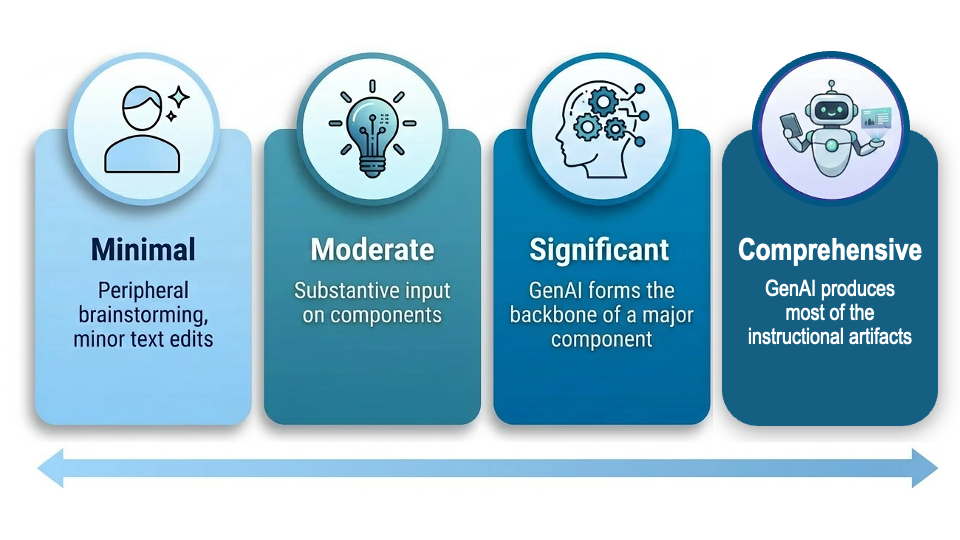
Under-disclosure undermines trust, while over-disclosure can overwhelm. The challenge lies in calibrating transparency to the audience. Students may need a clear statement about how and to what extent GenAI was used in content creation, while accrediting bodies may require documentation of the process and validation. In light of these competing needs, ethical disclosure benefits from a continuum-based approach where transparency and traceability are scaled to match the influence of GenAI (see Figure 1).
Four Levels of GenAI Use in Learning Design and Teaching
Identifying levels of GenAI use enables users to make informed choices about disclosure, documentation, and ethical responsibility. The GenAI Use Transparency Framework defines levels of influence on teaching artifacts and provides recommended practices for transparency and traceability.
Figure 1. GenAI Use Transparency Framework Definitions
Level 1: Minimal Use
At this level, AI is used as a brainstorming or editorial tool. Examples include generating a short list of activities, refining phrasing in a prewritten paragraph, or suggesting variations on existing prompts. Because the GenAI output does not substantially shape the structure, content, or pedagogical intent, a content expert or faculty member would not need to review the output.
Disclosure Recommendations
- A brief acknowledgment is recommended in internal project documentation (e.g., design notes).
- No external disclosure is required if the influence of GenAI is negligible in the final artifact.
- The interaction should be captured in a private archive (e.g., saved chat log) to allow retrospective review.
Minimal use still benefits from documentation, as even small changes can later raise questions about originality. Preserving the GenAI interaction models a consistent approach to transparency without overburdening the workflow. Even seemingly minor uses offer opportunities to model ethical practice. This consistency reinforces trust and sets a clear precedent for colleagues and learners.
Level 2: Moderate Use
With moderate use, GenAI contributes to sections of content, such as generating initial drafts of discussion questions, suggesting quiz banks, or creating course outlines. The human revises and integrates this output into a larger, human-led structure. For example, an instructional designer might use GenAI to adapt an open educational resource to a specific course context by updating terminology, adjusting reading levels, or adding formative questions while maintaining proper attribution to the original sources. GenAI shapes part of the material, but the human remains central in aligning it with the pedagogical goals of the course.
Disclosure Recommendations
- Internal documentation should identify the tool used, the model and version (if available), and the nature of the contribution.
- AI-generated portions should be disclosed in the syllabus or wherever the content is provided, such as a learning management system (LMS).
- The AI output and the revised version should be archived, with a version history or annotations highlighting human modifications.
Moderate use increases the risk that GenAI will shape pedagogical decisions in ways that may be invisible without documentation. Maintaining both the original and revised forms offers a traceable path from the machine-generated starting point to the human-curated final product.
Level 3: Significant Use
AI output forms the foundation for a substantial component of the design, such as creating detailed lesson plans, drafting lecture scripts, or developing full assessment sets. Human oversight focuses on reviewing, restructuring, and validating accuracy rather than originating most of the content. In some cases, this might involve asking GenAI to generate the core of a scenario-based simulation or role-play activity. The human then infuses it with discipline-specific context, ensuring accuracy, relevance, and alignment with the learning outcomes. GenAI sets the stage, but human expertise ensures academic and pedagogical integrity.
Disclosure Recommendations
- Internal documentation should include a rationale for selecting GenAI for this scope of work and the methods used to validate accuracy.
- Student-facing materials should disclose when AI-generated material comprises a visible portion of the learning experience.
- An edit log or annotated comparison should document the transformation from GenAI output to instructional artifact.
At this level, the boundaries of authorship between humans and GenAI begin to blur. The ethical imperative is to acknowledge the role of GenAI and explicitly state that humans are responsible for accuracy, appropriateness, and alignment with learning outcomes.
Level 4: Comprehensive Use
At this fourth level, AI is integrated into the design or delivery process, producing the majority of instructional content, media, or assessment materials as well as any GenAI-driven adaptive content, such as simulations or fully GenAI-authored course components. The content expert directs, organizes, and reviews the content for quality assurance.
Disclosure Recommendations
- Include detailed documentation of tools, model versions, prompts, and post-editing processes to provide full transparency in both internal and external contexts.
- Permanently store GenAI interactions and outputs in the creation stage, ideally in institutional repositories with identifiers that allow for categorization and tagging.
- Provide explicit context on the role of GenAI, its limitations, and the validation measures taken for learners and stakeholders.
Comprehensive use of GenAI carries the greatest responsibility for safeguarding academic integrity, ensuring factual reliability, and preserving long-term records. At this level of use, documenting the complete chain from prompt to practice is essential for institutional accountability.
The following rubric outlines our framework and offers a quick reference for determining the extent of GenAI influence and any corresponding disclosure obligations (see Table 1).
Table 1. GenAI Use Transparency Framework
| Level of Use | Scope of GenAI Contribution | Content Expert Role | Documentation Requirement | Disclosure Requirement |
|---|---|---|---|---|
| Minimal | Peripheral brainstorming, minor text edits | Optional | Internal note in design records | None required |
| Moderate | Substantive input on components (e.g., quiz banks, prompts) | Approval required |
Archive the original GenAI output and the human revision |
External note where learners encounter AI-assisted content |
| Significant |
GenAI forms the backbone of a major component (e.g., full lecture draft) |
Direction and guidance | Edit log with rationale and validation steps | Public disclosure in course or faculty-facing materials |
| Comprehensive | GenAI produces most of the instructional artifacts or adaptive content | Full oversight and QA review | Complete prompt-to-final archive in stable repository | Full transparency with detailed context for all stakeholders |
This rubric aids decision-making and aligns GenAI practices with institutional norms while maintaining flexibility to adapt to evolving tools and contexts. The goal is to encourage thoughtful engagement with GenAI rather than impose uniformity at the expense of context and judgment.
Education developers can calibrate their documentation and disclosure practices to the scope of each item they build. This tiered approach prevents the "one-size-fits-all" trap, avoiding unnecessary over-disclosure for minimal use while ensuring robust transparency when GenAI plays a substantial role. It also supports institutional efforts to develop policies that recognize the nuanced ways in which GenAI is integrated into teaching and learning.
In practice, GenAI use rarely unfolds in a single, linear stage. A designer may begin at a moderate level by generating an outline or bank of quiz items, then shift to minimal use for fine-tuning or escalate to significant use when GenAI proves valuable for producing a detailed component. Recognizing this fluidity helps prevent rigid classification and encourages reflective judgment about when and how to adjust documentation and disclosure as a project evolves. The rubric can be applied to all forms of media used for learning, from text to audio and visual materials to interactive content.
Documentation Versus Disclosure
Our driving assumption is that ethical GenAI use rests on two interdependent practices: internal documentation and external disclosure. These practices share the goal of transparency, but their audiences, formats, and purposes differ. Conflating the two can lead to either oversharing irrelevant details or omitting information critical for trust and accountability.
Internal Documentation Strategies
Internal documentation preserves a verifiable record of GenAI use for future reference, peer review, and institutional oversight. Documentation is accessible to relevant colleagues, units, or governance bodies and includes the following key practices:
- Archive GenAI interactions. Export chat logs, prompts, and outputs into stable formats (e.g., PDFs or text files) immediately after use. Avoid reliance on platform-based histories that may vanish if an account is closed or retention policies change.
- Preserve version histories and edit logs. Maintain records of the transformation from GenAI output to the final artifact, using tools such as Google Docs' version history or Microsoft Word's track changes.
- Record metadata. Record the GenAI tool, model version, and date of use, along with any parameters or settings that may have influenced the output.
- Store securely. Store records in institutional repositories or shared drives with clear naming conventions and backup protocols.
Retaining the original prompts alongside the outputs is important for capturing the framing, constraints, and intent that shaped the GenAI response. Preserving the prompts allows future reviewers to see not only what was produced but also how the human designer guided the process. Internal documentation ensures traceability, enabling the reconstruction of how GenAI contributed to a product and how human decisions shaped its final form.
External Disclosures
External disclosures communicate the role of GenAI to stakeholders outside the immediate design team, such as students, faculty collaborators, or accreditation reviewers. The goal is to provide enough clarity for informed trust without overwhelming audiences with irrelevant details. Here are a few examples:
- Course materials. Adding concise notes in a syllabus or LMS course when AI-generated content directly impacts the learning experience. (E.g., "Some quiz questions were drafted using a GenAI tool and reviewed by the instructor.")
- Presentation materials. Including discreet attributions in slide decks or handouts when GenAI contributed to publicly shared instructional artifacts.
- Assignment descriptions. Labeling GenAI-assisted elements so learners understand both the expectations for use and the origins of the material.
Internal documentation emphasizes completeness; external disclosure emphasizes transparency levels appropriate to the audience and the impact of GenAI.
Transparency Loop: Aligning the Two Practices
Documenting without disclosing risks opacity, and disclosing without documenting risks unverifiability. Together, these practices create a transparency loop that supports ethical practice: internal records establish accuracy and integrity, while external statements signal accountability and trustworthiness.
Standardizing internal documentation enables scalable peer audits, policy enforcement, and professional development. Calibrated external disclosures foster trust by establishing a culture where GenAI use is integrated as a legitimate and accountable part of curriculum design.
Disclosure Language Recommendations
Establishing clear principles for GenAI use is not enough. The practices must be operationalized into tools that education developers, faculty, and institutions apply consistently. Ready-made language can lower the barrier to consistent disclosure. The following examples scale with the level of GenAI use:
- Minimal use (internal documentation only). GenAI-assisted phrasing revisions were made to the existing text. The final content retains only human-authored ideas and instructional intent.
- Moderate use (internal and limited external disclosure). Portions of the discussion prompts were drafted using a GenAI tool (ChatGPT 4.0, May 2025 version) and revised by [name] [CD2] for accuracy, clarity, and pedagogical alignment.
- Significant use. The lecture outline for this course was initially generated using Claude 3.5 (released in June 2025) and underwent substantial human revision to ensure disciplinary accuracy and contextual relevance. All AI-generated content was reviewed for bias and factual integrity by [name].
- Comprehensive use. Major components of this course (lecture scripts, quizzes, scenario-based activities) were drafted using Perplexity AI (released August 2025). All materials were reviewed and revised by [role or name of team] to ensure accuracy, inclusivity, and alignment with learning outcomes. Full GenAI interaction records are stored in [institutional repository].
Tagging and Metadata Recommendations
A sustainable approach to GenAI documentation benefits from light tagging that can be embedded in the file properties, LMS content metadata, or shared drives. Suggested tags include the following:
- Tool and version (e.g., GPT-4o, June 2025)
- Purpose (brainstorming, drafting, editing, assessment creation)
- Review method (subject-matter expert validation, bias check, fact-checking)
- Disclosure status (internal only, public facing)
This metadata ensures that records remain searchable and interpretable over time, even as staff change or platforms evolve.
The Importance of Tools for Culture Change
The practical tools offered in this framework normalize the reflective use of GenAI. By embedding rubrics, templates, and metadata tags into day-to-day workflows, educators and education developers can build documentation and disclosure habits that become second nature. Over time, these habits can form the foundation of an institution-wide culture of ethical GenAI integration.
Institutional Considerations
Scaling ethical GenAI practices takes more than individual commitment. Even well-intentioned guidelines can fade amid competing priorities. Institutions should make transparency practical through support, visibility, and sustainable measures. Policies should account for real workloads. If documentation or disclosure feels like extra work, adoption and documentation will remain low. Policy templates can clarify expectations and leave room for local adaptation. Templates should outline the scope of the policy, use common language from the GenAI Use Transparency Framework, and specify what to document and disclose.
Long-term success also depends on where the records live. Housing AI-generated records in institutional repositories ensures stability, searchability, and the right balance between privacy and access, while avoiding loss from lapsed accounts and dependency on third-party platforms. Culture change happens when people see transparency modeled. When education developers save version histories, note GenAI contributions, and archive outputs, they demonstrate responsible use. Units can reinforce this practice through shared resource libraries, peer review, and onboarding that highlights good documentation habits. Finally, professional development connects the technical and the ethical. Training on how to tag, export, and store GenAI outputs and why it matters can help make these practices stick.
Conclusion
The ubiquity of GenAI means that the question is no longer whether to use it but how to use it responsibly and visibly. The GenAI Use Transparency Framework offers a structured way to calibrate transparency to the scope of GenAI's influence, ensuring that documentation and disclosure are neither perfunctory nor excessive. Transparency requires clear, intentional processes and models integrity for learners and colleagues alike. By being transparent about GenAI use, education developers take an intentional measure against misunderstanding or misuse and actively contribute to the scholarly and pedagogical record by documenting how ideas evolve, how decisions are made, and how human expertise and machine assistance interact.
AI Use Disclosure
Our GenAI use shifted between "moderate" and "significant," with the majority of use in the "moderate" domain. Access to any external sources was blocked throughout.
To provide conversational grounding, we generated a list of questions by prompting GenAI with our main assumptions. We used these questions to dig deeper into our insights during a series of recorded meetings, which were transcribed using the Google Meet transcription tool.
We fed the transcriptions into ChatGPT and Claude to derive possible outlines and then compared the results to refine the outline. Then, we used the same tools to draft sections of this article, drawing on our ideas and language from the transcripts. This yielded mediocre results but moved us to a place where we could edit, write, and refine.
We characterize this as "moderate" use because the GenAI tools worked only with our ideas and wording, and we continually reviewed the outputs to ensure they aligned fully with our perspectives and insights. All citations were gathered through research separate from this AI-assisted writing process.
Chat logs can be shared upon request.
Notes
- Sean Burns and Nicole Muscanell, "EDUCAUSE QuickPoll Results: A Growing Need for Generative AI Strategy," EDUCAUSE Review, April 15, 2024.Jump back to footnote 1 in the text.
- Jiahui (Jess) Luo, "How Does GenAI Affect Trust in Teacher-Student Relationships? Insights from Students' Assessment Experiences," Teaching in Higher Education 30, no. 4 (2024): 991–1006.Jump back to footnote 2 in the text.
- Ashley Mowreader, "Academic Success Tip: Establish Guidelines for AI Use,"Inside Higher Ed, September 28, 2023.Jump back to footnote 3 in the text.
Carol Damm is Head of Digital Education at Constructor University in Bremen, Germany.
Lance Eaton is Senior Associate Director of AI in Teaching and Learning at Northeastern University.
© 2026 Carol Damm and Lance Eaton. The content of this work is licensed under a Creative Commons BY-SA 4.0 International License