
Higher education can strengthen students' artificial intelligence (AI) literacy and responsible AI use by creating low-stakes, hands-on learning spaces where students, faculty, and staff explore emerging AI tools through guided experimentation, collaboration, and reflection.

Higher education institutions can no longer ignore the impact of generative artificial intelligence (GenAI) on their students and academic spaces. It is no longer a future technology but a present reality for incoming students, who are arriving on campus with a range of experience using AI tools. According to a Pew Research Center study of thirteen- to seventeen-year-olds, nearly two-thirds report using AI chatbots, and approximately three out of ten use chatbot technology daily.Footnote1
Students are beginning their higher education journey expecting to continue exploring and using these tools in their studies. The question is no longer whether students are using AI, but how we in the teaching and learning community will provide intentional spaces that support responsible, hands-on experimentation.
Access to spaces that allow students to explore and understand how AI technology works is crucial. However, these spaces should not be available solely to students, especially given the staggering divide in AI usage between students and faculty. Nearly 60 percent of students are using AI compared to only 36 percent of instructors.Footnote2 Providing spaces where faculty can safely experiment without pressure can help close this divide. In fact, spaces that invite faculty and students to explore, play, and collaborate can foster thoughtful use and integration of AI into the classroom.
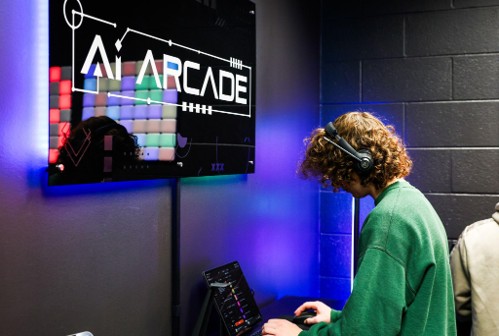
One emerging model for this kind of collaborative, low-stakes experimentation is the AI Arcade at Penn State (see Figure 1). Launched in the fall 2025 semester, this physical space is designed to make AI exploration accessible, guided, and, most importantly, fun.
Figure 1. The AI Arcade at Penn State
From Concept to Console: Creating the Arcade
The AI Arcade at Penn State is where learning and playing collide. It is an experiential learning space that invites faculty, staff, and students to discover, experiment with, and use premium AI tools. The arcade combines access to paid AI tool subscriptions with simple, guided activities so users can move from curious to confident by trying, reflecting, and trying again. There is no expectation to become a power user or integrate these tools into a course project.
The idea for the AI Arcade began as an optional introductory session at the 2024 Penn State MAKEiT conference.Footnote3 As members of the Teaching & Learning with Technology (TLT) team, we designed this activity as a fun, low-stakes activity for attendees to explore before the programming began. After receiving high praise, our team began exploring the creation of a physical space for the arcade in the Shields Media Commons, a space offering a suite of collaborative, multimedia learning spaces. The AI Arcade launched there in September 2025.Footnote4
As our team explored faculty, staff, and student needs related to AI, we identified a critical need to expand access to emerging AI tools through a shared campus space. New AI tools are announced almost weekly, and most, if not all, require a subscription to unlock all the features. Another barrier we encountered was support. Our institution, like many others, was in the early stages of figuring out how to support AI tools. We determined that the AI Arcade could help lower these barriers by providing a welcoming environment where faculty, staff, and students could build confidence through experiential learning.
The AI Arcade features three main components: access to premium AI tools; short, guided activities to support each tool; and AI-generated, retro-inspired video games. Faculty and staff use a companion app that guides them through using the tools, completing an activity, or playing a user-generated AI game.
Gameplay Mechanics: How the Arcade Works
The AI Arcade is designed as a learner-led space. Users are encouraged to jump in and explore at their own pace. Beginners can follow structured pathways, while more experienced users can move quickly into experimenting and remixing. Because the AI Arcade welcomes learners of varying confidence levels, a staff member is on hand to help users get started. This staff member walks new users through the AI Arcade platform, showcasing available tools, activities, and games; answering questions; and troubleshooting when needed. The arcade uses iPad-based stations to provide a simple, scalable experience that offers more flexibility than a managed group of laptops. The activities encourage conversation, collaboration, artifact sharing, and co-learning as users share how they created their artifacts.
Users have been engaging with the AI Arcade in several ways. The most common type of interaction is an individual or small group visiting the AI Arcade for ten to thirty minutes, depending on how long they spend exploring the platform and iterating. The Arcade also supports class visits, in which instructors bring their students to explore AI through activities aligned with course goals. We are currently developing additional opportunities for course integration. The mobile-friendly design of this program also supports pop-up events across campus.
To support an inclusive and evolving learning environment, all tools added to the AI Arcade are vetted by accessibility professionals. If a tool does not meet all accessibility needs but the software is unique enough to be a valuable addition to the AI Arcade, our team has other plans in place to support all users, including alternative tools that perform similar functions, such as image generation. Tools, activities, and featured experiences are updated on a rolling basis as new tools are released, as existing tools roll out new features, and as new learning goals inspire new activities. These ongoing updates ensure the AI Arcade experience remains fresh, relevant, and aligned with learners' evolving needs.
Player Stories: Impact in Action
Within just one semester of its opening, the AI Arcade has become a staple for infusing creativity and low-stakes media creation into student projects. For example, Daniel Foster, an associate professor in the College of Agricultural Sciences, brought students from his Communication in Agricultural and Natural Resource Careers course to the AI Arcade, where they created intro music for their student-produced podcast series, Planting Ideas Between Rows.Footnote5
Following that visit, Foster tasked two teaching assistants with exploring how the AI Arcade could support his Practical Parliamentary Procedure course. The teaching assistants used the Brain Beats activity to transform learning concepts into custom songs designed to help students remember key concepts. They then shared these songs with the students.Footnote6
Another faculty member, Bill Zimmerman, an assistant teaching professor in the Bellisario College of Communications, brought his first-year seminar students to the AI Arcade to participate in an interactive small-group activity in which they created a one-minute podcast pilot for randomly assigned target listeners. These audiences included children, vloggers, and even extraterrestrial life forms. After researching their assigned audience, students rotated between stations throughout the Shields Media Commons, including Studio One and the Podcast Lounge, to record their pilots. They then returned to the AI Arcade to create cover art for their podcasts.
Figure 2. Student-Created Podcast Cover Art
Little Listeners Podcast Cover Art
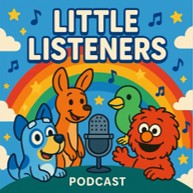
ChatGPT-4o response to "podcast cover featuring children's show characters. animated."
Little Listeners Podcast Cover Art, October 3, 2025
Life Through the Lens Vlogging 101 Cover Art

ChatGPT-4o response to "cover art for a podcast about vlogging and title the podcast 'life through the lens.'"
Life Through the Lens Vlogging 101 Cover Art, October 3, 2025
How to Earth 101 Cover Art

Midjourney-7 response to "half alien half human cartoon split cover."
How to Earth 101 Cover Art, October 3, 2025
Foster and Zimmerman's classes are just two examples of how faculty are using the technology tools in this space to enhance assignments. The AI Arcade offers a safe space for students to take risks with AI tools they might otherwise avoid and continues to reveal new possibilities for integrating AI into teaching and learning.
Leveling Up: Lessons from the Arcade
While the AI Arcade lowers barriers to AI use and encourages students to take risks they might otherwise avoid, it has also become a space that sparks inquiry into the ethics surrounding AI. For example, users have explored copyright law related to AI-generated content during visits to the AI Arcade. This issue has received growing attention in high-profile cases such as Disney v. Midjourney, New York Times v. OpenAI, and Andersen v. Stability AI. Each of these cases examines whether GenAI companies can lawfully use copyrighted works to train their models.
While these cases center around whether copyrighted works can be used as inputs for training AI models, students also explored the copyright status of AI-generated outputs. Expanding on its 2023 policy statement, the U.S. Copyright Office confirmed in its January 2025 report that only works with human authorship can be protected by copyright.Footnote7 Inspired by this topic, AI arcade users have tried to push these tools to generate imagery and audio that toe the line of copyright law. Most notably, one group of users explored whether image-generation models would accurately depict Penn State-branded logos and motifs. Prompts such as "Nittany lion" and "Penn State" generated various entertaining, but inaccurate, results, suggesting that AI models have been trained to recognize aspects of Penn State branding (blue and white colors, visuals of a lion-like figure) but will not directly replicate copyright-protected visuals.
Figure 3. AI-Generated Images from Prompts Referencing Penn State Branding

Midjourney response to "A Penn State Nittany Lion mascot as a professional wrestler."Footnote8

Midjourney response to "Create a podcast thumbnail background representing a summer at Penn State University using old main."Footnote9
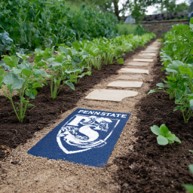
Midjourney response to "Planting ideas between rows with Penn State logo."Footnote10
Currently, TLT staff do not purge the content created in the AI Arcade from the devices. This approach is based on two considerations. First, the AI Arcade has not reached a storage threshold within the applications or on the iPads themselves. Content would need to be removed if storage capacity became a concern. Second, not all users have a clear goal of what they want to create. Many come to the arcade to seek guidance and explore what is possible. Retaining examples of past creations helps inspire and motivate learners to develop their own ideas and projects. Users are welcome to delete their own generated content at the end of their session for any reason.
The AI Arcade: Continue Playing
What started as an experiment has shifted into a service that represents experiential AI learning. The AI Arcade was not created in isolation. Its growth can be directly attributed to the culture of creativity, innovation, and critical engagement at Penn State. The university has made strategic investments to prepare students for an AI-driven future, focusing on AI literacy, responsible use, interdisciplinary collaboration, workforce readiness, and access to AI tools and infrastructure.Footnote11
Spaces like the AI Arcade translate that purpose into practice by lowering barriers to entry, encouraging ethical inquiry, and fostering collaborative experimentation between students and faculty. Penn State faculty, staff, and students are pushing the boundaries of AI tools and using this technology as a medium for exploration and expression.
Conclusion
The AI Arcade has revealed, or rather reinforced, a broader insight: strategy alone does not build confidence; experience does. When students and faculty are given structured, low-stakes opportunities to experiment, question, and create with AI tools, AI can shift from a source of disruption to a tool for collaboration. As higher education continues to navigate rapid technological change, intentional spaces that combine access, guidance, and reflection will be essential for supporting responsible AI exploration. Students are already curious about and using this technology; the question is how institutions will support and guide that curiosity.
Notes
- Michelle Faverio and Olivia Sidoti, "Teens, Social Media and AI Chatbots 2025," Pew Research Center, December 9, 2025. Jump back to footnote 1 in the text.
- Johanna Alonso, "Divided Over Digital Learning," Inside Higher Ed, June 12, 2024. Jump back to footnote 2 in the text.
- MakeiT is a full-day hands-on education technology event that focuses on emerging technologies, such as artificial intelligence. See, "MakeiT Artificial Intelligence," Penn State, accessed August 3, 2026. Jump back to footnote 3 in the text.
- Penn State University Libraries, "AI Arcade Launches, Brining AI Exploration to Shields Media Commons," news release, September 22, 2025. Jump back to footnote 4 in the text.
- Emily Taberes, "Planting Ideas Between Rows – Food Security," YouTube video, 14:08, December 9, 2025. Jump back to footnote 5 in the text.
- Listen to the Brain Beatsexample songs, "Privilege Motions" and "Reconsider, Rescind, Take from the Table."Jump back to footnote 6 in the text.
- U.S. Copyright Office, "Copyright Registration Guidance: Works Containing Material Generated by Artificial Intelligence," Federal Register 88, no. 51 (March 16, 2023): 16190–16194; U.S. Copyright Office, Copyright and Artificial Intelligence: Part 2: Copyrightability Report (U.S. Copyright Office, January 2025). Jump back to footnote 7 in the text.
- Midjourney-7, response to "A Penn State Nittany Lion mascot as a professional wrestler," Midjourney Inc., July 10, Jump back to footnote 8 in the text.
- Midjourney-7, response to "Create a podcast thumbnail background representing a summer at Penn State University using old main," Midjourney Inc., July 10, 2025 Jump back to footnote 9 in the text.
- Midjourney-7, response to "Planting ideas between rows with Penn State logo," Midjourney Inc., November 6, 2025. Jump back to footnote 10 in the text.
- Penn State University, "Penn State Makes Strategic Investments to Prepare Students for an AI-Driven Future," Penn State News, February 18, 2026.Jump back to footnote 11 in the text.
Zach Lonsinger is Interim Innovation and Experiences Manager at Penn State.
Brian Shook is an Applications Developer at Penn State.
Emily Sikora is Media Commons Consultant and Teaching and Learning with Technology Specialist at Penn State.
© 2026 Zach Lonsinger, Brian Shook, and Emily Sikora. The content of this work is licensed under a Creative Commons BY-NC-ND 4.0 International License.