
Artificial intelligence (AI) will transform the classroom into an interactive ecosystem of guidance and support. The Triadic Learning Ecosystem (TLE) offers an architecture of that near future, connecting teachers, students, and AI-enabled tools in a collaborative model of learning.

As artificial intelligence (AI) becomes increasingly embedded in higher education, the faculty conversation still tends to orbit three questions: Should we allow it? How do we catch cheating? How do we redesign our assignments? These are all worthwhile questions, but they share a limiting assumption: AI is a disruptive variable that should be managed in order to maintain a stable system. This framing positions educators as defenders of a pedagogical status quo rather than as creators of something new.
To move beyond this framing, the Triadic Learning Ecosystem (TLE) offers a pedagogical architecture for the AI-integrated classroom—one that positions teachers, students, and AI tools as collaborative participants in a shared learning environment.
Defining the Triadic Learning Ecosystem
The TLE begins with a simple premise: the most productive classroom of the near future is built on structured collaboration among a teacher, students, and an in-class pedagogical AI assistant, or PAIA (see figure 1).
Figure 1. The Triadic Learning Ecosystem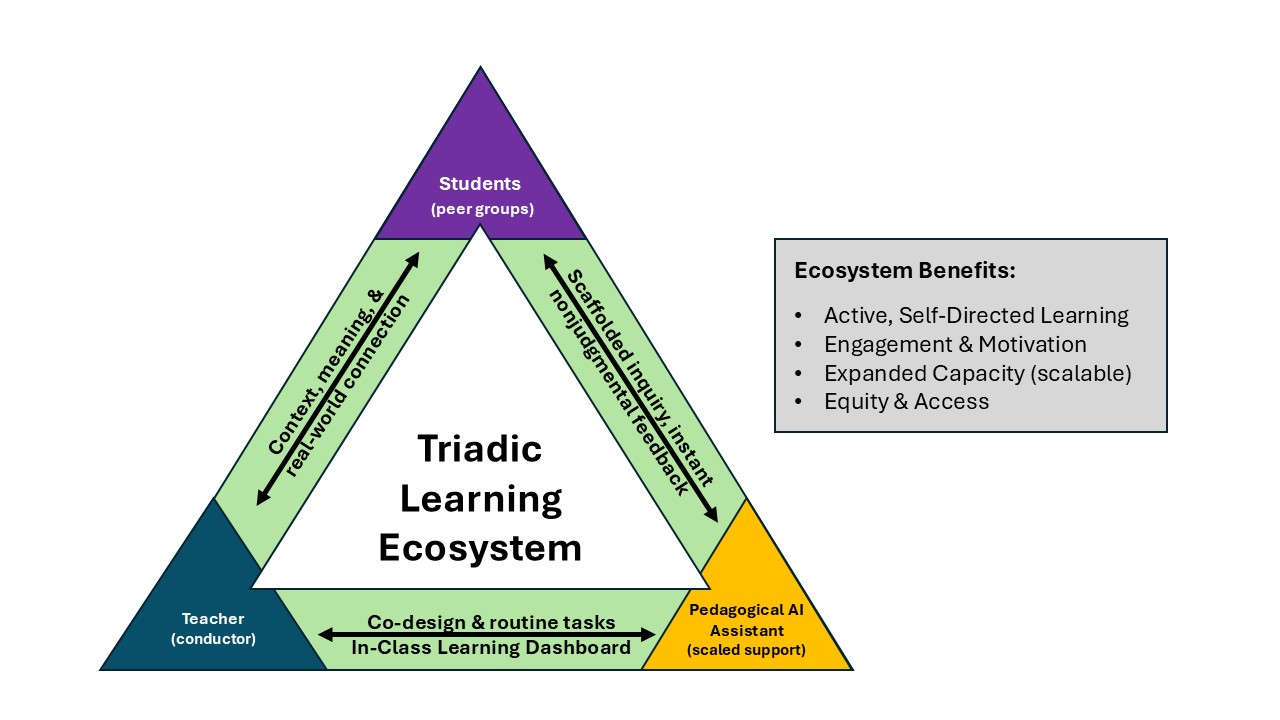
The PAIA supports both the students and the teacher. For students, it clarifies instructions without collapsing productive struggle, guides reasoning through progressive inquiry, and provides instant nonjudgmental feedback. The primary advantage of the PAIA is its scale: simultaneous, individualized, responsive attention to every student. Research has shown that a course-customized AI tutor designed to provide productive struggle rather than answers produces learning gains more than double those of an in-class active-learning classroom.Footnote1
The PAIA also supports the teacher by helping with the design and delivery of the lesson, aggregating student outputs, and providing actionable data during class through a real-time learning dashboard. Teachers are elevated from content-communicator to classroom conductor. They encourage, challenge, intervene, motivate, and lead. In the Triadic model, the teacher co-designs the learning activity with the PAIA before class begins and then conducts the session in real time: monitoring the dashboard, reading the room, and choosing where to push and where to let things breathe. The human elements, including stoking wonder and connecting lessons to the world or students' lives, remain the teacher's domain.
The students are not passive recipients of information but active builders of it. In small peer groups, they produce, debate, and explain to one another. Peer explanation becomes structural: students who grasp a concept are positioned to articulate it to those who do not, and the PAIA scaffolds that exchange. Learning flows multidirectionally.
What is compelling about this model is that it does not force a choice between the warmth of human teaching and the scalability of AI. It is designed to integrate both in productive symbiosis.
Structuring a TLE Classroom Through Five Phases
The TLE consists of five phases, each with distinct roles for teachers, students, and the PAIA.
Phase 0: Co-design. With a lesson in mind, the teacher collaborates with the PAIA to design the in-class session: the material, the learning outcomes, a scaffolded sequence of tasks, comprehension checkpoints, and the data to be collected.
Phase 1: Student exploration and creation. Students form small peer groups to engage in the designed activity. The PAIA clarifies instructions, motivates the learning outcomes, and guides the students through tasks at a pace that matches the group. The PAIA does not provide direct answers but instead nudges students' reasoning without removing productive struggle. Students produce an initial artifact—such as a group decision, a policy position, or a product design—and submit it to the AI system.
Phase 2: Structured analysis. The PAIA aggregates the outputs from student peer groups and visualizes patterns across class submissions. The teacher reviews those patterns with the class and challenges students to critically analyze them: What assumptions led to the results? What might any outliers tell us? The small-group artifacts provide material for collective class analysis.
Phase 3: PAIA simulation. Co-designed with the teacher, the AI runs a simulation based on the students' submissions. What happens when student decisions play out over time, at scale, or in competition with one another? Students see consequences of their choices: potential winners and losers, unintended effects, and emergent inequities. The teacher challenges students to reexamine their original decisions.
Phase 4: Real-time feedback loop. Peer groups return to their interface, where the PAIA asks targeted comprehension questions, measures learning, identifies misconception clusters, and flags them for the teacher, displaying them on an organized, private "dashboard" that enables the teacher to intervene in real time.
Phase 5: Reflection and synthesis. Individually, students engage in meta-analysis of their learning: What changed in their thinking? What assumptions were challenged? The PAIA generates a learning report that shows concept mastery, participation patterns, and persistent misconceptions. The feedback loop closes inside the learning event, mapping students' understanding and influencing the contours of the next session.
Applying the Framework in Practice: Build-a-Baby
During my fall 2025 Technology Ethics class, I led a classroom activity I created called "Build-a-Baby: The Genetic Design Lab." In this structured exercise, students grapple with the ethical dimensions of genetic selection technology. The comprehensive PAIA system envisioned by TLE did not yet exist as a unified product, so I assembled an approximation from tools my institution already had: Google Gemini for co-design, Google Forms for aggregation, a custom GPT for simulation, and Nearpod for live response. Because the exercise used hypothetical children and pseudonyms, no personal student data was collected or stored.
Phase 0. I collaborated with Google Gemini to co-design the structure of the activity and align its scaffolding with the learning outcomes.
Phase 1. Students worked in pairs on the following scenario: "Congratulations, you're having a baby! You live in a future when parents have access to genetic selection technology. What traits would you select for your child, select against, or leave to chance?"
First, each pair named their hypothetical child before completing a trait-selection survey in which they decided whether to select against severe diseases. They then faced a further choice: stop there or go beyond prevention to actively select for positive traits such as intelligence. They also had to contemplate what counted as "negative" at all: ADHD, deafness, autism? The goal was not corrective but to generate productive struggle by eliciting students' assumptions and then analyzing those assumptions together.
Phase 2. Google Forms aggregated decisions and produced graphs, which I then projected for the students to examine. The patterns were stark: a notable preference for male children, near-universal avoidance of Down syndrome, and palpable discomfort with autism or deafness. Some students volunteered that they were neurodivergent and viewed their condition as both a challenge and a gift, which deepened the discussion considerably. We examined ableism, the capabilities approach (Amartya Sen and Martha Nussbaum's view that well-being is best measured by what people are actually able to do and to be), definitions of disability, and what it might mean societally if the bandwidth of human diversity were narrowed.Footnote2 We considered how traits that society generally perceives as "negative," such as neuroses, addiction, or depression, can become the raw material from which sublime art, cathartic comedy, and profound literature emerge.
Phase 3. I input the data from the Google Forms into a custom GPT and tasked it with running a longitudinal simulation that projected life trajectories for each pair's child, extrapolating from selected traits to outcomes such as achievement, well-being, and life satisfaction. The ethical questions from Phase 2, which previously had been abstract, suddenly became manifest. Students were now confronted with the consequences of a choice they had made twenty minutes earlier.
The simulation was probabilistic, and the results were sometimes counterintuitive. The child optimized for cognitive performance became a preeminent scientist; a balanced, resilient child led a quiet yet fulfilling life; a child designed for athleticism, without attention to tradeoffs, stalled in early adulthood.
When pairs considered if they would change anything if they were to have a second hypothetical child, the answers were telling. After seeing positive trajectories for children with selected-for intelligence, many concluded they felt intense pressure to optimize their second child or risk disadvantaging them. And yet the students also recognized that, at a societal scale, such optimizations would carry serious costs: a loss of human diversity, a genetic arms race in which each family feels pressure to keep pace, and an eroded societal acceptance of disability and difference.
Phase 4. Nearpod served as a functional approximation for the PAIA: it can provide polls, open responses, word clouds, and collaborative boards. I tasked groups with contributing to a word cloud, which formed on the screen in real time, making their collective reflection and thinking visible. A full PAIA would go further, providing data to the teacher through their private "conductor's dashboard," displaying patterns, generating differentiated follow-ups, identifying misconception clusters, and adapting challenge levels in real time.
Phase 5. Students work independently to produce a final reflective artifact that details what they chose, what they revised, and why. A significant number of students identified assumptions about normalcy and disability they had never consciously recognized. This self-discovery was the major learning goal—not just learning ethical concepts but having one's reasoning changed through scaffolded interaction and reflection.
A note on assessment: The PAIA dashboard informs but does not grade. The teacher awards participation scores based on preparation, engagement, quality of reflection, and responsiveness to feedback. Individual accountability is preserved within collaborative work, as each student's Phase 5 responses are submitted separately. The ecosystem facilitates assessment without automating it away.
Building the Technology Layer
Here is an estimated mapping of the current landscape onto the TLE framework:
Co-design (phase 0). Any capable large language model (LLM) such as Gemini, ChatGPT, or Claude can serve as a co-design partner. This is the most readily available layer, as prompt engineering for pedagogical design is a skill LLMs are quite good at. The primary challenge is showing faculty how to think and design collaboratively and creatively with AI.
Student interaction and aggregation (phases 1 and 2). Live response platforms such as Nearpod, Poll Everywhere, Top Hat, or Mentimeter approximate the aggregation function of the PAIA. However, no existing tool automatically interprets or adapts to patterns. Google Forms surveys can fill the gap somewhat: an instructor can structure questions to reveal likely misconceptions, review the aggregated responses between activities, and adjust accordingly.
Simulation (phase 3). Custom GPTs or their equivalents can run scenario simulations with surprising effectiveness. Faculty with prompt-engineering skills can build sophisticated simulations; those with little prompt-engineering experience can start with simple prompts and iterate with help from the LLM.
Real-time feedback and the conductor's dashboard (phase 4). This is the current gap. There is no unified platform that automatically identifies misconception clusters, generates differentiated follow-ups, and surfaces them to the instructor in real time during a live session.
That integrated platform is coming. As edtech and LLM capabilities continue to develop, such platforms are likely to evolve into a new generation of learning management systems (LMSs) purpose-built for AI-integrated learning environments. Educators should begin designing the pedagogical architecture now, so that instructional goals guide that development rather than the other way around.
Teaching Beyond Content Knowledge
In any human–AI collaboration, the crucial distinction educators must be mindful of is between cognitive scaffolding and cognitive offloading. Scaffolding is like having a personal spotter in weightlifting, adjusting the degree of assistance to ensure optimal muscle growth. TLE provides scaffolded learning to promote cognitive growth. The PAIA asks questions; it does not provide answers. It surfaces patterns; it does not interpret them. The synthesis belongs to the student.
A randomized controlled trial found that students using a custom-designed AI tutor learned more than twice as much core content in less time than they did in an in-class active-learning session, at least for delivering and scaffolding foundational content.Footnote3 But as Rose Luckin, a researcher specializing in AI and learning, has argued, this covers only about 16 percent of human intelligence and learning. The remaining 84 percent includes the metacognitive, social, and epistemic dimensions of learning. The TLE is designed to ensure that while AI handles some of the cognitive heavy lifting, those dimensions remain the dynamic center of the human classroom.
The TLE integrates what decades of research identifies as effective pedagogy: guided challenge (zone of proximal development), scaffolding, active learning, retrieval practice, peer interaction, formative feedback, and iterative revision. AI does not replace these practices. It makes them visible, scalable, and responsive in real time.
The TLE extends beyond course content, equipping students with skills they'll need to work with AI thoughtfully and collaboratively in their careers. Students soon entering the workforce will spend their professional lives in environments saturated with AI tools. Teaching them to be discerning, reflective, active participants in human–AI collaboration—rather than passive consumers of AI output—may be among the most important things educators can do. The Triadic classroom is a rehearsal for that reality.
Implementing the TLE
- Pilot a partial TLE using tools already on your campus. A single class session using an LLM for co-design, a live response platform for aggregation, and a custom simulation are enough to test the architecture.
- Map your existing edtech stack against the five phases. Identify where current tools approximate TLE functions and where gaps exist. That gap analysis is the beginning of an institutional technology conversation.
- Design for accessibility from the start. Build TLE activities around accessibility and Universal Design for Learning (UDL) principles. The PAIA's individualized pacing, multimodal prompts, and nonjudgmental feedback can actively support students with diverse needs—provided the surrounding tools meet standards such as WCAG.
- Name the "conductor dashboard" in your procurement requirements. The next generation of LMSs and classroom technologies is being shaped by RFPs and vendor relationships. The pedagogical architecture—and the gaps that need solutions—should frame those conversations.
- Reach out to collaborate. The TLE framework is in active development. Faculty piloting AI-integrated pedagogy, instructional designers building supporting infrastructure, and researchers studying learning outcomes are all needed to advance this work.
Advancing Institutional Leadership
Higher education institutions should not wait for a unified AI-powered platform to begin. Many campuses already have the tools to implement their own triadic learning ecosystems. What institutions lack is not the technology itself, but the pedagogical architecture that provides a coherent framework for what the technology should do, how the roles of teacher, student, and AI should be structured, and how best to aim for the learning outcomes.
The Triadic Learning Ecosystem is one foundation. Others are worth developing, particularly AI-augmented studio models, Socratic approaches, and human-in-the-loop designs suited to different disciplines and institutional contexts. The goal is not to converge on a single framework but to develop, name, test, and evaluate multiple approaches with the rigor this moment demands.
The higher education community needs to move beyond reactive conversations about AI policies, cheating crises, and assignment redesign, and start shaping how an AI-transformed classroom will function. This is an opportunity for educators to help design what comes next—and to ensure it deepens, rather than diminishes, what learning can be.
Author's Note
Google Gemini and a custom GPT from OpenAI were used as pedagogical tools in the classroom activity described in this article. Gemini supported instructional co-design, and the custom GPT was used for student-facing simulation. These tools were not used in the writing of this article.
Notes
- Greg Kestin et al., "AI Tutoring Outperforms In-class Active Learning: An RCT Introducing a Novel Research-based Design in an Authentic Educational Setting," Scientific Reports, June 3, 2025. Jump back to footnote 1 in the text.
- Martha Nussbaum and Amartya Sen, eds., The Quality of Life (Oxford, 1993; online edition, Oxford Academic, November 2003), accessed July 14, 2026. Jump back to footnote 2 in the text.
- Kestin et al., "AI Tutoring Outperforms In-class Active Learning." Jump back to footnote 3 in the text.
Matthew E. Brophy is Associate Professor of Philosophy at High Point University.
© 2026 Matthew E. Brophy. The content of this work is licensed under a Creative Commons BY 4.0 International License.