
Redesigning learning experiences, not just adding tools, can build faculty confidence and develop students’ critical, ethical, and applied AI literacy.
Institutional Context and Goals
When the National & Global (N&G) unit at Indiana Wesleyan University (IWU) began exploring generative artificial intelligence (GenAI) tools in early 2023, faculty were invited into a collective effort to understand the technology and cultivate curiosity. Innovating with and embracing emerging technologies is central to the IWU N&G identity and shapes how the unit serves more than 11,000 online adult learners. As at many institutions, IWU N&G leadership recognized that faculty AI literacy is foundational because preparing learners for an AI-enabled workforce requires confident, informed instructors. Consistent with an AI literacy framework described in a 2024 EDUCAUSE Working Group paper that called for institutions to equip faculty with the competencies, confidence, and critical perspectives needed to teach with and about AI, IWU N&G developed intentional strategies to foster faculty readiness.Footnote1 Throughout 2023 and 2024, the Office of Academic Innovation (OAI) led a series of strategic efforts to invest in faculty culture and AI:
- AI awareness webinars that demystified emerging technologies
- Pilot projects to experiment with GenAI tools in educational contexts
- Collaborative showcases and events that highlighted emerging practices and pedagogical innovation
- Small-group discussions that invited faculty to wrestle with the ethical, spiritual, and pedagogical implications of GenAI
Within IWU’s faith-based context, supporting faculty and students necessarily extends beyond technical and pedagogical exploration. The spiritual dimension is understood as engagement with questions of discernment, human dignity, and responsible AI use as part of the broader formation of students and faculty. These considerations are increasingly reflected in emerging scholarship on AI and formation in religious higher education.Footnote2
These activities created a strong foundation to build upon. By 2025, faculty were thoughtfully contemplating AI use, and their curiosity gave way to deeper questions about how to use AI well and how to guide their students to use AI responsibly. IWU leaders recognized that lasting innovation cannot be established through isolated training events. The gap between institutional policy and personal AI use—where true AI literacy should take root across the curriculum—had not yet been addressed. OAI leaders began exploring scalable ways to address AI literacy and AI usage at the assignment and course level.
A People-Centered Model for AI Literacy
Within OAI, the Faculty Engagement group has historically focused on equipping and empowering faculty through development, experimentation, and collaborative learning around emerging technologies, including AI. The creation of the Future Learning Lab (FLL) in 2025 established a hub for applied innovation, designing the infrastructure, processes, and tools needed to translate emerging technologies into scalable course and program redesign. Together, these complementary efforts came together to create the twelve-week AI-Enhanced Course Refresh Institute, where faculty were guided through the redesign of their own course to include AI literacy and more effective learning experiences.
The first cohort launched in summer 2025, bringing together faculty, OAI leadership, learning technologists, and learning experience designers for a collaborative experience. The institute demonstrates how colleges and universities, including those without costly enterprise AI solutions, can develop AI-enhanced courses while simultaneously building faculty confidence and equipping students for an AI-shaped workforce. Our goal is to offer a model other institutions can adapt to advance AI literacy across the curriculum.
AI Literacy and Beyond
At IWU, the lack of clarity on AI usage led to frustration among both faculty and students. As Bowen and Watson remind us, “All assignments are now AI assignments.”Footnote3 At NG, this reality was intensified by a master course system in which courses are centrally developed and then copied for faculty to teach. Because most master courses were built before GenAI became commonplace, many of the existing activities failed to build AI literacy skills or adequately address the increase in inappropriate AI usage such as plagiarism or patchworking without attribution. Students reported using AI inappropriately “when they believed assignments to be repetitive, redundant, or busy work.”Footnote4 Therefore, the institute focused on equipping faculty to reimagine their assignments to build “critical thinking and AI literacy skills.”Footnote5
To prepare for the institute, the leaders created an IWU N&G AI Literacy and Integration Scale. The development of the scale was informed by the foundational work of the AI literacy framework noted above and the AI Assessment Scale.Footnote6 IWU’s faith-based mission led the developers to create a framework that emphasizes competency and ethical formation while highlighting some of IWU’s core values, such as humility, integrity, innovation, and courage as lived expressions of AI use. Building on the two models, the developers created a simplified, practical scale for everyday use that highlights institutional values and provides guidance across courses. Figure 1 illustrates the five levels of the IWU scale, which guide faculty in progressively embedding AI literacy within their courses.
Figure 1. IWU N&G AI Literacy and Integration Scale
| Level/Category | Description | AI Literacy Focus | Documentation Requirements | Examples |
|---|---|---|---|---|
| 1. No AI Use | Students may not use AI for brainstorming, writing, or research. AI tools can be used for assistance with grammar, syntax, and formatting, but students should not accept suggestions that rewrite sentences or add new ideas. |
|
No acknowledgment of tools used (e.g., Grammarly, spell check) |
|
| 2. Limited AI Use | Students may use AI to support revisions and clarification. AI should not be used to generate, plan, or write content. Focus on building foundational skills and AI literacy. |
|
|
|
| 3. Collaborative AI Use | Students use AI as a thought partner, but students may not accept or submit AI-generated text without revision. They must adapt, reshape, and/or reject AI suggestions as part of their process, demonstrating critical decision-making in what to keep, revise, or discard. |
|
|
|
| 4. Integrated AI Use | AI tools are embedded in the learning process. Students apply advanced AI techniques while emphasizing reflection, originality, and responsibility with evidence of purposeful tool choice, iterative refinement, and improvement across multiple steps. |
|
|
|
| 5.AI Innovation | Students innovate with AI. They design, evaluate, and/or advocate for responsible AI practices in academic, professional, or civic domains demonstrating originality, ethical rigor, and meaningful disciplinary or societal impact with clear evidence of outcomes. |
|
|
|
Although AI literacy was the focus of the institute, participants were also encouraged to refresh other assignments to be more AI resistant by reducing vulnerability to generic, easily replicable outputs from generative AI tools. While participants were adding AI-literacy assignments, they were encouraged to further enhance courses by updating media, adding formative assessments, and addressing other content or pedagogical issues in their chosen courses at the same time. The focus on embedding AI literacy and improving course design set the stage for the institute’s hands-on structure.
AI-Enhanced Course Refresh Institute
The institute was promoted to both full-time and adjunct faculty as an opportunity to advance AI literacy, update a course, and receive a digital badge and modest stipend. To participate in the institute, faculty submitted an application that asked them to identify the course they would refresh and to affirm that they would attend five virtual two-hour sessions, redesign at least four activities to include AI literacy, address other course issues, and present about their updated course in a final showcase session for faculty colleagues. Fifteen participants—twelve full-time and three adjunct faculty—participated in the initial round of the institute; the second round enrolled twenty participants—fifteen full-time and five adjunct faculty. Their disciplines varied from computer science to teacher education to graduate nursing. With growing interest, late applications were denied for the second round in order to ensure adequate mentoring and timely support.
Support Structure
Leaders from Faculty Engagement and the Future Learning Lab co-facilitated the synchronous, online sessions, providing direction, instruction, and continuity across sessions. They were joined by learning experience designers, who typically focus on developing new courses but volunteered to participate and contribute to course design decisions, and Learning Technology Specialists (LTSs), who are skilled in building in the LMS. In addition to the support team, all faculty in N&G are provided subscriptions to Boodlebox, a multi-tool GenAI platform, for unlimited access to institute-specific custom bots and to create custom bots and resources for their courses. In addition to the group sessions, personalized support was a key feature of the institute.
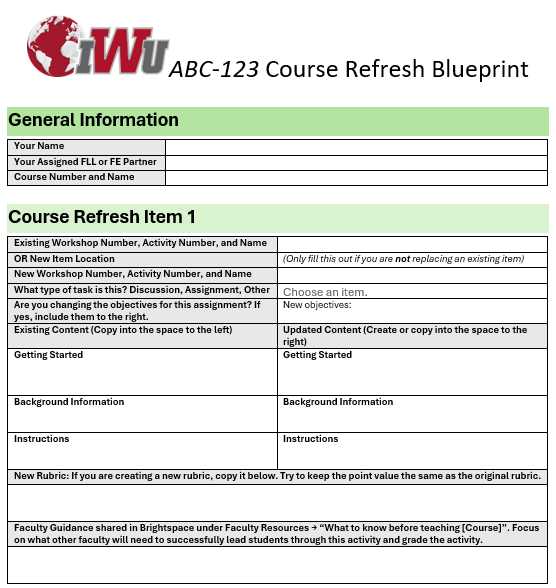
Between sessions, each participating faculty member was assigned a mentor to guide them through the course refresh process. The mentors met individually with the participants as needed and provided feedback in a revision document called a “blueprint,” a working document where faculty outlined proposed course changes that also served as a record of changes for review (see figure 2). The LTS team created development courses to serve as sandboxes, built refreshed activities, created videos from scripts, and performed quality-assurance checks. The structure was designed to progressively build faculty AI literacy while redesigning courses to extend that literacy to students.
Figure 2. Sample Blueprint Document
AI Literacy Institute Organization
Each two-hour meeting blended the sharing of information with practical, hands-on tasks related to the redesign, beginning with awareness and progressing to application. To add a celebratory note to the sessions, we included an element of “gifts,” often in the form of custom bots for participants to accelerate their progress, which we introduced in the first session and carried throughout.
The session design followed a two-sided approach, introducing AI literacy assignments as well as AI-resistant assignments. In addition, faculty were encouraged to address other aspects of the courses they were updating, such as outdated content. Between sessions, faculty worked in their blueprint documents, copying existing activities from their course into one column and transforming them into AI literacy assignments in a second column. In a later section of the blueprint they placed other aspects in need of updating, such as adding design elements or videos.
Over the twelve-week experience, the sessions were sequenced to move from awareness to application, beginning with building a sense of community through introductions of the leadership, support staff, and faculty participants. The focus then shifted to data-informed decision-making. Participants are gifted at least one bot or tool for each session.
Session 1: Data-Informed Course Refresh
In the first session, faculty were gifted two years of raw data (with identifiable information removed) from student evaluations and faculty feedback for the course they selected to refresh, as well as two bots, one a custom GPT and the other a Boodlebox bot. The bots generated course data analysis reports that identified and prioritized areas in need of updating, as well as potential locations for AI literacy assignments to be added in the courses. Faculty were given work time to test the bots and reflect on course data. Their deliverable, to be completed before Session 2, was to identify four activities to refresh by adding AI literacy components and documenting their decision in the blueprint for mentor review.
Session 2: AI Literacy Scale and AI Literacy Tasks
The second session focused on AI literacy through the introduction of the IWU N&G AI Literacy Scale and sample activities at each level, including examples from existing N&G courses that were developed by the Learning Experience Design team. The scale emphasizes progressive understanding and ethical integration of AI. The AI literacy approach was chosen to help faculty embed responsible and reflective AI use to systematically build student AI literacy.
The session gifts included custom bots into which faculty could enter existing assignments and receive a redesigned AI literacy assignment that aligned with the IWU AI Literacy Scale—faculty explored the assignment at multiple levels and selected the best option for their course. To reinforce concepts and highlight creativity, teams participated in a digital escape room activity to experience gamified options that could be added to their courses. The deliverable for this session was to transform one course activity or discussion to build AI literacy for students and document it in the course blueprint to be reviewed by their mentor.
Session 3: Academic Integrity and AI-Resistant Assignments
Following the exploration of AI literacy, the third session was devoted to academic integrity and AI-resistant assignment design. The gifts for this session included custom bots that transformed existing assignments to make them more AI resistant. As a secondary focus, the faculty were introduced to AI script-to-video tools that turn text into professional-looking videos to enrich their courses (see sidebar, “Video Tools”).
In the second hour, faculty were assigned to breakout rooms with the support team to build their first redesigned activity in their development courses. Between sessions, faculty redesigned two additional course activities in their blueprint, which were subsequently reviewed by a mentor.
Video Tools
Faculty could select different video types to add multimodal content and increase engagement. They could receive assistance from a Script Assistant bot and submit either a written script or a video recording of themselves along with optional graphics. The support team used AI-powered video tools (e.g., HeyGen, Pictory, Descript) to produce the final videos. Scripts, graphics, or recordings could be submitted under three general categories:
- Introduction Videos: Brief course or unit introductions created from faculty-written scripts.
- Content Explainer Videos: Short visual summaries or demonstrations that combine narration, slide content, and stock video to clarify complex ideas.
- Enhanced Lecture or Feedback Videos: Edited recordings of faculty-created and recorded mini lectures or explainer videos, refined using AI video editing tools to improve pacing, clarity, and accessibility, as well as to add introductory and closing screens.
Session 4: Bots, Simulations, and Visual Interest
The fourth session expanded on creative integration of AI through bots and simulations. Faculty learned how to create custom bots in Boodlebox that provide faculty support (e.g., creating announcements) or student-facing role-play simulations, games, and other creative AI activities. To ensure sustainability, student-facing bots are centrally housed, added to courses, and maintained by the FLL team to allow for ease of updating and consistency if personnel changes occur. Participants were also invited to request graphics and images to be added to their courses by the FLL team to improve the overall course design and student experience. In the second hour, faculty built their next AI literacy activity in breakout rooms with the support team. Before Session 5, participants submitted one final course activity in their blueprint for mentor review and, if they chose to, also submitted video scripts.
Session 5: Peer Sharing and Wrapping Up
The final virtual session centered on faculty sharing their work with peers, preparing for the final presentations at the in-person faculty showcase, and building their final activities. Presentation slide templates were the session gift, designed to boost faculty readiness and save time. Institute leaders also outlined the steps needed to move a development course to a new master course, including academic leader approvals and final blueprint and quality-review deadlines.
Session 6: Course Refresh Showcase
The institute culminated in Session 6, an in-person showcase. Faculty gathered to present their AI literacy activities and refreshed courses to more than one hundred colleagues from across N&G. The showcase was both a celebration of innovation and an invitation for other colleagues to join subsequent institutes or update their courses through a process apart from the institute.
Post Institute
The FLL team updated courses based on the final blueprint submission and then performed a quality-assurance check. The development courses were returned to schools for academic leader approval and were subsequently designated as the new master courses. Due to the master course model, redesigning a single course extends those improvements to every future section, creating compounding impact on student learning and AI literacy. Faculty received a badge and stipend for their successful participation and refresh of a course and were asked to complete a survey about their experience.
Results and Lessons Learned
The first round of the AI-Enhanced Course Refresh Institute met its initial goal: to generate awareness, spark interest, and move faculty from curiosity to confident implementation through the creation of AI literacy activities in their refreshed courses. Within one week of the final showcase, the institute generated twenty new applications for the second round, nearly 20 percent of the full-time N&G faculty body. Several applications were submitted the same day as the final presentations, signaling an encouraging enthusiasm and demonstrating the power of peer-to-peer influence.
Thirteen of the fifteen participants in the inaugural cohort completed the full twelve-week experience, including redesigning at least four course activities to include explicit AI literacy components.
A small but representative sample responded to the post-institute survey. Their feedback reinforced the momentum and underscored the value of the experience:
- Overall mean satisfaction: 4.9/5.0
- 100 percent plan to use AI-literacy strategies in other courses
- 100 percent would recommend the institute to a colleague
Several key lessons emerged from the inaugural round that informed the subsequent rounds:
- Celebrate mindset changes and progress. Participants entered the institute with widely different levels of technological skill, pedagogical experience, and comfort with GenAI. The OAI team learned that celebrating small wins, such as faculty experimenting with course refresh bots or creating video scripts, was important to maintain momentum. Deans and other academic leaders noted significant changes in their faculty and commented on how the institute had “moved the needle” in building a culture of AI literacy. In the future, more emphasis will be placed on scaffolding instruction through managed experimentation to transfer mindset changes to even more gains in refreshed courses.
- Keep the focus on AI literacy to prevent scope creep. The first institute revealed a common pattern. Although some participants were eager to use GenAI tools to refresh their courses, they sometimes failed to make the explicit connection to AI literacy outcomes for students. To address this, session facilitators and mentors will embed AI literacy reminders and tasks in every session and devote Session 2 entirely to developing AI literacy activities, including using the provided bots to transform the same assignment from their course for each level of the AI literacy scale to reinforce understanding of the progression through the scale.
- Introduce more scaffolding and purposeful pacing. Participants expressed appreciation for the wealth of resources but also used fewer resources than expected overall. To reduce “tool overload,” the second round includes more dedicated space in each session for tool demonstration, experimentation, and reflection to ensure that faculty do not feel rushed or overwhelmed by what is available.
Conclusion
The AI-Enhanced Course Refresh Institute began as a small but mighty effort to advance AI literacy for faculty and students, independent of an enterprise AI solution. For other colleges and universities navigating similar questions about where to go next with GenAI, this model offers a faculty-centered approach to building AI literacy across the curriculum.
The focus remains on people—both students and faculty. The leaders are committed to, and encourage others to, prioritize celebrating mindset growth, keep AI literacy as a central component, and provide purposeful scaffolding. The momentum observed within the faculty community has been both exciting and affirming. This work is shared to inspire other institutions and contribute to the growing body of practice and scholarship supporting AI literacy in higher education.
Notes
- Michelle Kassorla, Maya Georgieva and Allison Papini, “AI Literacy in Teaching and Learning: A Durable Framework for Higher Education,” EDUCAUSE Working Group Paper, October 17, 2024.Jump back to footnote 1 in the text.
- Christos Papakostas, “Artificial Intelligence in Religious Education: Ethical, Pedagogical, and Theological Perspectives,” Religions 16, no. 5 (April 28, 2025).Jump back to footnote 2 in the text.
- José Antonio Bowen and C. Edward Watson, Teaching with AI: A Practical Guide to a New Era of Human Learning (Johns Hopkins University Press, 2024).Jump back to footnote 3 in the text.
- Kristin Bailey Wilson, Kristen Gay, Dylan Barth, Colette Chelf, Cristi Ford, and Emma Zone, Student Engagement and AI: Research Overview and Findings, The Online Learning Consortium, 2025.Jump back to footnote 4 in the text.
- Bowen and Watson, Teaching with AI.Jump back to footnote 5 in the text.
- Mike Perkins, Leon Furze, Jasper Roe, and Jason MacVaugh, “The Artificial Intelligence Assessment Scale (AIAS): A Framework for Ethical Integration of Generative AI in Educational Assessment,” Journal of University Teaching and Learning Practice 21, no. 6 (2024). Jump back to footnote 6 in the text.
Tasha Bleistein is Director of Future Learning Lab at Indiana Wesleyan University.
Tiffany Snyder is Director of Faculty Engagement at Indiana Wesleyan University.
© 2026 Tasha Bleistein and Tiffany Snyder. The content of this work is licensed under a Creative Commons BY-NC 4.0 International License