A Collaboration with Salesforce | 2026 EDUCAUSE Mission Partner
A thoughtfully designed AI agent can relieve staff of repetitive tasks, freeing time for them to engage deeply with students.

Institutional Profile
Founded in 1898, DePaul University is the nation's largest Catholic university and one of the country's leading urban institutions, serving a diverse community of undergraduate, graduate, and professional students across campuses in Chicago. Guided by its Vincentian mission, DePaul is committed to academic excellence, student success, access, and social impact, combining rigorous scholarship with experiential learning and deep engagement with the city it calls home. As a modern, digitally enabled university, DePaul leverages technology, data, and innovation to support teaching, learning, research, and institutional effectiveness while advancing an inclusive and student-centered educational experience.
The Opportunity
Some of the biggest barriers students face in higher education stem from administrative and business processes, not academics. Furthermore, helping students navigate those processes can be difficult for staff, who are already facing mounting workloads without commensurate increases in resources. As detailed in EDUCAUSE workforce research from 2025, a majority of staff (60%) described their workload as very or somewhat excessive, and 57% disagreed that their unit had enough staff to meet its needs.Footnote1 As workloads become increasingly unsustainable, artificial intelligence (AI) capabilities and adoption are skyrocketing. According to EDUCAUSE research, nearly three-quarters of staff and faculty use AI tools for work-related tasks on a daily or weekly basis.Footnote2 The development of AI tools for specific business cases is still nascent, however, with the majority of respondents indicating that they use AI tools for tasks such as brainstorming, drafting emails, and summarizing long-form content. Challenges such as lack of AI expertise, difficulty evaluating AI outputs, and lack of examples of best practices make it difficult for higher education technology leaders to meaningfully leverage AI tools to gain efficiencies at work.
Turning to an AI Agent
At DePaul University, leaders in technology and financial aid recognized an opportunity to forge a path, developing a staff-facing AI agent in the financial aid department. Bob McCormick, vice president for Information Sciences at DePaul, sat down with EDUCAUSE to describe the project, which began not with the technology but with the problem: Financial aid regulations, institutional policies, and student circumstances have become increasingly complex. Staff often need to consult multiple knowledge sources before resolving a student inquiry. This limits the time available for high-value student interactions.
In response to this challenge, DePaul partnered with Salesforce to use its Agentforce platform to create a staff-facing financial aid AI agent to help staff provide consistent, high-quality assistance to students coming to the financial aid office for help. Specific goals of this project were to decrease repeat visits of students to the financial aid office and increase the available time counselors can spend engaging with students by decreasing administrative burden during appointments. Further, though not stated as a prior goal, the team sees potential for this AI agent to reduce training time for new financial aid staff onboarded in the future.
How the AI Agent Works
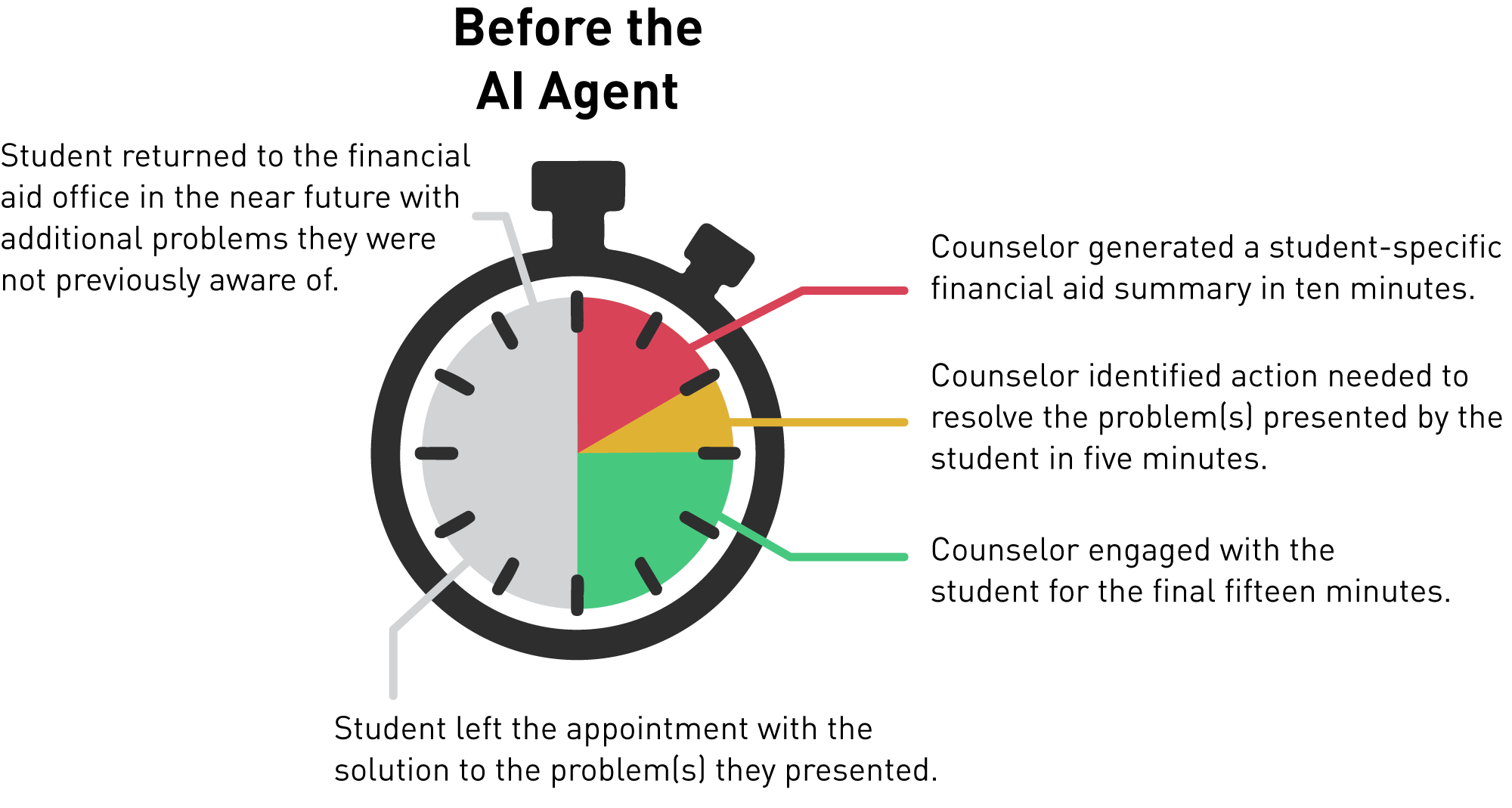
The AI agent uses the first minute of a student's financial aid advising appointment to generate two things: a "big picture" overview of the student's financial aid–related data and an action plan. Typically, a financial aid appointment is initiated by a student looking for help with one or more problems they have encountered. Before the introduction of the AI agent, each appointment would begin with the financial aid counselor generating a comprehensive financial aid summary for the student (see figure 1). The counselor could consult up to four disparate data systems to build a broad overview of the student's financial situation. Next, the counselor would identify the actions the student needed to take to resolve the problems that prompted the appointment.
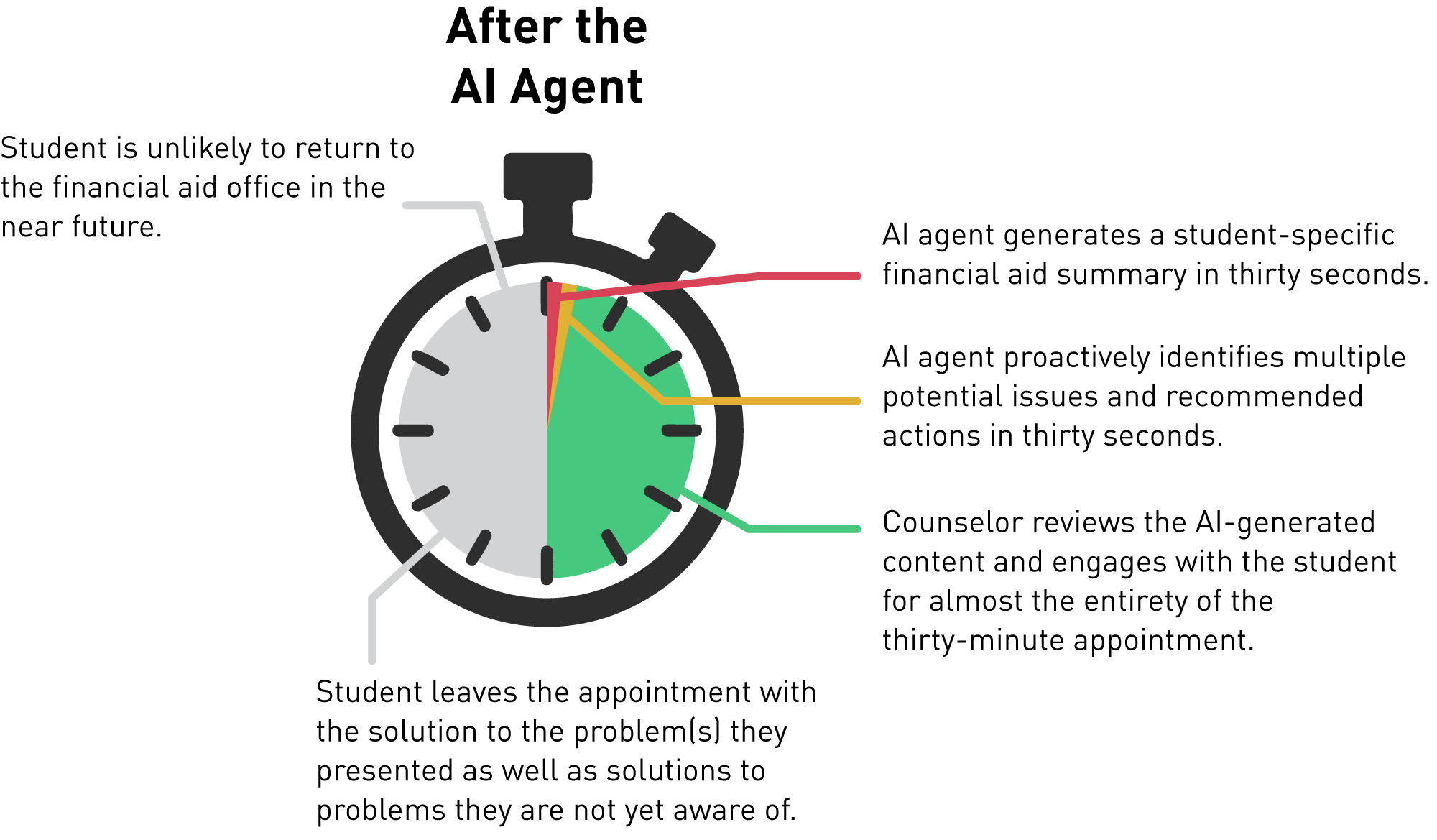
Now, with the AI agent, a counselor's administrative burden has been reduced from fifteen minutes to about one minute, roughly doubling the time counselors can spend meaningfully engaging with students (see figure 2). McCormick explained that advisers are now able to "engage with the student, almost from the first minute, with full context, and they can really get to resolution." Additionally, because the AI agent not only analyzes problems presented by the student but also looks for other common problems that the student might not be aware of, the AI-generated action plan helps counselors cover more ground and reduce the need for repeat appointments.
Process
The first step in this process was assembling the team. In addition to leadership from both IT and financial aid, the team comprises a technical lead and a third-party implementation partner. The technical lead is a financial aid data analyst with thirty years of experience at DePaul. He had previously worked on financial aid data warehouse initiatives, and he has a deep understanding of financial aid data structures. Salesforce connected the team with an implementation partner responsible for helping the team design, build, and implement the AI agent. The implementation partner also helped the team understand the Agentforce environment, identify the right LLM for each of the agent's tasks, and connect the agent to all necessary data sources.
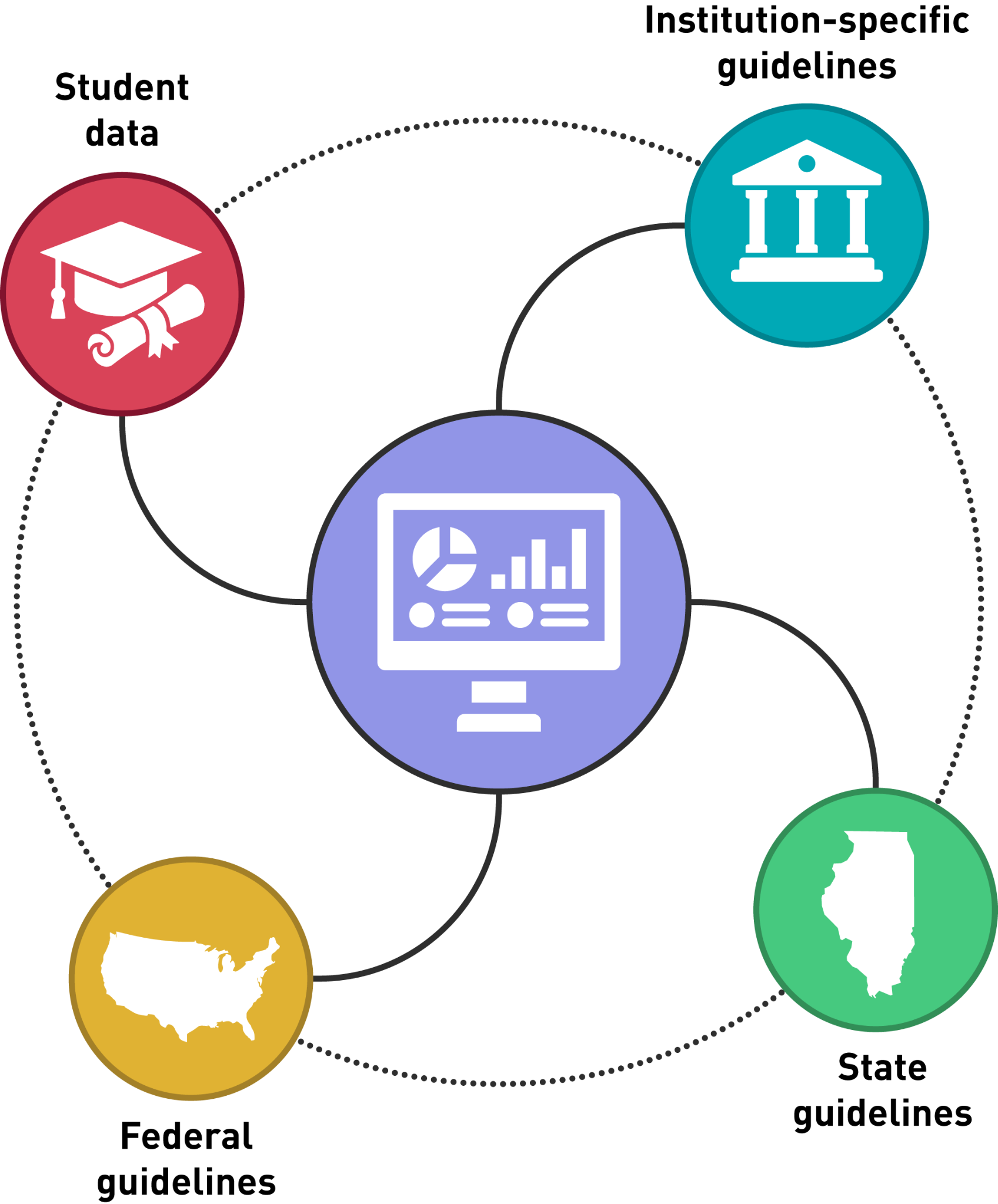
Next, the technical lead and the implementation partner engaged in a discovery process for four weeks. They interviewed every financial aid counselor at the institution and identified more than sixty actions that the counselors take to help students resolve challenges. The team's technical lead was already familiar with the financial summary counselors usually generate, so using his previous knowledge and the lessons learned in the counselor interviews, the team determined that the generation of the financial summary and the action plan would be the AI agent's two primary tasks. To accomplish these tasks, the agent draws on four types of data, found in four disconnected sources (see figure 3):
- Knowledgebase articles about DePaul financial aid processes, in DePaul's Salesforce instance
- Federal financial aid guidelines, on the federal financial aid website
- Illinois state financial aid guidelines, in an Illinois state knowledge repository
- Student-specific financial aid data (e.g., loans, tuition bills), in DePaul's Data360 environment in Salesforce
Finally, the team spent a total of eight weeks building, testing, and fine-tuning the AI agent over three iterations. The agent was launched in November 2025, and since its introduction it has freed over one hundred hours of time to focus on human connection and has reduced processing time for financial aid tasks by an average of 90 percent.
Outcomes and Lessons Learned
Conversations about the goal of an AI agent should be held early and often. In this case, the DePaul team aimed to use the agent to increase time for human connection. The team discussed this goal from the very beginning, both internally and with other stakeholders such as financial aid counselors. McCormick asserted, "I don't think you can do enough of that early on."
Good data governance is a prerequisite for AI initiatives. Before this AI agent project, the DePaul team had already worked with an implementation partner and Salesforce on a predictive-analytics project that required a Data360 implementation. That implementation acted as the data foundation for the AI agent. Institutions that do not have such a data environment in place should plan for additional work.
Key data decisions should be made up front, not along the way. Though this is part of good data governance, it's so essential that it warrants its own discussion. Teams should try to make as many data decisions as possible before an AI initiative gets started—what data are needed, how they will be aggregated, what the latency is, etc. Making these decisions early ensures that work processes don't need to be revised and that stakeholders' expectations are accounted for.
A staff-facing agent minimizes data privacy and security risks and maximizes human empathy. Though a student-facing agent could hypothetically support students with financial aid challenges, providing students with access to such a tool increases the risk that students could inappropriately access others' data in the event of a malfunction. Further, financial aid issues can be stressful for students, and one of the key functions of financial aid counselors is to support students' affect.
Efficiencies gained from AI agents should be intentionally leveraged to increase human connection. Higher education staff are constantly being asked to do more with less, so teams working on AI initiatives must be intentional about repurposing the time gained from the technology. As McCormick explained, "We're maximizing the humans and we're complementing the humans with this technology. We're not removing the humans."
AI agents require extensive "red teaming." Testing an AI agent means not only making sure it does the things it is supposed to do but also making sure it does not do things it is not supposed to do. AI agents should always undergo extensive red-team testing, but this is especially important for agents that access sensitive data or are student facing.
Where to Learn More
For the latest AI-related EDUCAUSE research, articles, and professional learning opportunities, see these resources:
- The EDUCAUSE AI Library page
- EDUCAUSE AI Events and Trainings
Thank You

Notes
- Kristen Gay, 2025 EDUCAUSE Teaching and Learning Workforce in Higher Education, research report (Boulder, CO: EDUCAUSE, April 2025). Jump back to footnote 1 in the text.
- Jenay Robert, The Impact of AI on Work in Higher Education, research report (Boulder, CO: EDUCAUSE, January 2026). Jump back to footnote 2 in the text.
Jenay Robert is Research Manager at EDUCAUSE.
© 2026 EDUCAUSE and Jenay Robert. The content of this work is licensed under a Creative Commons BY-NC-ND 4.0 International License.