ROI for technology solutions is an emerging practice in higher education that offers promise for helping institutions balance financial constraints with continued innovation.

This content is sponsored by Jenzabar, a 2025 EDUCAUSE Mission Partner. EDUCAUSE and Jenzabar collaborated to identify the topic and the institution for this case study, as well as formulate and evaluate the research objectives.
Higher education is in the midst of a perfect financial storm—traditional funding sources are dwindling, the cost of living is at an all-time high, and public concerns about the value of a college degree persist. These conditions put colleges and universities under pressure to tightly manage their budgets. At the same time, however, they need to stay current with the latest technology, not just for the sake of staying current but for more effectively and efficiently accomplishing their mission and providing students, faculty, and staff with the best possible learning and work experiences.
Evaluating return on investment (ROI) can help institutions balance these competing interests, blending fiscal responsibility with bold decisions around technological investment and innovation. Here’s Sam Burgio, president and COO of Jenzabar:
One of the biggest trends taking form in higher education is that institutions will begin to act more like businesses; leaders and decision-makers will need to demonstrate and show proof of ROI to validate their short- and long-term strategies for success. This will mean that CFOs and other business office leaders will hold more weight, tighten budgets, and look more intensely at all investments, large and small. There will likely be more guardrails set in place to keep financial decisions in check, which may limit investments but will encourage thoughtful, strategic innovations.
With these emerging challenges and opportunities in mind, EDUCAUSE offers this report as an exploration into current technology ROI practices across higher education and as a step toward better understanding the road ahead as institutions increasingly seek to benefit from these practices.
How Are Institutions Engaging in ROI Practices?
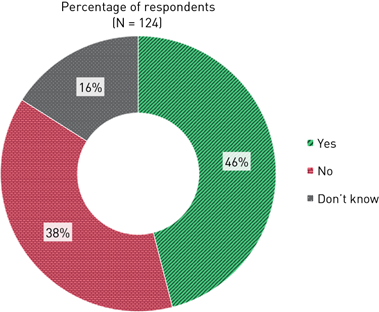
In a QuickPoll survey of 124 higher education technology leaders conducted in September 2025, a wide majority of respondents (71%) rated ROI as at least “moderately important” when evaluating or implementing new edtech tools, with only 8% of respondents rating it as “not at all important” (see figure 1). Asked whether their institution considers or measures ROI when evaluating or implementing new edtech tools, however, less than half of respondents (46%) said yes, while the remaining 54% either reported that their institution does not or said they don’t know (see figure 2).
Figure 1. Importance of Tracking ROI When Evaluating or Implementing New Edtech Tools

Figure 2. Institutional Consideration/Measurement of ROI When Evaluating or Implementing New Edtech Tools
To further explore ROI practices in higher education technology, we offer a pair of individual use cases to help illustrate the successes, challenges, and opportunities of these practices.
Berry College
At Berry College, in northwest Georgia, admissions staff have made it a priority to provide more high-touch, personalized services to their students, spending more time on outreach in their local communities and interacting more directly with students and their families. These efforts demand significantly more time from a team that is not in a position to hire new staff, so the decision was made to implement a new AI solution to help with the more administrative aspects of the team’s work, such as GPA recalculations and preread summaries of students’ transcripts and coursework data. GPA recalculations, in particular, can be time-intensive work that, when done by human hands, is prone to errors and inconsistencies depending on who does the work. The hoped-for return on the college’s investment in this new AI solution, then, included reduced time spent on GPA calculations, increased accuracy of those calculations, improved student experience of the admissions process, and refocused staff time on personalized outreach and student support.
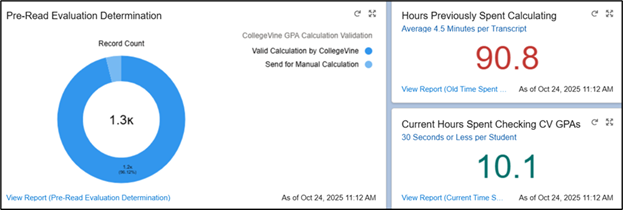
In the first area of return—reduced time spent on GPA calculations—the new AI solution was a resounding success. Through a dashboard created for easier tracking and communication of results (see figure 3), staff and leadership were able to see a dramatic reduction in the time spent on this work, from 90.8 hours of manual work down to 10.1 hours of automated work. Berry College CIO Penny Evans-Plants noted, “[This dashboard] made the impact of the AI tool immediately clear. Regularly sharing these metrics with leadership and staff has helped communicate the value of our investments and fostered a culture of continuous improvement.”
Figure 3. Berry College GPA Calculation Dashboard
Southeastern University
At Southeastern University, in central Florida, technology leadership has historically lacked a consistent process for tracking technology use, student impact, and financial ROI. But recent budget constraints are driving the institution to focus on measurable outcomes for all its investments and work, including the costs and outcomes of technology investments.
According to Southeastern CTO Neal Dyer, technology leadership has been tasked with performing an ROI assessment of all major technology systems and tools across the institution, including their learning management systems, student success platforms, admissions CRM, transcript evaluation tool, AI-enabled tools, third-party instructional technology add-ons, and enterprise-wide SaaS academic tools. With such a widespread view across the institution, the project has required involvement and input from a range of stakeholders from outside the technology team, including academic affairs, the finance and budget office, enrollment teams, teaching and learning teams, and faculty champions, as well as from external solution partners.
To date, the team’s data tracking has included user experience and adoption data (including satisfaction feedback from faculty and students and usage tracking), data on time savings and efficiencies realized through solution adoption, and financial data on the cost and cost avoidance for each solution. The team has developed a usage-versus-cost dashboard for visualizing solution ROI for stakeholders on an ongoing basis, and they’ve established an annual “edtech value assessment” process as an opportunity for system-wide summary and evaluation of the success of the institution’s overall technology portfolio.
Challenges and Opportunities for ROI Practices
Although emerging implementations of ROI for evaluating technology investments have realized short-term successes at some institutions, particularly in areas related to work efficiency and time savings, this model remains a maturing area of practice with room for growth and improvement. As a capability that requires institution-wide alignment of data and analytics practices in particular, ROI practices often encounter barriers around data silos, staff and leader comfort and skill with data-based decision-making, and data privacy and compliance considerations. As Jenzabar‘s Burgio put it:
Many institutions are focused on delivering their mission with existing processes, which can make it difficult to quantify the impact of their tech investments. There are also a series of regulatory requirements that can further complicate the picture—constraints like financial aid rules or Title IX compliance can limit the ways institutions implement new systems or measure outcomes.
Through our case studies of Berry College and Southeastern University, we see evidence of these challenges, limitations, and opportunities for the future.
Berry College
At Berry College, opportunities for using ROI to evaluate technology purchases begin with broadening the scope of how success for a solution implementation is measured and arriving at a more complete picture of whether and how that solution has impacted the operations and life of the institution. The goal of efforts at Berry College to streamline GPA calculations, for example, is not simply to do it as quickly as possible (in which case just measuring time saved would be sufficient). The goals are also to improve students’ experience of and satisfaction with the admissions process, as well as to free admissions staff time to invest in more meaningful outreach and student support activities. Evaluating the success of a new AI tool implementation, then, requires also incorporating data such as student feedback on the admissions process, as well as measures of the impact of a more high-touch, personalized admissions team culture on the student experience. Evans-Plants said:
Many edtech projects, especially those involving AI, often simply report ROI as hours saved. The tool is launched to complete a task and then estimates the amount of time it would take staff to do the same task. While that is one measure of success, it cannot be the only measure. In most use cases the goal is not to eliminate staff and replace them with AI but instead to accomplish more projects effectively and efficiently. ROI must measure the added benefit of the initiative and not just time saved.
In addition to more nuanced data on what constitutes returns, effective ROI practices also require more nuanced data about cost. New technology solutions often require additional time from technology teams to support and maintain those solutions, as well as additional cost and time for end-user training and collaboration. These additional costs can sometimes be significant and should be included in the ROI calculations. One of the biggest challenges and opportunities for Berry College moving forward, then, is to arrive at a more complete picture of the impacts of a technology solution and to weigh that against a more complete picture of its total cost.
As Burgio noted on the promise of these more holistic views into the impacts of technologies:
In the past, technology departments were seen as cost centers—investments in technology were necessary, but costly. Today … teams are leveraging new tools that enable them to see and experience results that go beyond financial measurements: more enrollments, higher retention rates, and happier students due to more personalized, engaging experiences.
Southeastern University
For institutions such as Southeastern that are piloting system-wide ROI practices, challenges and opportunities abound in standardization and collaboration. Decisions around how success for a technology solution will be defined, agreement on the data needed and how those data will be collected and analyzed, and key stakeholder buy-in and support are all critical ingredients for ensuring ROI is calculated effectively and consistently, resulting in the best possible data-informed technology decisions for the institution overall.
Dyer shared that the next steps for improving the efficacy of Southeastern’s ROI efforts will focus on breaking down the data silos that still exist across the institution to ensure more system-wide access to the data needed for more consistent and holistic ROI assessments. Next steps will also focus on continuing to develop an institutional culture that values these kinds of assessments and gains buy-in from the stakeholder groups that can make or break these efforts.
Faculty, in particular, have emerged as a stakeholder group that serves as both an important source of information and a source of friction. Technology leaders rely on faculty, as users of many of the most important institutional technology solutions, to provide feedback on the impact of each solution in their practice and outcomes, as well as to provide behavioral data such as time spent on task and solution usage. Technology leaders have encountered some barriers to faculty reporting on solution impacts, however, particularly where institution-wide agreement on evaluation metrics may still be needed.
The external technology solution partner, too, is a key stakeholder that can either diminish or enrich the success of an institution’s ROI practices. Indeed, solution partners are critical for understanding and communicating the functionalities and impacts the solution can and cannot deliver for the institution, exploring the most effective approaches to implementation and use, and supporting the ongoing need for solution updates, fixes, and additions.
Commenting on the potential role for solution partners in navigating the impacts of the institution’s technology decisions, Burgio noted:
Institutions need to ask, "How will this new technology help us recruit more students? How will a new system enable our university to get more donations?" This is where institutions can turn to trusted advisors and partners. Colleges need a technology partner that will help them identify the right tools to achieve success and implement those systems without delays or roadblocks. A proven partner like Jenzabar can be that strategic support, helping decision-makers make sound investments that will deliver valuable returns and empowering institutions to overcome the challenges of tomorrow.
Next Steps for Your Institution
Your institution might see a variety of opportunities for developing ROI practices, depending on current levels of data and analytics maturity and on cultural readiness for engaging in institution-wide assessments. We offer the following as potential first or next steps to consider:
- Connect with your peers to learn from others’ successes and challenges and to share insights from your own journey with ROI. You might begin by reaching out to peers, including Penny Evans-Plants at Berry College or Neal Dyer at Southeastern University, and many more peers across many other institutional types and contexts can be found through resources such as the EDUCAUSE Connect platform.
- Connect with solution partners to discuss expectations for ROI and to consider opportunities to more effectively work together on making the case for the impacts of technology solutions. Industry leaders such as Sam Burgio from Jenzabar can serve as engaged and thoughtful conversation partners, and EDUCAUSE Demo Days provide spaces for discussing and vetting the higher education solution marketplace.
- Assess your institution’s current levels of data and analytics maturity and your readiness to engage in complex, institution-wide assessment practices such as ROI. The EDUCAUSE Analytics Institutional Self-Assessment tool can serve as an opportunity to identify institutional strengths and challenges in these areas of practice.
 EDUCAUSE Mission Partners
EDUCAUSE Mission Partners collaborate deeply with EDUCAUSE staff and community members on key areas of higher education and technology to help strengthen collaboration and evolve the higher ed technology market. Learn more about EDUCAUSE Mission Partners and how they're partnering with EDUCAUSE to support your evolving technology needs.
Mark McCormack is Senior Director of Research and Insights at EDUCAUSE.
Jenay Robert is Senior Researcher at EDUCAUSE.
Sean Burns is Corporate Researcher at EDUCAUSE.
© 2025 EDUCAUSE. The content of this work is licensed under a Creative Commons BY-NC-ND 4.0 International License