
Colleges and universities can leapfrog from personalized to N-of-1 precision learning by modernizing their data architecture, building dynamic learner profiles, and adopting computed curriculum. This signals a paradigm shift from the one-size-fits-all model of learning that characterizes most of higher education to an individualized model fine-tuned for each learner.

Articles in this series:
The higher education community has long grappled with a persistent challenge: how to deliver learning experiences that effectively meet the needs of each individual student. While education innovators have pursued the ideal of "personalized learning" for decades, traditional methods and past technological advances have largely fallen short of achieving true individualization at scale.
With this goal in mind, this article explores the emerging potential of computed curriculum—an approach that leverages artificial intelligence (AI) to dynamically generate and deliver content and activities. By incorporating contextual variables and engaging in natural language dialogue, AI offers an opportunity to leapfrog personalized learning to what we call precision learning, mirroring the ongoing shift in medical fields toward more precise treatments.
As educators, researchers, and scientists, our goal is to move beyond population-level personalization to create learning experiences that are genuinely unique, shaped by each learner's knowledge, interests, psychological attributes, and goals. By combining event-driven data architecture with the adaptive capabilities of large language models (LLMs), a computed curriculum may finally bridge the long-standing gap in providing education that is precisely aligned to each learner's needs in the moment. We sometimes describe this as giving each learner what they need, when they need it, and in the ways that serve them best. When fully realized, for example, twenty learners in the same program will master the same outcomes and skills but will have twenty different pathways to mastery. This is a paradigmatic shift from the current one-size-fits-all learning model to one that precisely matches instruction to each learner.
Background
An effective approach to using AI in higher education, one that promotes learning and fosters student success, requires careful consideration of both the current capabilities of AI and the traditional ways colleges and universities have measured achievement. For years, education researchers believed the "holy grail" of personalization could be reached through data and analytics. Many companies have attempted personalized learning, from K–12 software providers like DreamBox Learning to higher education companies like Knewton and Smart Sparrow, as well as large publishers like McGraw-Hill with ALEKS. These efforts focused on delivering resources and services to meet a student's needs at a particular moment. In doing so, these companies helped establish entire fields of research under various banners, including personalization, adaptive learning, and intelligent tutoring systems. They also launched a range of innovations, including learning lockers, learning record stores, and student learning wallets.
Yet, the results have been mixed. Most would agree that we have not yet fully realized Benjamin Bloom's two-sigma effect, where one-to-one tutoring dramatically improves student performance, despite significant investments in adaptive learning solutions.Footnote1 In higher education, especially, many promising ventures were only absorbed into enterprise systems, ultimately falling short of their original vision of fundamentally transforming education.
This is not unusual. Over the past several decades, educators have been inundated with wave after wave of proclaimed transformational innovations in teaching and learning. Innovation fatigue is real, and past failures make it difficult to objectively evaluate new technologies that are caught in a similar hype cycle. But three developments suggest that it may now be time to set aside our collective skepticism: modern data architectures, aggregated individual learner profiles, and the transformative power of AI. Together, these developments create the conditions for a breakthrough.
At Matter and Space, we're combining these three elements to design and deliver learning experiences that meet the specific needs of each individual student (rather than an aggregated learner profile) and do so at the point of need. The following scenarios show how AI can deliver context-aware support to shape each learner's path:
- June wants to develop AI skills to move into a health care administration role, but she's been out of school for decades and is a slow technology adopter. Her learning path adapts to blend quick prompting wins that build confidence, health care–specific examples to support transfer, and additional modules on digital literacy and resiliency to strengthen her foundation.
- Marcus sits down to study at 10 p.m. His personal data shows he is carrying a significant sleep debt. Instead of the intensive practice activity that was queued up, the AI offers him a lighter gamified review—helping him maintain momentum without overtaxing his cognitive resources.
- Kaya is flying through her data visualization session, completing assignments with accuracy and enthusiasm. Inferring that the moment is right for a stretch, the AI generates a personalized challenge to create a scatter plot using the garden dataset she uploaded last week.
The examples above illustrate how computed curriculum enables educators to deliver genuinely unique experiences that are fine-tuned to individual learner needs in the moment. This capability is only possible because of modern data architectures, robust learner profiles, and AI. Until now, none of those three elements has been available in higher education.
Data Infrastructure
Many higher education institutions still rely on legacy data architectures that struggle to support the demands of modern adaptive and personalized learning. True adaptivity requires systems to work with learner data as it is generated, rather than days or weeks later. Today's learners are accustomed to the instant feedback provided by modern recommendation systems that power digital platforms such as online shopping and social media, but most learning management systems and college and university data environments struggle to cost-effectively provide this level of immediacy at scale.
Delivering real-time recommendations and interventions that improve learning outcomes requires a fundamentally reimagined architecture. Instead of static, siloed data collection, institutions need systems capable of dynamic ingestion, immediate processing, and centralized analysis of learner interactions and performance. Such an architecture might leverage event streaming platforms, robust APIs, cloud-native databases, or other technologies to make data available and actionable the moment it is created. With this shift, educational systems can identify learning gaps, trigger personalized recommendations, and adapt curricula in real time—moving from post hoc analysis to proactive support.
One of the first things that colleges and universities can do is untangle the mess of siloed systems that hold their most important data. Right now, a student's academic history might live in the student information system, their engagement patterns in the LMS, their advising notes in yet another platform, and their career outcomes in alumni surveys. None of it connects easily. AI applications built on this kind of data architecture can only ever access fragments, never the whole learner. The way forward is to build an integrated, interoperable system—a data architecture that allows for data to flow securely and in standard formats across the entire institution. When this happens, the full student journey comes into view, and AI tools can help faculty, advisors, and students make sense of it in powerful new ways.
A second step is to take the quality and governance of student data seriously. Anyone who has worked inside a college or university knows how often student records are incomplete, inconsistent, or simply incorrect. Feeding such data into an algorithm only produces more errors, or worse, introduces bias. Building real capacity in data governance, naming data stewards, setting standards for accuracy and timeliness, and monitoring for drift can turn data into an asset rather than a liability. The result is AI systems that generate insights people can trust, not just dashboards they eye with suspicion.
Finally, none of these innovations will matter if students, faculty, and staff do not trust how their data is being used. Colleges and universities are stewards of extraordinarily sensitive information—academic performance, financial aid status, and even health and wellness indicators—and the arrival of AI makes people understandably nervous. Institutions that invest in strong security, transparent consent practices, and ethical review frameworks will cultivate a willingness among faculty, staff, and students to engage with AI tools. They will reduce risk, yes, but more importantly, they will foster a culture in which AI is seen not as something being done to people, but as a tool that serves them.
This last point can be a critical differentiator for higher education institutions. We already hear people asking what colleges and universities might be for if learning can be done with one of the large LLM providers, all of which are moving into the learning space. If OpenAI, Anthropic, and Google offer not only learning content but also interactive one-on-one tutoring models, what unique value do colleges and universities provide to learners? Higher education's monopoly on what counts as learning has been eroding for some time. Alternative offerings now include coding bootcamps, MOOC providers such as Coursera and edX, and corporate programs such as Grow with Google and Salesforce's Trailhead. Many of these offerings provide credentials that are increasingly valued in the workplace.
In the age of AI, higher education institutions will have to offer a better answer to why they should be valued, and part of that answer can lie with data. Colleges and universities need to harness the copious amount of siloed student data they possess while also implementing robust data security and protections. While LLMs are powerful and large AI companies are rolling out impressive learning innovations, will students trust them with their personal data? Should they? Trusted stewardship of student data is more aligned with the ethos of higher education than with the for-profit motives of the corporate sector.
Understanding Learners
The kind of proactive and precise learner support we envision depends on fully understanding learners—not just as student ID numbers, but as three-dimensional humans. Higher education institutions collect significant amounts of student data, yet much of it often remains fragmented across unconnected systems. A student information system may capture demographic and enrollment data, the library may record borrowing and reading history, and the LMS may track courses, grades, relative engagement, and forum contributions. And vendors may use a range of external systems to collect student data, such as video engagement or online lab activities. Other important aspects of a student's life might be known only superficially or in glimpses. Are they food- or housing-insecure? Do they work long hours to care for family members? Are they struggling with anxiety or loneliness? These fragmented datasets offer only a narrow slice of the picture, depending on which data silo is accessed, and a genuinely holistic view of a learner is rarely seen. If those insights could be brought together in one place and updated in real-time, it would be possible to understand a learner's knowledge, skills, preferences, context, challenges, and even aspects of their psychological makeup—insights that could unlock powerfully personalized learning. Unfortunately, no institution has achieved this kind of holistic learner profile.
This is a missed opportunity. The traces of data strewn across systems provide signals not only about what learners do, but about who they are. Taken together, they reveal how a learner works best and where they may need greater support, often surfacing insights that the learner themselves may struggle to articulate. To move closer to the long-promised ideal of personalization, higher education must get its data house in order. These disparate sources must be compiled and prioritized into a comprehensive learner profile (see figure 1).
Figure 1. Learner Profile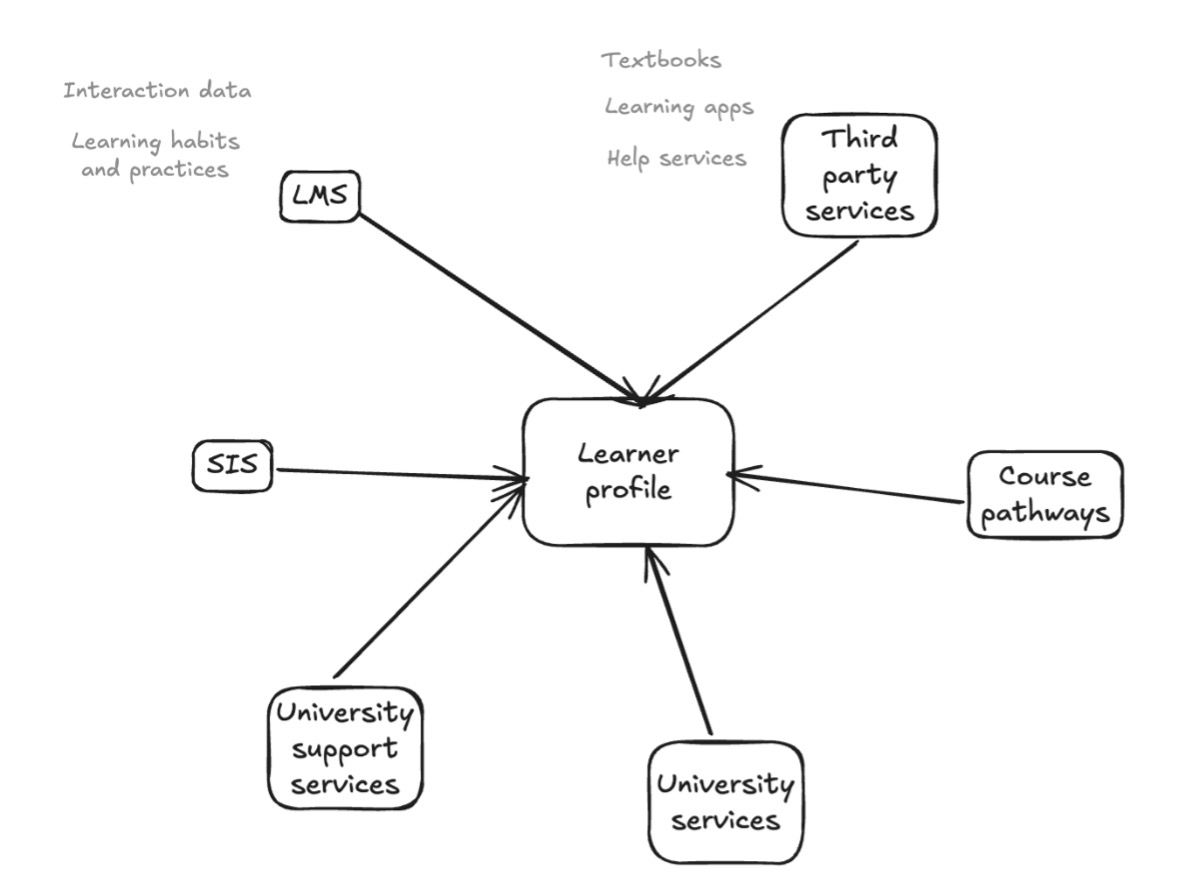
Most of us know how powerful such a learner profile can be because we likely have experienced it in our own learning journey. We often ask people to name the most transformative teachers they have had from kindergarten through college. We find that people name three on average, and when we ask them, "Why those teachers?" the answer is rarely about their teaching. It's about relationships: how those teachers made students feel like they matter, took the time to know them as people, understood their background and contexts, and found ways to help them connect better with the subject. Transformative teachers have a holistic understanding of their students and use that understanding to support their learning and human development. Learner profiles can serve as the foundation for building and scaling AI student support services that accomplish a lot of what our best teachers have always done.
Data + LLMs = Computed Curriculum
With robust learner profiles, modern data architectures that enable real-time intervention, and advances in AI, higher education stands on the threshold of precision learning. Learner attributes such as background, interests, prior coursework, and social connections can be fed into LLMs to create learning experiences that feel relevant and engaging. This is the essence of computed curriculum: content and activities dynamically generated in real time and curated for the individual learner, rather than predesigned months before a course begins for an imagined average learner that doesn't really exist.Footnote2
Imagine a curriculum created in the moment and delivered precisely when the learner needs it. In an introductory psychology course, for example, a student might not just passively consume pre-seeded articles or videos on classical conditioning. Instead, she could actively engage in a dialogue with an AI agent that helps her explore a semantic map of behaviorism or dive into tailored resources. The system identifies her needs in real time, and the AI adapts its direction and support to ensure she persists and succeeds. In this model, the content is computed at the moment of need.
The same is possible for more complex activities and interactions, such as case studies and role-plays. Realistic scenarios and dynamic dialogues can be spun up instantly, customized with elements from the learner's profile—whether it's hobbies, professional context, or specific workplace challenges. This not only boosts engagement but also enhances the transfer of learning to real-world contexts.
Figure 2. Computed Curriculum
Figure 3 illustrates what that can look like in practice, with screen grabs from the Matter and Space learning platform, LE-1.Footnote3
Figure 3. Integrating Profile and Content with Learning Activities
At its core, this kind of precise learning experience mirrors the goal of any one-to-one engagement, whether that's tutoring or a more traditional apprenticeship. The key to these interactions, many of which have a legacy that spans centuries, if not longer, is that the guidance adapts to the learner's context and existing knowledge. A masonry apprentice, for example, wouldn't be retaught how to mix standard mortar if that skill were already mastered. Instead, the mentor would expand or increase the apprentice's learning into advanced techniques, such as specialty mortars for different environments.
LLMs can take in contextual variables and immediately adapt, engaging learners in natural language interactions that create a synthetic relationship between the knower and knowee that can feel authentic. Reasonably precise individual learner profiles, combined with the ability of the LLM to weave that data into a live conversation, make these interactions feel authentic. While current limits on the amount of information an LLM can take in at once (its context window) constrain how much data it can incorporate, rapid progress suggests these limits will ease over time. The resurgence of interest in personalization is fueled by the breakthrough ability of LLMs to engage in human-like, context-aware dialogue that responds to a learner's current needs.
LLMs + Learner Profile + Computed Curriculum = Precision Learning
Personalization has long been a central ambition in higher education, but today the industry is entering a fundamentally new phase that opens the possibility of something even better: precision learning. This breakthrough requires two critical components: modern data architectures that enable interventions in real or near real time and the adaptive power of LLMs to deliver responsive, context-aware learning experiences. The payoff is significant: Students who feel recognized and supported are more engaged, persist longer, and achieve better outcomes. This isn't about efficiency alone; it's about relevance, motivation, and equity.
To realize this promise, institutions must invest in real-time data infrastructure and embrace pedagogical models that treat every learner as an individual. Done right, precision learning can finally deliver on one of education's oldest aspirations: providing each student with the right support, at the right time, in the right way.
Traditionally, educational data has been applied at a population level. For example, institutions identify groups of students at risk of dropping out based on patterns such as failing grades on recent assignments or infrequent logins. These approaches have proven valuable in reducing attrition, but they focus on groups rather than individuals. The next frontier is N-of-1 precision learning. N of 1 means using data that is unique to a single student to create a learning experience tailored to that learner only—not to the broader population to which the student belongs. While personalization has historically relied on population-level patterns, precision learning is grounded in learner-specific data and attributes (see figure 2).
The shift toward precision learning in higher education presents formidable challenges:
- Evolving faculty roles. Precision learning requires a fundamental rethinking of pedagogy and the faculty role in AI-mediated environments. It also calls for intentional integration of advanced AI, particularly LLMs, into learning design and delivery.
- Updating infrastructure. Institutions must invest in modern, real-time data systems and break down entrenched silos in order to move beyond static, retrospective analysis.
- Ensuring data privacy. Precision learning depends on extensive, often sensitive student data. Strong frameworks for consent, security, and responsible use are essential. The approach used at Matter and Space is one of radical transparency: Learners know exactly what data is captured and why.
- Equity and bias. AI systems can inadvertently reinforce inequities. There is a fine line between providing support and unintentionally capping potential. We must guard against over-adapting to short-term needs in ways that undermine long-term growth.
- Evaluation and assessment. Dynamic content requires equally dynamic assessment. Fixed checkpoints and static competency maps will not suffice. Institutions need measures that capture nuanced skill development, or they risk applying outdated logics to a new paradigm.
However, as the list of challenges suggests, the Matter and Space team is very early in this work, and there are many ways we can get it wrong. Indeed, technologically driven breakthroughs often solve stubborn problems, such as how to scale individualized and holistic learning, while introducing new ones. There are three important questions that the team spends a lot of time thinking about:
- How do we balance support and challenge? While precision learning aims to meet learners where they are, there is a fine line between providing support and inadvertently capping potential. For instance, if a student reports low reading speed and comprehension, a system might respond by consistently offering shorter texts. While this may ease immediate frustration, it risks "over-adapting" and removing the productive struggle necessary for growth. Precision learning must therefore balance responsiveness with intentional challenge, ensuring that interventions scaffold progress rather than protect learners from the very experiences that help them develop.
- How must we rethink evaluation, mastery, and evidence? An additional hurdle is the need for robust evaluation frameworks. How will institutions know whether precision learning is truly working? Colleges and universities may need to rethink traditional notions of mastery and assessment. If the curriculum is computed in real time, then static checkpoints such as midterms and finals, or even fixed competency maps, may no longer capture a learner's actual progress. Precision learning demands assessment models that are as dynamic and adaptive as the instruction itself, capable of tracking growth in real time, and surfacing not only what a learner can demonstrate now but also how they are developing over time. Do the new assessments become growth assessments rather than static benchmarks? Without new measures of growth and mastery, institutions risk applying old evaluation logics to a new paradigm and missing the full potential of precision learning.
- When everyone has an individualized learning experience, what do they have in common? When students move through a program together, largely covering the same content at the same pace and with the same lectures, assessments, and activities, they have a common experience. In a world already too fragmented and isolated, where loneliness is at an epidemic level and people seem less connected than ever, we worry about what is inadvertently lost with precision learning and know that even as we improve learning for an individual student, we have to be even more thoughtful about what it means to curate a learning community, foster connection, and build the human skills of empathy, collaboration, and navigating the "other." These are skills that seem sadly lacking in society today, and we want the learning models we pioneer with AI to not only support better learning and well-being for individuals but also create space for more, not less, human connection.
Conclusion
The future of higher education will be shaped not only by the power of AI itself, but by how higher education institutions choose to build the foundations on which it runs. Legacy systems, siloed data, and after-the-fact reporting no longer serve the needs of learners who expect immediacy, adaptivity, and personalization. Colleges and universities that fail to modernize risk ceding their relevance to corporate providers who can offer learning experiences that feel more responsive, more tailored, and more in step with the digital lives students already lead.
Yet there is an opportunity here. Colleges and universities possess something that new entrants do not: a reservoir of trust and a mission rooted not in monetizing attention but in fostering growth, knowledge, and human development. By reimagining data architectures, stewarding information responsibly and ethically, and turning raw data into timely insights that support students as whole people, institutions can carve out a distinctive role in the age of AI. They can build connections and community in ways corporate entities cannot. And they can offer far more than advanced job training, which far too many people now believe is their only purpose.
The work before us as a sector is not merely about keeping pace with technology. It is about reclaiming higher education's broader value proposition at a moment when alternatives are multiplying and skepticism (and outright attacks) about our work mounts.
The choice is stark: Remain bound by infrastructures built for another era, or embrace systems that enable real-time care, insight, and support. If colleges and universities take up this challenge, they can offer something no algorithm can deliver: the transmission of knowledge and the guidance, trust, and ethical stewardship that turn learning into transformation.
Notes
- See, Benjamin S. Bloom, "The 2 Sigma Problem: The Search for Methods of Group Instruction as Effective as One-to-One Tutoring,"Educational Researcher 13, no. 6 (June–July 1986): 4–16. Jump back to footnote 1 in the text.
- See, Todd Rose, The End of Average (HarperOne, 2017). Jump back to footnote 2 in the text.
- To watch a video demonstration of the learner's journey, visit Matter and Space, "Matter and Space Product Demo" YouTube video, 04:49. Jump back to footnote 3 in the text.
Tanya Gamby is Vice President of AI Learner Development at Southern New Hampshire University.
David Kil is CEO and Founder of CML Insight.
Rachel Koblic is a Learning Architect and Product Strategist.
Paul LeBlanc is Visiting Scholar and Special Advisor at the Harvard University Graduate School of Education.
Mihnea Moldoveanu is Director of Desautels Centre for Integrative Thinking and Rotman Digital and the Marcel Desautels Professor of Integrative Thinking and Professor of Economic Analysis at University of Toronto.
George Siemens is Chief Artificial Intelligence Officer at Southern New Hampshire University.
© 2025 Tanya Gamby, David Kil, Rachel Koblic, Paul LeBlanc, Mihnea Moldoveanu, and George Siemens. The content of this work is licensed under a Creative Commons BY 4.0 International License