
Microcredentials operate differently from traditional education, and they call for a more flexible, adaptable system to organize and classify learning objectives.

About three years ago my mentor, Sherri Braxton Castanzo, wrote about the importance of creating a digital badge taxonomy.Footnote1 Since then, numerous institutions, including Kennesaw State University, the University of Texas at Austin, the Alamo College District, the University of Maine System, and my own institution, the University of Maryland, Baltimore County (UMBC) have implemented some form of a microcredential taxonomy. These taxonomies serve a crucial purpose: They help clarify the type of learning or achievement that a microcredential represents. At UMBC, our taxonomy, like Braxton Castanzo’s original model, was heavily influenced by Bloom’s Taxonomy and the Dreyfus model of skill acquisition. These frameworks provided a foundation for distinguishing between different types of learning outcomes and levels of competency.
With the rapid adoption of taxonomies across institutions and even external validation frameworks such as 1EdTech’s TrustEd Credential Coalition, it’s clear that taxonomy design has become a best practice in digital credentialing. The hierarchical cognitive models that serve as the underlying structures, however, might not be the best fit for the flexible, learner-centered experiences that microcredentials aim to support.
It may be time for a shift.
What if we moved away from linear, vertical frameworks and embraced something more dynamic, something more reflective of how people holistically acquire competencies? Here I propose a new way forward, a Radial Microcredential Taxonomy that combines Fink’s Taxonomy of Significant Learning Outcomes with demonstrable levels of achievement. This model offers a more holistic, adaptable, and equitable approach to recognizing learning without forcing every credential into a hierarchical mold.
Beyond Bloom
At UMBC, we currently provide four primary types of microcredentials: Engagement, Knowledge, Proficiency, and Mastery. Engagement microcredentials acknowledge participation or attendance. While they are sometimes dismissed as “souvenirs” or “stickers,” these credentials can serve important purposes: tracking involvement, encouraging future participation, and offering a point of pride or community identity for earners.
The remaining types are based on Bloom’s Taxonomy and the Dreyfus model:
- Knowledge microcredentials recognize remembering and understanding.
- Proficiency acknowledges applying and analyzing knowledge.
- Mastery reflects the ability to evaluate and create with that knowledge.
While this structure has proven useful in academic environments, it doesn’t always align with the diverse learning contexts that microcredentials can recognize. Today, digital credentials are utilized in classrooms, across the co-curriculum, in experiential learning settings, and even in professional development programs for faculty and staff.
The Bloom/Dreyfus model offers a hierarchical structure that privileges cognitive achievement, but this hierarchy can become rigid. It risks flattening the nuance of different learning experiences and underrepresents the emotional, social, and personal growth that microcredentials can capture. Microcredentials currently ask, “What did you know, and how well did you use it?” There is an opportunity for them to also ask, “How did it change you, or why did it matter?” That’s where Fink’s Taxonomy offers a compelling alternative.
Fink presents a more holistic and integrated model that expands Bloom by incorporating cognitive and affective domains. His framework identifies six dimensions of significant learning:
- Foundational Knowledge
- Application
- Integration
- Human Dimension
- Caring
- Learning How to Learn
Unlike Bloom’s, Fink’s taxonomy is nonhierarchical. Each domain represents a meaningful type of learning; none is considered “higher” than the others. Instead, the power lies in their interconnection—how knowledge and application, values and reflection, all shape a learner’s experience.
The Radial Microcredential Taxonomy
Fink’s Taxonomy offers a holistic view of learning, but microcredentialing needs to address another aspect: depth. One of the strengths of the taxonomy that Braxton Castanzo proposed was its integration of the Dreyfus model of skill acquisition, which helped distinguish between levels such as novice, proficient, and expert. This concept of learning depth continues to be valuable, especially when paired with the broader learning domains that Fink introduces.
So what if we didn’t have to choose between them?
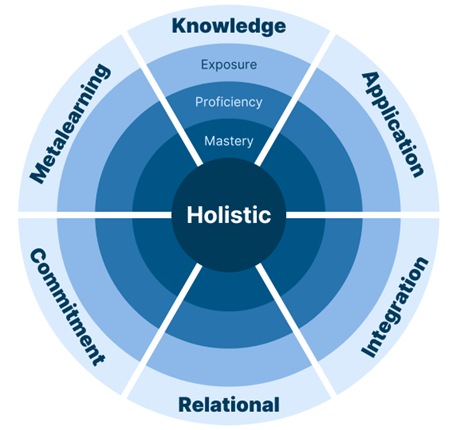
The Radial Microcredential Taxonomy combines Fink’s six domains of significant learning with three levels of demonstrated learning depth (see figure 1). The outcome is a flexible, learner-centered model that honors Fink’s nonhierarchical spirit while providing practical tools for credentialing observable growth across the six domains:
- Knowledge: Developing foundational understanding and the ability to explain core ideas, theories, or systems
- Application: Applying knowledge or skills in real-world contexts, including critical, creative, or technical tasks
- Integration: Drawing meaningful connections across disciplines, experiences, and personal or professional contexts
- Relational (“Human Dimension”): Gaining awareness of oneself and others, and understanding the social or collaborative implications of learning
- Commitment (“Caring”): Developing new values, interests, or motivations that shape decisions, behaviors, or long-term goals
- Metalearning (“Learning How to Learn”): Improving self-awareness as a learner and developing strategies for independent and lifelong learning
Each of these domains can be recognized through microcredentials that indicate various levels of depth or development:
- Exposure: The learner has been introduced to the concept or skill and can describe or demonstrate it in a supported context.
- Proficiency: The learner independently applies the skill or concept in familiar or moderately complex situations.
- Mastery: The learner demonstrates expert-level understanding or execution and can transfer, adapt, or teach the skill in new contexts.
Consider this example (which is a piece of cake…): an Application microcredential focused on baking.
- A learner at the Exposure level might follow a recipe alongside an instructor, demonstrating foundational familiarity with techniques.
- At the Proficiency level, the learner can independently bake, adjusting for timing, temperature, or substitutions as needed.
- At the Mastery level, the learner not only bakes effectively but can also teach others, design new recipes, or adapt baking techniques for various audiences or settings.
This example can also illustrate Metalearning—rather than focusing on the act of baking itself, the emphasis can shift to how learners reflect on, improve, and ultimately transfer their learning strategies through the process of baking a cake:
- At the Exposure level, the learner reflects on early attempts at baking (successes, failures, what worked, what didn’t) and begins to notice how these experiences inform the current approach to baking a cake.
- At the Proficiency level, the learner develops intentional strategies to improve baking, targeting personal strengths and weaknesses. For example, the learner might seek resources, test variations, track outcomes, or troubleshoot mistakes and is able to articulate how these tactics support and develop learning.
- At the Mastery level, the learner demonstrates deep self-awareness as a baker, recognizing strengths, weaknesses, and preferences, and can transfer these metacognitive strategies from baking to cooking more broadly.
This model scales effectively. It works equally well for technical skills such as data visualization and grant writing as it does for interpersonal growth, civic leadership, or reflective learning. Additionally, because it is structured around learning depth within a domain, rather than progression between domains, it supports nonlinear learning pathways and personalized development.
The Radial Microcredential Taxonomy also aligns with the TrustEd Microcredential Framework. Engagement microcredentials correspond to the Engagement type in the TrustEd Microcredential Framework, while all other Radial Taxonomy microcredentials map to the Application type. As Braxton Castanzo shared in a recent article, the TrustEd Microcredential Framework can be adaptableFootnote2; linking these frameworks not only enhances clarity and relevance but also sets practitioner expectations for the level of metadata required to support each credential.
Implications for Credential Design
Microcredentials are most powerful when they are nimble, capable of capturing specific, focused, and meaningful learning experiences. The Radial Microcredential Taxonomy supports this by enabling each credential to reflect one domain of significant learning and one level of demonstrated depth. Gone are ambiguous levels such as “Tier I” or “Badge Level II.” This taxonomy offers a clear structure in naming conventions and communicating what a credential represents.
It also honors the nonlinear nature of learning. There is no single pathway or universal sequence of outcomes. Learners can engage at different levels across various domains, depending on their goals, context, and readiness, and credentials built through this model affirm personal growth and demonstrated competence across cognitive and affective dimensions. For employers, the taxonomy provides a straightforward yet meaningful way to understand not only a learner's abilities but also how well they can perform, including often overlooked skills like emotional intelligence and relational capacity.
This framework provides coherence across a diverse range of learning contexts for institutions. It offers a shared language that connects academic and student affairs, curriculum, and co-curriculum while supporting consistency and creativity in assessment and design.
Expanding the Taxonomy: Three More Credential Types
While the taxonomy presents 18 distinct microcredential types (6 domains × 3 depth levels), it is not a closed system. Three important additional types of credentials exist outside the primary structure:
- Engagement Microcredentials: As discussed earlier, these recognize participation or presence rather than demonstrated learning. Although not tied to a specific domain or depth, they remain valuable tools for encouraging involvement and tracking engagement.
- Meta Microcredentials: These symbolically signify the completion of a broader learning pathway. They integrate multiple individual microcredentials and can validate intricate, cross-disciplinary competencies that do not fit neatly within a single domain or level of depth.
- Holistic Microcredentials: A special form of meta microcredential, the holistic microcredential recognizes learners who have demonstrated competency across all six domains—Knowledge, Application, Integration, Relational, Commitment, and Metalearning. Rooted in the heart of Fink’s philosophy, it celebrates the full arc of learning: content, connection, emotion, reflection, and growth. This recognition offers institutions a unique way to honor truly transformative learning experiences.
A Call to Action
As microcredentials continue to evolve, our frameworks for understanding and designing them must also adapt. The Radial Microcredential Taxonomy is not intended to be prescriptive—it is a flexible, theory-informed model that connects learning science, equity, and practical application. My call to fellow practitioners is this: Interrogate your current taxonomy. Examine where it aligns—or doesn’t—with this model. And most importantly, keep pushing. Continue asking how we can better utilize microcredentials not just to label learning but to illuminate it—for learners, institutions, and the world beyond.
Notes
- Sherri Braxton Castanzo, “Creating a Digital Badge Taxonomy to Foster Shared Meaning,” EDUCAUSE Review, September 27, 2022. Jump back to footnote 1 in the text.
- Sherri Braxton Castanzo, “Building Trust and Rigor in Microcredentials: Synthesizing Standards, Taxonomy, and Frameworks,” EDUCAUSE Review, October 7, 2025. Jump back to footnote 2 in the text.
Collin Sullivan is Program Director, Digital Credential Innovation, at the University of Maryland, Baltimore County.
© 2025 Collin Sullivan. The content of this work is licensed under a Creative Commons BY-NC 4.0 International License