
By integrating rigorous standards, a unified taxonomy, and an established and trusted framework, microcredentials can be designed and implemented as credible, transparent, and valuable indicators of learners' skills and competencies across various sectors.

The 2025 EDUCAUSE Top 10 converged on the need for higher education to restore trust with its constituents.Footnote1 The value of higher education degree programs is still being questioned as students and families wonder if the investment will yield the expected return.Footnote2 Trust must be rebuilt through institutional practices and the quality of the programs and credentials that are awarded to learners. In an increasingly digital and skills-driven economy, microcredentials have emerged as a critical evolution in education, providing learners with opportunities to gain and showcase competencies outside traditional degree programs. As microcredentials become more common, it's important to make sure they are credible, rigorous, and trustworthy. This article draws on my prior scholarship on digital badges and microcredential quality to present a cohesive approach to developing high-quality microcredentials that meet the demands of learners, educators, and employers.Footnote3 This approach includes three critical components:
- Consistency through a shared taxonomy
- Rigor through clear standards
- Practical application through the TrustEd Microcredential Framework, aligning credentials with validated competencies
The result is microcredentials that ensure and enhance transparency, credibility, and portability.
TrustEd Microcredential Framework: Building on Standards and Taxonomy
The TrustEd Microcredential Framework further enriches these concepts by outlining three specific types of microcredentials: knowledge microcredentials, application microcredentials, and recognition badges.Footnote4 Each type corresponds to different levels of the digital badge taxonomy, aligning the framework's design with the structured approach of the taxonomy.
- Knowledge microcredential: This type of microcredential is issued when learners demonstrate foundational knowledge through a validated assessment. It aligns with the taxonomy knowledge level where assessment and measurable outcomes are critical, such as the cognitive competencies associated with "awareness." The emphasis on validated assessments ensures that the microcredential accurately represents the learner's knowledge, remains consistent across learning domains, and upholds transparency and rigor.Footnote5
- Application microcredential: This is awarded when learners demonstrate their ability to apply knowledge in practical or real-world scenarios, such as projects or labs. This type of microcredential requires assessment and aligns with the higher levels of competency in the taxonomy, such as "proficiency" and "mastery." By validating practical skills through performance assessments, these microcredentials provide trusted evidence that learners can apply their knowledge effectively, aligning with the standards of rigor and trust.Footnote6
- Recognition badge: Unlike the other two types of microcredentials, a recognition badge is issued for participation or attendance without requiring assessment. This type of badge corresponds to the lower level in the taxonomy, where assessment is not mandated, clarifying the distinction between recognition and skill validation. The recognition badge aligns with the principle of transparency by explicitly acknowledging engagement without validating a specific competency.
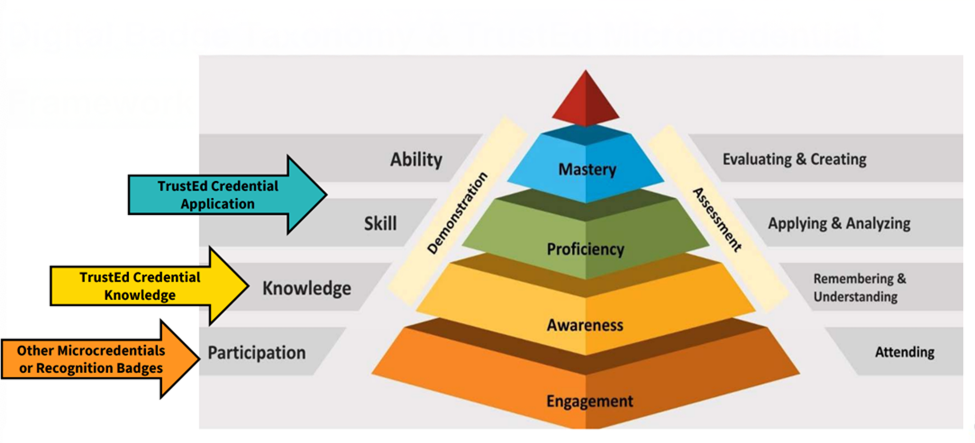
Through the integration of the taxonomy and TrustEd framework shown in figure 1, a comprehensive approach to designing microcredentials emerges:
- Consistency through taxonomy: The taxonomy ensures that microcredentials are consistently categorized, making it possible for various stakeholders to understand and trust them across different domains. This shared language is essential for lifelong learners navigating multiple sectors, as it enables their credentials to hold value in a variety of contexts.
- Rigor through standards: A quality framework is essential for ensuring that microcredentials represent credible and valuable learning experiences. By embedding evidence and transparency into microcredentials, these standards create a foundation that allows learners, educators, and employers to trust the validity and significance of the credentials.
- Practical application through the TrustEd framework: The TrustEd Microcredential Framework ties these elements together and clarifies the expectations and rigor associated with each type by differentiating between microcredentials that require assessment (knowledge and application microcredentials) and those that do not (recognition badges). This helps higher education institutions and organizations design microcredentials that are both meaningful and transparent. The resulting impact is a microcredential ecosystem that clearly distinguishes those digital badges that signal validated skills from those that do not.
From Framework to Implementation: Why It Matters
Integrating the TrustEd Framework with existing standards and taxonomies provides tangible benefits for three key stakeholders: learners, employers, and issuing institutions. Learners gain clearer communication of their achievements, while employers benefit from greater confidence in verified competencies and skills because criteria and assessment strategies are transparent. For issuing institutions, the framework promotes consistency across disciplines by applying standards through clearly defined levels of competency in the taxonomy. Wichita State University recently issued the world's first TrustED Microcredential with the Territorium platform.Footnote7 Two other organizations that have also implemented the TrustEd Framework are the University of Maryland, Baltimore County (UMBC), which applies it to its microcredential programs, and Instructure, which integrates it into its Canvas Credentials platform. UMBC has established a governance model for microcredentials that uses a twelve‑criterion evaluation rubric aligned with national frameworks, including the TrustEd Microcredential Framework. The UMBC Microcredential Review Board (MRB) and Microcredential Advisory Committee (MAC) ensure that all credentials meet high standards for quality, transparency, and equity, thereby improving employer confidence and learner outcomes.Footnote8
Canvas Credentials, along with Territorium, was one of the first platforms to adopt the TrustEd Framework, ensuring interoperability and transparency by embedding metadata such as skills, framework alignment, issuer, and assessment details into every credential.Footnote9 Organizations that adopt the TrustEd Microcredential Framework alongside a standardized taxonomy and evaluation rubric, such as UMBC and Canvas Credentials, create a credential ecosystem that is scalable, transparent, and trusted. This approach rebuilds confidence in credentials as meaningful signals in the education-to-employment pipeline.
A Holistic Approach to Microcredential Design
The TrustEd Microcredential Framework enables institutions to move from conceptual principles to actionable, scalable microcredential design. By clarifying assessment levels and differentiating credential types, it provides a practical roadmap for creating credentials that stakeholders—including learners, employers, and educators—can trust. When paired with a unified taxonomy and rigorous metadata standards, this approach ensures that microcredentials are credible, transparent, and transferable across sectors.Footnote10 It also highlights validated competencies, supports lifelong learning, and builds confidence in digital credentials. By adopting this framework, institutions can expand microcredential programs responsibly, maintaining quality and verifiability while addressing the evolving needs of learners and employers.
Notes
- Susan Grajek and the 2024–2025 EDUCAUSE Top 10 Panel, "2025 EDUCAUSE Top 10: Restoring Trust," EDUCAUSE Review, October 23, 2024. Jump back to footnote 1 in the text.
- Ashley P. Finley, The Career-Ready Graduate: What Employers Say about the Difference College Makes (AAC&U, 2023), iii. Jump back to footnote 2 in the text.
- Sherri Braxton Castanzo, "Creating a Digital Badge Taxonomy to Foster Shared Meaning," EDUCAUSE Review, September 22, 2022; Sherri Braxton Castanzo, "Quality and Trust: Not a New Consideration in Microcredentials,"The Evolllution, November 7, 2024. Jump back to footnote 3 in the text.
- "TrustEd Microcredential Coalition: TrustEd Microcredential Framework," 1EdTech, last modified May 29, 2024.Jump back to footnote 4 in the text.
- Braxton Castanzo, "Creating a Digital Badge Taxonomy." Jump back to footnote 5 in the text.
- Ibid.Jump back to footnote 6 in the text.
- Barton School of Business, “Barton School’s Micro-Credential Programs Recognized as the First of Their Kind in the World,” March 13, 2025 Jump back to footnote 7 in the text.
- Collin Sullivan, "Microcredentials that Matter: Building Trust through Quality and Review," November 14, 2024; Collin Sullivan, "A Rubric for Microcredential Evaluation: Strengthening Quality Assurance," Innovative Higher Education, June 7, 2025. Jump back to footnote 8 in the text.
- Adrienne Roberston, "Establishing Standard Digital Badges and Credentials," Instructure Blog, January 10, 2024. Jump back to footnote 9 in the text.
- Sherri Braxton Castanzo, "Creating a Digital Badge Taxonomy to Foster Shared Meaning," EDUCAUSE Review, September 22, 2022. Jump back to footnote 10 in the text.
Sherri Braxton Castanzo is Deputy CIO for Digital Innovation at Bowdoin College.
© 2025 Sherri Braxton Castanzo. The content of this work is licensed under a Creative Commons BY-NC-SA 4.0 International License