
Higher education institutions can better prepare students for an artificial intelligence–augmented workforce by shifting from teacher-centered models to facilitative instructional approaches that develop the enduring professional capacities that become more, not less, valuable as AI transforms work: critical thinking, collaboration, creativity, and adaptability.

Recent data shows that amid economic uncertainties and a changing organizational landscape, current graduates are struggling to find jobs.Footnote1 In his visionary 2017 book Robot-Proof: Higher Education in the Age of Artificial Intelligence, Joseph Aoun called for a new model of teaching and learning that would rebalance content acquisition with the development of uniquely human skills—a model he termed humanics.Footnote2 Now, as the influence of artificial intelligence (AI) grows, some educational leaders propose an alternative framework called interactionalism, aimed at equipping students with the skills, knowledge, and mechanisms they need to thrive "in a world where human and machine intelligence work together."Footnote3 Both frameworks point to the need to teach to this rapidly evolving techno-human landscape. Whether through humanics or interactionalism, approaches to fostering student learning must evolve to meet the demands of a changing world and workforce. This evolution is essential not only to help students learn in an era in which AI can effectively handle considerable knowledge work but also to prepare them for the AI-augmented workforce that increasingly needs "super facilitators"—professionals skilled at fostering collaborative, problem-solving conversations.Footnote4 To meet this need, instructors must become facilitators of human-centered learning experiences.
While some higher education institutions have attempted to shift from the "sage-on-the-stage" model to a more student-centered "guide-on-the-side" approach, this transition has been inconsistent and unsystematic, with lectures largely remaining the dominant instructional method.Footnote5 As AI becomes increasingly prevalent in academia and the workforce, the educational system must adapt once again. A comprehensive approach to building faculty capabilities is needed—one that equips instructors with the competencies and mindsets to teach course content while developing students' collaboration, creativity, and critical thinking skills. This approach moves beyond the sage-on-the-stage and guide-on-the-side models to intentionally designed learning experiences that integrate knowledge acquisition with the human skills needed to prosper in today's workforce. Figure 1 illustrates this shift as a continuum of teaching approaches.
Figure 1. Teaching Approaches: A Continuum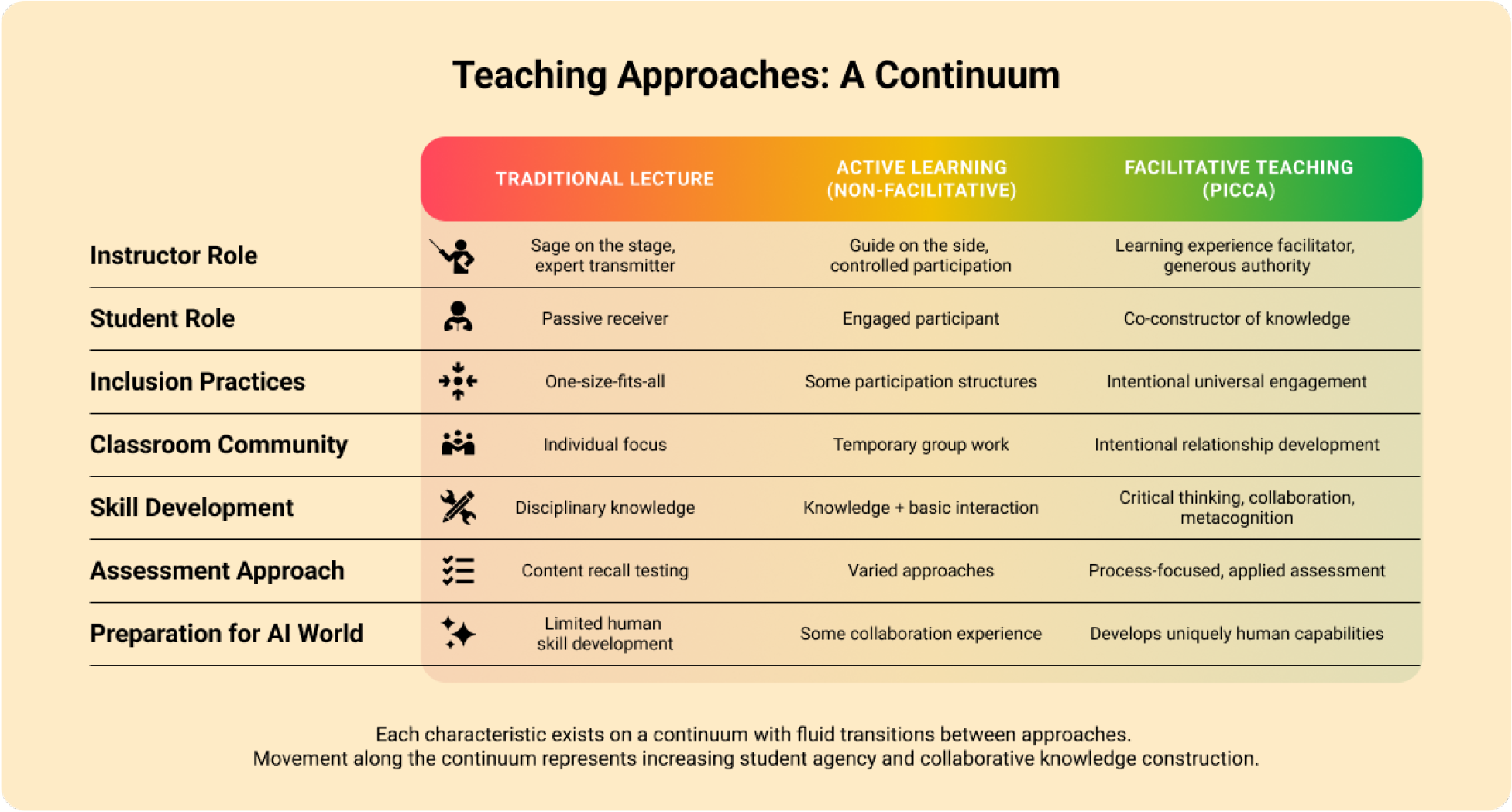
This continuum illustrates a progression of instructional practice marked by increasing skill and intentionality in designing learning experiences that elevate the human dimensions of teaching and learning. It does not compromise instructors' roles as experts in their disciplines; rather, it shifts how they facilitate learning experiences. Institutions may look to AI for efficiency, but cultivating deep learning, dialogue, and critical decision-making still requires human connection and human skills. While facilitation is a well-established competency in corporate learning contexts, it is underutilized in faculty teaching development. To meet this moment, faculty need support not only in adapting to emerging technologies but in developing the mindsets and skills required to facilitate and lead collaborative learning effectively.
Active Learning and Facilitative Teaching
Active learning focuses on specific activities and strategies. Facilitative teaching emphasizes the mindsets, intentionality, and relational skills that support the effective use and student acceptance of active learning models. It is grounded in educational theory that prioritizes social, experiential, and interactive learning. Educational psychologist Carl Rogers, for example, asserted, "we can't teach another person directly; we can only facilitate his learning."Footnote6 Even though facilitative learning and its tools are not yet mainstream in higher education, the notion of what it is and how it can effectively foster learning and engagement is emerging. For instance, Henri Lipmanowicz and Keith McCandless' book Liberating Structures (a fundamental resource in the facilitation community) provides a set of facilitation frameworks and activities that form the backbone of many tools and design practices that are being used across higher education and the workforce.Footnote7 Although some of the strategies detailed in the book (such as think-pair-share) are already widely used by active learning practitioners, the methods are largely disconnected from an intentional, facilitative approach.
The PICCA Facilitation Competency Model
While a guide on the side may imply that instructors passively nudge students, the facilitative instructor instead exercises what Priya Parker calls "generous authority."Footnote8 This positions the facilitator as strong and confident—someone who uses their authority selflessly. Generous authority reframes the "guide-on-the-side" role, shifting it from occasional group projects or jigsaw activities to intentionally grounded, purposeful class sessions.
The Purposed, Inclusive, Clear, Crafted, and Adaptive (PICCA) facilitation competency model offers a practical framework that supports instructors in designing impactful learning experiences and equips students to carry these competencies across disciplines and professional contexts (see figure 2).Footnote9 This model, developed by Voltage Control as the foundation of its facilitation certification program, aligns with established frameworks such as the International Association of Facilitators' Core Competencies and with pedagogical scholarship on facilitation in adult learning and transformative education.Footnote10
Each aspect of the PICCA framework outlines the educator's mindset and competency, the student's corresponding role and response, and how these practices develop students' professional and interpersonal skills.
Figure 2. The PICCA Facilitation Competency Model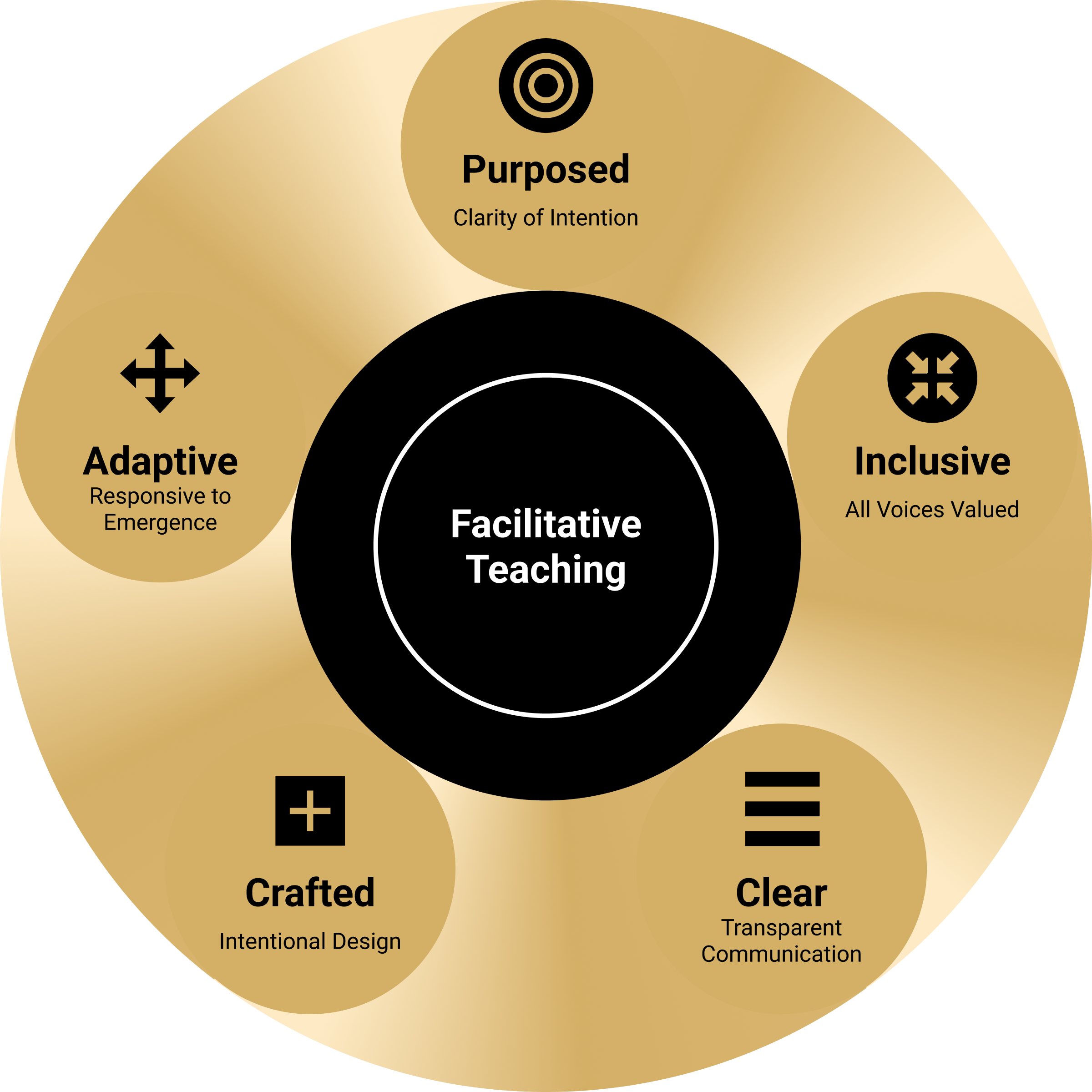
Purposed facilitators begin with clarity of intention, aligning activities with broader outcomes and competencies. Rather than lecturing or assigning activities without context, they design learning experiences with purpose and communicate that purpose clearly. For example, instead of assigning group work simply for "collaboration," purposed educators explain how the syllabus and each activity connect to disciplinary competencies and real-world decision-making. They articulate clear goals for the class session, expected interactions, and agreed-upon norms. In turn, students learn to ask what they are trying to achieve, why it matters, and how their work supports long-term growth. These questions foster students' agency, deepen their role in the meaning-making process, and prepare them to act with intention in professional contexts.
Inclusive facilitators ensure that all voices are heard, intentionally acknowledging the diversity of students' voices, lived experiences, and prior knowledge, as well as the value this diversity brings to learning experiences. They draw on a range of strategies to create multiple avenues for engagement. For example, inclusive facilitators may design small-group dialogues with rotating roles so that students who are less likely to speak have structured opportunities to contribute, or they may establish community agreements that protect space for dissenting viewpoints. These practices provide opportunities for introverted, neurodiverse, and underrepresented students to participate. As a result, students not only experience more inclusive forms of engagement but also internalize strategies for equitable collaboration, preparing them to foster a sense of belonging in diverse professional environments beyond the classroom.
Clear facilitators emphasize transparent communication and expectations that connect the work students are doing with a purpose. They help students see the relevance, applicability, and meaning behind assignments and activities. For example, an educator might open a session by previewing both the learning objectives and the process students will use to get there: "Today you'll work in pairs to map stakeholder perspectives, and then we'll synthesize themes as a group. This allows us to practice understanding human needs and centering those needs in order to develop potential solutions." Through these practices, students experience how clarity reduces uncertainty and anxiety and enables focus. They see the through line and relevance of their group work while also recognizing the level of communication precision required in professional contexts, where misalignment can derail projects.
Crafted facilitators intentionally design group experiences that engage students not only in the course content but also in its applicability and complexity. They incorporate problem-based, inquiry-aligned, and collaborative approaches to create meaningful learning opportunities. For example, a crafted educator might replace a standard lecture with a role-play activity that builds empathy across perspectives or design reflection prompts to deepen individual meaning-making. Through experiences like these, students see how thoughtful design can unlock richer outcomes than traditional instructional methods. As the focus of an activity shifts from content delivery to application, students learn how they can apply the same mindset in professional settings.
Adaptive facilitators respond to what emerges in the moment without losing sight of purpose. They foster dialogue on challenging topics and create reflective experiences that help students examine their biases, assumptions, and conceptual understanding of complex issues. For example, if a planned debate devolves into unproductive conflict, an adaptive instructor might pause for a reflective writing activity to reset the energy and reframe the discussion. Students learn that flexibility and presence are not signs of losing control but of staying aligned with intention amid complexity. This prepares them for the unpredictable realities of professional life, where agility is essential.
The Impact of the PICCA Competencies
Taken together, these competencies illustrate teaching as a form of facilitation that extends beyond knowledge transmission and provides a more intentional approach to active learning. They create learning environments that model the skills students need to thrive in collaborative, interdisciplinary, and leadership contexts, as well as in the rapidly changing world of work beyond the college or university.
The Strategic Case for Facilitative Teaching
Given the accelerating pace of AI automation and its implications for both learning and work, this ambitious approach seeks to re-center and re-value the distinctly human skills required for transformative learning and evolving workforce demands. It represents the next step in pedagogical development—building on active learning by grounding those practices in facilitative mindsets and practices.
The matrix in figure 1 illustrates a continuum from traditional sage-on-the-stage instruction to active learning approaches to facilitative teaching. Although these practices are not particularly complex, they align with professional learning standards and emphasize the interpersonal and professional skills needed for advanced academic study or for the transition to the workforce. Educational developers and instructional designers who manage the art and science of course design and instructional delivery can leverage the PICCA framework as a central, unifying approach that provides implementation guidance to foster highly engaging learning experiences.
Reframing the instructor role—moving beyond being a guide on the side to being a facilitative teacher and learning experience designer—provides an opportunity for instructors to apply their expertise in ways that cultivate students' critical thinking, problem-solving, creativity, and adaptability skills. This shift not only elevates the importance of human skills in an increasingly automated world but also prioritizes process over product. While reclaiming classroom time is reminiscent of the flipped classroom model, facilitation extends this approach by providing clearer direction on how students develop and apply these skills.
Facilitation as a Core Instructional Competency
The move toward facilitative teaching is imperative as institutions grapple with strategy and work to maintain human relevance and support student success amid increasing AI automation in learning management systems and broader edtech ecosystems. Higher education is again at an inflection point. The rise of generative AI has intensified longstanding pressures around cost, trust, equity, and public value, making it untenable to rely on instructional models that prioritize transmission over transformation.
There is a practical and research-aligned path forward: center facilitation as a core instructional competency. When faculty adopt facilitative competencies, they create conditions for inquiry, collaboration, and judgment: capacities that remain distinctly human and that employers consistently prize.
PICCA translates this stance into actionable practice. Purposed teaching anchors activities to consequential outcomes. Inclusive practice cultivates a sense of belonging and equitable participation. Clear practice makes processes and expectations transparent. Crafted design sequences scaffold meaning making. Adaptive facilitation maintains direction while responding to what emerges. Together, the PICCA model reframes teaching as the expert design and guidance of learning experiences rather than as the management of content delivery, the value of which is diminishing.
Investing in facilitation is a strategic choice with institutional implications. It aligns classroom practice with evidence on learning; prepares students for collaborative, AI-augmented work; and signals to society that the institution values the complex craft of making learning happen for what is needed in the market.
Educational developers can accelerate this shift by focusing professional learning on facilitative competencies, aligning assessment and recognition with facilitation practice, and supporting departments in redesigning courses and programs to reflect these commitments.
Conclusion
If higher education institutions are to meet this moment, absorbing the shock of rapid technological change and delivering on decades of calls for student-centered learning, then facilitation competency must move from the margins of faculty development to the center of pedagogical identity. The invitation is clear: adopt PICCA as shared language and practice, continue redesigning and facilitating courses so students co-construct knowledge, and cultivate classrooms where collective intelligence, human connection, inquiry, and judgment can flourish. In doing so, institutions can begin to restore public trust in the relevance of higher education. Colleges and universities must prepare faculty and students to facilitate and lead in a future where human–AI collaboration is central to learning and work.
Notes
- The Labor Market for Recent College Graduates (Federal Reserve Bank of New York, May 2026). Jump back to footnote 1 in the text.
- Joseph Aoun, Robot-Proof: Higher Education in the Age of Artificial Intelligence (MIT Press, 2017). Jump back to footnote 2 in the text.
- Tanya Gamby et al., "The AI Tsunami Is Here: Reinventing Education for the Age of AI," EDUCAUSE Review, September 18, 2025. Jump back to footnote 3 in the text.
- Jamil Zaki, "Every Team Needs a Super-Facilitator," Harvard Business Review, September 22, 2025.Jump back to footnote 4 in the text.
- Scott Jaschik, "Lecture Instruction: Alive and Not So Well," Inside Higher Ed, April 1, 2018.Jump back to footnote 5 in the text.
- Carol Rogers, Client-Centered Therapy: Its Current Practice, Implications, and Theory (Houghton Mifflin, 1951), quoted in Mark K. Smith, "Carl Rogers, Core Conditions and Education," infed.org, updated August 8, 2025.Jump back to footnote 6 in the text.
- Henri Lipmanowicz and Keith McCandless, The Surprising Power of Liberating Structures: Simple Rules to Unleash a Culture of Innovation (Liberating Structures Press, 2014). Jump back to footnote 7 in the text.
- Priya Parker, The Art of Gathering: How We Meet and Why It Matters (Riverhead Books, 2018).Jump back to footnote 8 in the text.
- The PICCA framework was developed by Voltage Control, a facilitation-led AI transformation consultancy that has worked with teams and leaders from top organizations around the world. Although this framework shares the initialism PICCA with the PICCA Model for Online Instructors, the two models are unrelated and were developed independently. Jump back to footnote 9 in the text.
- International Association of Facilitators, "IAF Core Competencies," December 6, 2021.Jump back to footnote 10 in the text.
Krista Wojdak is Professor of Instructional Design and Technology at Appalachian State University.
Erik Skogsberg is Vice President at Voltage Control.
© 2026 Krista Wojdak and Erik Skogsberg. The content of this work is licensed under a Creative Commons BY-NC-ND 4.0 International License.