Communication, collaboration, results, and trust are the cornerstones of a successful organizational transformation. Building this foundation with intention is critical to positioning the IT organization as a trusted partner in driving transformational initiatives that advance the mission of higher education institutions.

Information technology (IT) is essential in the higher education environment, where it can be a game-changer in supporting student success and advancing the mission of the institution. Various higher education stakeholders contribute to the successful identification, implementation, and utilization of technologies and tools on their campuses. Building strong partnerships with—and trust in—IT organizations is crucial to ensuring these technologies are used effectively and securely. Such relationships typically lead to improved communication, collaboration, and adherence to IT processes and policies, including cybersecurity standards. Establishing these partnerships is foundational to creating a technology ecosystem that advances institutional goals.
This philosophy guided the IT department (OneIT) at Tarrant County College (TCC) as it embarked on an intentional journey of transformation. Reflecting on the progress made to date, Shelley Pearson, TCC vice chancellor and provost, stated, "There has been a marked shift in the overall attitudes toward IT as a result of the elevated overall performance."Footnote1
Her insights—along with those shared by others—served as the inspiration for this article.
Reimagining the Mission of the IT Organization
OneIT collaborates with College stakeholders to deploy and support secure, stable, and sustainable technologies, applications, and systems that advance student success and further the mission of TCC while providing excellent customer service. These efforts emphasize the role of strong collaboration and trust as critical components of successful partnerships.
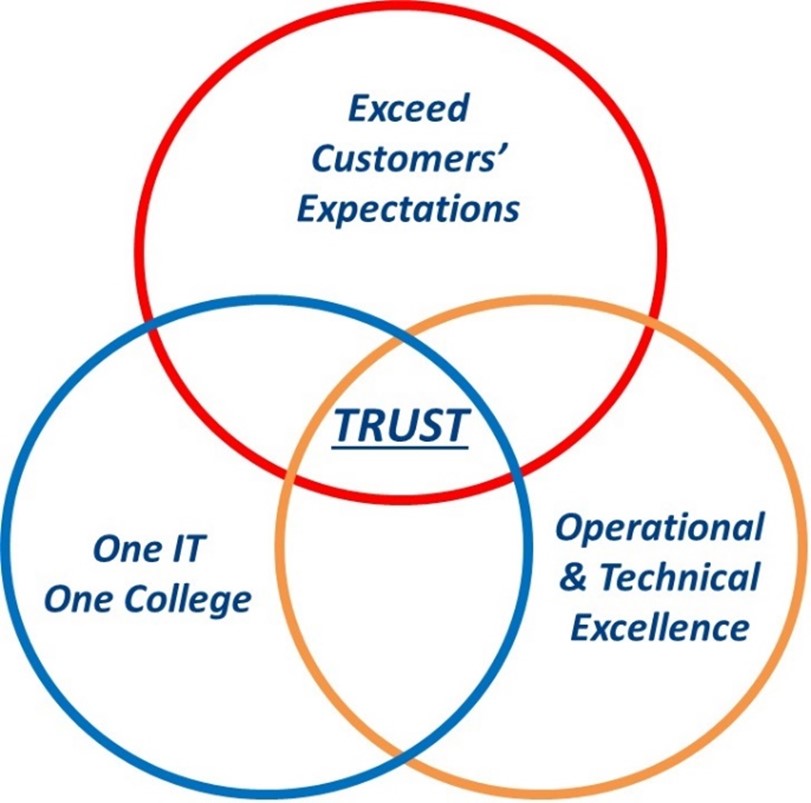
By focusing on three guiding objectives—exceeding customers' expectations, achieving operational and technical excellence, and fostering a unified IT culture—OneIT has strengthened its ability to deliver impactful, responsive services and build trust among institutional stakeholders. This approach exemplifies how strategic IT engagement can elevate institutional outcomes (see figure 1).
Figure 1. Guiding Objectives Venn Diagram
Exceeding Customers' Expectations
Although customer service includes many core competencies, timely communication and results are often what separates poor or average IT customer service from best-in-class customer service. Improving customer service is a key component of building trust.
Going into this transformation initiative, each IT department at TCC had different priorities. Leaders within OneIT developed a long, but not exhaustive, list of opportunities for improvement. We then prioritized the following focus areas based on our specific circumstances and the impact each would have on improving IT performance and stakeholder trust.
- First response: We defined the service-level objective for first response as one business day or less, with the goal being much less. Alerts were configured to notify supervisors when 80 percent of the maximum allotted response time had elapsed. Timely response became a focus at all levels of the IT organization. The result of these efforts has been a 90 percent sustained decrease in average response time. Feedback across TCC has been overwhelmingly positive.
- Next contact date: Setting expectations, following up, and following through are essential to building trust between college stakeholders and the IT department. To support these goals, OneIT added a "next contact date" field to the IT service management tool. We communicated this addition through IT leadership meetings and town hall meetings. Initially, it took time for staff to understand that the purpose of this change was to exceed customers' expectations and strengthen trust. Once that understanding was in place, staff began using the field more effectively to enhance communication and improve the overall customer experience.
- Outage communication plan: OneIT recently completed a comprehensive plan to improve communication about outages and service degradations. These process changes have resulted in significant improvements in the timeliness, consistency, and clarity of our messages. Customer feedback has been very positive.
Our streamlined communication practices have also substantially increased stakeholder trust in the IT organization. Following a "OneIT Roadshow" presentation to the TCC cabinet in November 2024, Dan Lufkin, TCC South Campus president, said, "Over the past eighteen months, there has been a night and day difference in the customer service, engagement, and responsiveness of IT at the South Campus. We used to discuss concerns about IT in virtually every leadership meeting, but we don't need to do that anymore."
The enhanced customer service and growing trust among IT departments at TCC have sparked a significant shift in collaboration and partnership across the organization. This transformation has led to greater efficiency and better outcomes for our customers.
OneIT will continue to collaboratively identify, deploy, and support appropriate technology and services to better facilitate student success, enhance the student experience, and improve operational efficiency and effectiveness at TCC. Each improvement moves us one step further on our journey of elevating the IT organization.
Operational and Technical Excellence—Demand Management
While operational and technical excellence is a broad category, our specific circumstances warranted an initial focus on demand management operational initiatives, which we believe will improve technical excellence over time. Like most IT organizations, workload and changing priorities made it difficult to focus and complete projects in a timely manner. Juggling tasks is no substitute for completing projects on time and on budget.
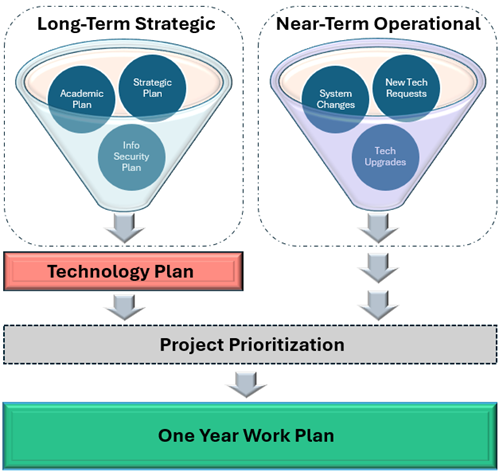
Demand management (DM) is the practice of aligning the current project workload with available resources. Based on my experience, projects utilizing effective DM are significantly more likely to succeed. Figure 2 illustrates the components of long-term strategic and near-term operational plans for managing demand at TCC.
Figure 2. Demand Management at TCC
The OneIT DM ecosystem now includes the following elements:
- Project prioritization and governance: Projects are scored on impact, urgency, and feasibility; the maximum score is one hundred. This score serves as the initial prioritization mechanism. Project priorities are then reviewed and possibly adjusted by the IT Steering Committee. Capacity is represented visually as lanes on a freeway. Motorcycles, cars, trucks, and buses represent small, medium, large, and very large projects. Vehicles entering from on-ramps represent projects in the queue. If all lanes are full, the committee can remove one vehicle (project) to make room for another. Committee members like this visual approach.
- New technology request process: Our new technology request process provides a structured approach for the purchase, implementation, and integration of technology that TCC does not currently own, confirming cabinet-level buy-in and ensuring alignment with the institutional mission. The process confirms budget availability and includes a security review, which incorporates difficulty and feasibility assessments.
- IT systems review: An IT systems review process was developed as a holistic approach to managing and prioritizing functional modification and enhancement requests associated with the enterprise resource planning (ERP) and related systems that TCC owns. Requests to address core business needs, state reporting, or compliance requirements are reviewed with ERP functional and technical experts.
This process ensures that everyone involved understands the heartbeat, health, and gaps associated with the ERP system. Requests are scored, and the total scores, along with resource availability, guide the order in which requests are addressed. Before this initiative, tickets often would fall into a black hole without the necessary evaluation or customer engagement. Tara Firmin, TCC director of strategic support, expressed her appreciation for the improved systems review process and commended OneIT for implementing the change:
I want to extend kudos to the IT team for increased communication and general effectiveness. I appreciate the weekly status updates for the myriad tickets I submit and for the more engaged conversations (like on the Student Ready Report) to take time to understand the information needed to successfully support students. Keep up the fantastic work! Y'all are making our lives easier!Footnote2
As a next step in our transformational journey, the framework developed during the systems review is now being adopted in other IT areas. This additional effort further ensures that requests are processed, prioritized, and managed in alignment with institutional priorities. Two critical actions taken involved the development of the following:
- Technology plan and IT work plan: The technology plan addresses long-term strategic needs and is informed by the TCC strategic plan, academic plan, and information security plan. Projects are then prioritized, along with near-term operational needs, in the one-year work plan. Near-term operational needs include new technology requests, projects referenced in the IT systems review, and similar IT reviews mentioned above.
- IT Steering Committee: The IT Steering Committee consists of TCC senior leaders. Although the responsibilities of the committee extend beyond DM, it plays a key role in ensuring that IT projects, initiatives, and resources align with institutional priorities. The committee also serves as a communication and collaboration touchpoint between OneIT and TCC leadership for relevant strategic and operational discussions.
OneIT—One College
Maintaining a unified approach across OneIT and the College enhances collaboration and improves our ability to advance the mission of the institution. IT town halls and leadership meetings provide an excellent forum for relationship building. These meetings are akin to retreats and serve as think tanks for how to achieve our objectives. For example, during a breakout session at a 2023 IT leadership meeting that focused specifically on exceeding customers' expectations, participants identified the following priorities and tactics:
- Bring together the right people and resources and strengthen internal IT relationships.
- Create a OneIT portal that includes metrics, kudos, and a functional organizational chart.
- Hold both structured and unstructured mixers after town hall meetings to get to know each other better.
- Improve communication.
- Develop a certified communicator series and guidelines for improving the support experience.
- Don't let go! Follow through.
- Develop dashboards that enable OneIT staff to better understand the status of issues and how to follow up and follow through.
OneIT has implemented all of the tactics identified during the 2023 meeting, and the feedback has been positive. Unsurprisingly, our ability to work together as one was key to improving our customer service. We built a culture of "we" across OneIT and leveraged that culture to include TCC constituents. Partnerships—both internally within IT and across the College—have created a positive energy, which, at times, has been palpable.
Trust
Elevating the IT organization begins and ends with trust. In OneIT, trust serves as the barometer of our efforts and the lens through which we measure our success or failure. Key components of trust include communication, collaboration, responsiveness, exceptional customer service, and results. As we continue to deliver quality technical services and solutions when we say we will, trust will increase.
The benefits of increasing trust in the IT organization include, but are not limited to, the following:
- Adherence to processes and standards: Customers are more likely to follow the standard processes for requesting assistance if they know they will receive a timely response.
- Support of IT initiatives: To be truly successful and advance the College mission, the appropriate leaders and other key personnel must be committed to the project. The investment of time, rigor, and thoughtful discussion in various initiatives, including the ERP replacement initiative, has been exceptional.
- Focus on demand management: Leveraging DM best practices was critical to our success. Without the increased trust in the IT organization, this level of success likely would not have been achieved.
- Investment in technology: Technology that is beyond its useful life and is no longer supported can result in outages and cybersecurity breaches. A fiscally responsible approach that is aligned with institutional needs ensures that technology is an enabler of the TCC mission. For example, our Wi-Fi technology upgrade initiative has resulted in a 133 percent increase in the number of Wi-Fi access points. The additional access points significantly boosted Wi-Fi coverage and simultaneously decreased complaints about Wi-Fi across the College.
Key Transformation Elements
The processes and initiatives implemented in OneIT, which are aimed at improving communication, collaboration, customer service, results, and trust, have been instrumental in elevating information technology at TCC. But to turn vision, mission, and goals into reality, the following additional elements were woven into the culture of the IT organization:
- Stakeholder engagement: OneIT prioritizes engaging with customers and stakeholders to understand their unique needs. All too often, IT departments are considered the department of "no," whereas we have aimed to become recognized as the department of "know." This has included understanding the technology and its risks as well as the needs of the institution and the impact of not meeting those needs. This increased understanding has led to successful collaborative initiatives that have moved the needle on student success and employee engagement.
- Collaboration: Technology must be a driver of innovation, transformation, and differentiation in advancing the mission of an institution, but technology alone is not the answer. It must be the right technology. For change to truly be transformational, it must align with and advance the mission of the institution. Achieving this alignment requires collaboration grounded in open communication and trust. This principle has remained a cornerstone of effective transformation throughout my career. The following excerpt from an article I wrote on collaboration illustrates this enduring truth:
- IT staff engagement: Town halls and leadership meetings provide opportunities to reinforce the guiding objectives and associated goals of the IT organization and communicate the progress being made. At TCC, these meetings have evolved from one-way information broadcasts to hybrid gatherings that include breakout sessions where staff can participate in initiatives aimed at elevating the IT organization. Session presenters are not limited to IT senior leadership. The chancellor, the CFO, and a campus president have been guest speakers. IT staff appreciate the messages, which further clarify the goals of the College and the value OneIT provides.
- Strengthen leadership and management skills: Achieving transformation requires trust. Elevating the perception of the IT organization occurs one project, one trouble ticket, and one interaction at a time, and requires improved performance and focus from individual staff members across the IT organization. The IT leadership team plays a key role in coaching, mentoring, setting expectations, and following up on assignments. To support these goals, we've invested significantly in creating interactive, engaging leadership meetings on topics such as leadership, delegation, and accountability. These conversations have delivered tangible value to participants.
The ideal end game, which I have witnessed firsthand with multiple constituent groups at Johnson (Cornell University), is one in which a culture of collaboration, coupled with a relentless focus on challenging the status quo, results in our encouraging, pushing, and helping each other innovate, transform, and differentiate.Footnote3
Conclusion
The IT guiding objectives and other goals outlined in this article were intentionally developed to create a foundation of communication, collaboration, results, and trust. Expectations, successes, and opportunities are consistently discussed during one-on-one and team meetings, IT town halls, and leadership meetings.
While a symphony of efforts contributed to the many "night and day transformation" accolades, the significant positive change in responsiveness is the lever that truly began to elevate the IT organization. The buy-in, performance, and contributions of the staff have been crucial to our success. OneIT has leveraged transformational initiatives to deliver impressive results.
Senior leadership at TCC have also been supportive of OneIT's transformation journey. The formation of the IT Steering Committee, support for the new technology request process, and engagement in IT initiatives are just a few examples of how that support manifested itself. TCC Chancellor Elva LeBlanc said, "This is a phenomenal accomplishment from OneIT. We're talking a much-needed culture change. Collaboration, communication, trust—all are greater with IT as the connector."Footnote4
The positive feedback has reinforced the impact of the efforts by the OneIT staff. The journey to innovative and transformational IT services runs along the streets of timely communication, over the bridge of trust, and through the community of collaboration. Although much has been accomplished, there is still important work ahead as we continue partnering with stakeholders to advance student success and further the mission of Tarrant County College.
Notes
- Shelley Pearson, remarks, Tarrant County College IT Steering Committee Meeting, June 10, 2024.Jump back to footnote 1 in the text.
- Tara Firmin, email message to Vicki Hutto, September 19, 2024.Jump back to footnote 2 in the text.
- Todd Kreuger, "Building Productive and Collaborative Relationships at the Speed of Trust," EDUCAUSE Review, March 2, 2015.Jump back to footnote 3 in the text.
- Elva LeBlanc email message to Todd Kreuger and others, January 17, 2025. Jump back to footnote 4 in the text.
Todd Kreuger is Chief Information Officer at Tarrant County College.
© 2025 Todd Kreuger. The content of this work is licensed under a Creative Commons BY-NC 4.0 International License.