
Prompting careful dialogue through incisive questions can help chart a course through the ongoing storm of artificial intelligence.

More than two years after its release, ChatGPT continues to evolve. The now-ubiquitous large language model—a generative artificial intelligence (GenAI) tool that creates human-like output in seconds in response to user prompts—has caused many to question whether and how it might revolutionize education. Given ChatGPT's unprecedented abilities, it's hard to know what to make of the tool. Is it an essay mill? A thought partner? A new digital species? Or, as some say, humanity's last act?Footnote1 In spite of a veritable explosion of research into AI, educators' understanding of how to effectively approach this tool remains at a developmental stage. Deeply probing, thoughtful conversations, facilitated by a common frame of reference, are needed to advance understanding of how to effectively develop ethical educational applications of a technology poised to have significant impacts not only on fundamental activities of learning but also on basic dimensions of human well-being.
AI in Education: A Multidimensional Framework
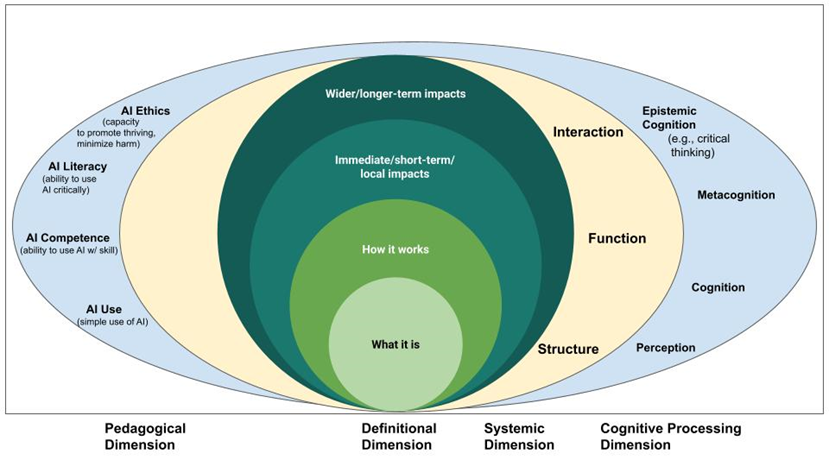
Taking advantage of GenAI's potential while recognizing and avoiding its hazards calls for a framework that educational developers, faculty, and administrators can use as they approach integrating GenAI into higher education. The framework described here identifies four dimensions of interest through which educators might view GenAI: definitional, systemic, cognitive processing, and pedagogical (see figure 1).
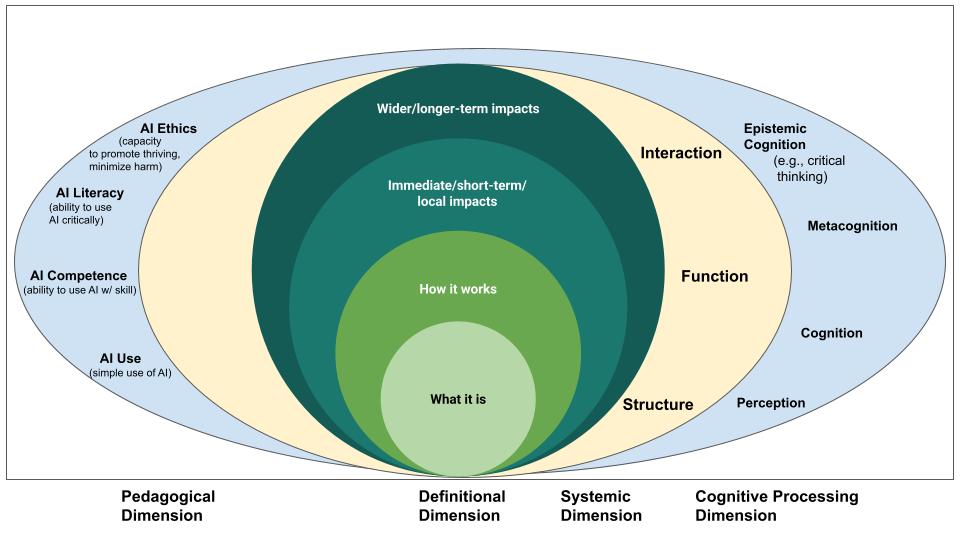
The definitional dimension gives us an understanding of AI itself—what it is, how it functions, and its short- and long-term effects on learning and beyond. The systemic dimension acknowledges various meta-levels—structural, functional, and interactional—at which AI operates and maps onto the levels of analysis in the definitional dimension. The cognitive processing dimension traces a pathway for humans' developing understanding of GenAI, from perception through a series of cognitive categories that give rise to critical thinking. Finally, the pedagogical dimension outlines a range of developmental levels at which pedagogical interventions can be implemented, ranging from a focus on the use of AI to the ethics around it. These four dimensions can inform educators' approaches to GenAI by creating a frame of reference for educators to think and teach both critically and holistically about its use in education.
Definitional Dimension
What it is. At the center of the framework is a descriptive, multilevel core that centers on GenAI itself (see figure 2). The smallest circle ("what it is") represents a basic understanding of AI—its technical definition and the varieties and types of GenAI that can be used in education.
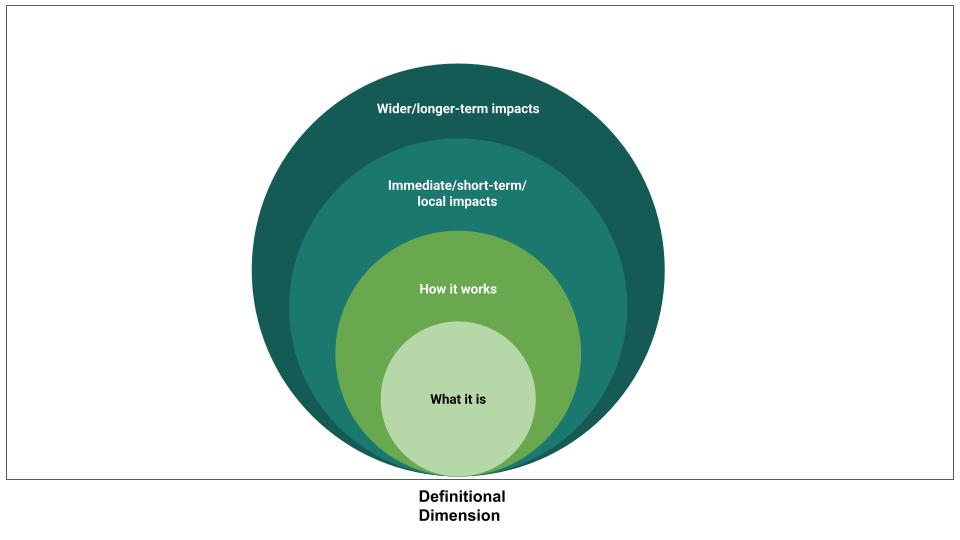
How it works. The next step is understanding how AI works in an educational setting. This includes investigations into effective user prompts and may also concern the types and accuracy of the output, as well as fidelity of the output to academic tasks that instructors assign. This level of analysis focuses on instructor strategies for leveraging AI for use in classes and course planning. Conversations at this level often focus on such questions as "What can I do with AI in my class?" and "How can I take advantage of AI in my teaching?"
Immediate/short-term/local impacts. The next level concerns immediate, short-term, or local impacts on learning and instruction in a given course. These range from impacts on academic integrity (e.g., plagiarism) to AI's propensity to provide inaccurate information ("hallucinations"), as well as its tendency to produce stereotypical, racist, and/or sexist output, raising concerns about possible negative impacts on students. These concerns can also move toward more serious, longer-term impacts, as we consider the longitudinal effects of such content on students' self-image, sense of efficacy, academic performance, and even cognition.
Wider/longer-term impacts. Longer-term impacts cover a wide variety of concerns, such as the extent to which AI preparation is necessary for students' success in the workforce. Could students rely too heavily on AI and fail to learn the knowledge and skills that they enter higher education to learn? How can instructors avoid creating conditions that prompt students to offload to GenAI cognitive tasks that play a central role in their intellectual development? What will be the impact of using GenAI on human cognition in coming decades? Impacts magnify as we consider other domains: social structures such as families and communities, economic structures such as domestic and international commerce, and political and governmental structures ranging from city governments to the nation state.
Systemic Dimension
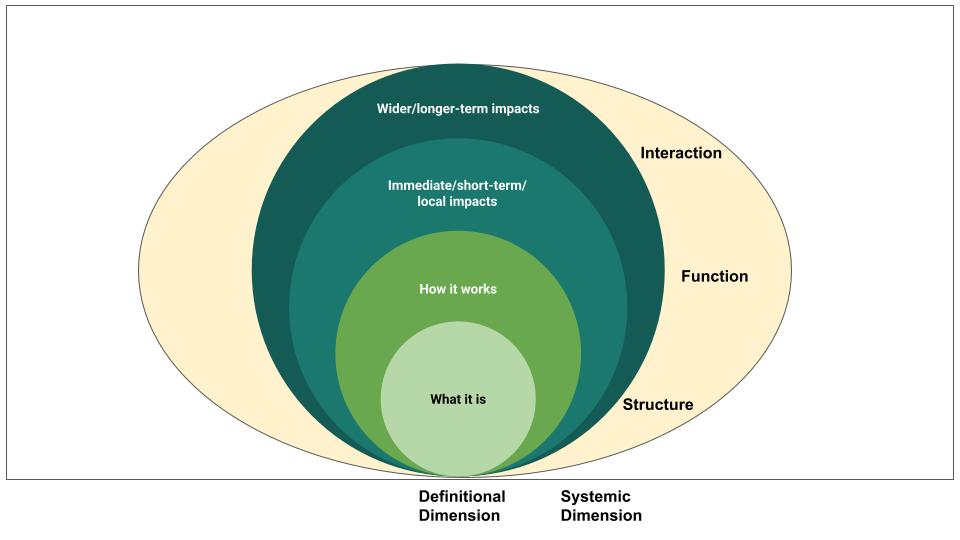
Viewed from a systems perspective, several abstract levels of analysis become clear. Considering AI's structures, functions, and interactions (constructs employed in disciplines such as linguistics, biology and chemistry) is instructive (see figure 3). Thus, concerns with what GenAI is (definitional), systemically speaking, are lodged at the level of structure. Moving up a level in the definitional core, questions about how GenAI works in the systemic dimension relate to an interest in the functions of GenAI. Beyond structure and function is interaction—GenAI as part of a larger, more complex ecology and, in particular, its interactions among other elements. At the systemic level of interaction, the immediate and longer-term impacts of GenAI in the definitional domain become salient. Analyzing GenAI at the level of interaction necessarily involves other entities—individuals, groups, populations, and institutions—and their interactions with GenAI, as well as their mutual interactions in a dynamic and complex system of relationships. Concerns about plagiarism that occurs in a classroom, for example, touch upon interactions between students, instructors, and institutions; likewise, concerns about harmful stereotypes in GenAI output involve interactions between students, marginalized groups, and institutions. Concerns about deficits in learning or negative cognitive effects arise when we think of the interactions between GenAI and individual students, the workplace, the economy, and humanity as a whole.
Cognitive Processing Dimension
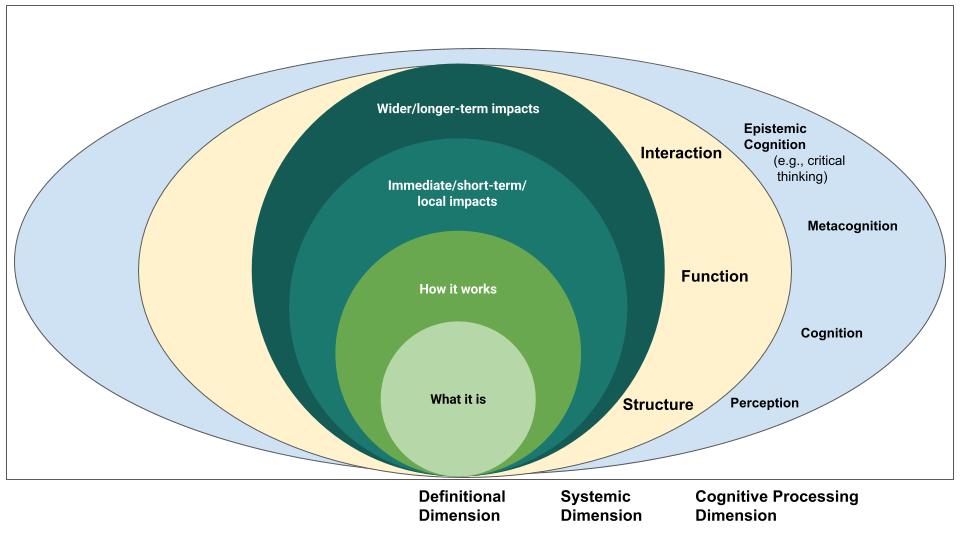
The cognitive processing dimension shifts the focus away from the tool to look at human thinking about GenAI. In this dimension, four relevant constructs emerge, each mapping onto the levels discussed in the definitional and systemic dimensions. In articulating this dimension, I rely on the cognitive processing model developed by psychologist Karen Strohm Kitchner, who viewed cognition (including perception), metacognition, and epistemic cognition as key in explaining the "complex monitoring in which [individuals] engage when they are faced with ill-structured problems."Footnote2
A productive way of understanding this dimension is to look at it across the definitional and systemic dimensions (see figure 4). When thinking about what GenAI is (definitional), we are focusing on its structure (systemic). At this stage, perception (cognitive processing) plays a major role. Moving on to how GenAI works—that is, focusing on its functions—introduces complexities that arguably require greater levels of cognition. As we move into the wider impacts of the definitional dimension, mapped to the interaction level, perception and cognition remain engaged; however, higher order modes of thinking such as metacognition—simply defined as "thinking about one's thinking"—and epistemic cognition, related to critical thinking, come into play. Analyzing GenAI in this way makes explicit the varying cognitive lenses through which one can perceive AI, lenses that students themselves need to understand when they learn about and use AI.
It's worthwhile to focus here on epistemic cognition, the cognitive prerequisite for critical thinking. In their 2016 article "Educating Critical Thinkers: The Role of Epistemic Cognition," Jeffrey Greene and Seung Yu define epistemic cognition as "a process involving dispositions, beliefs, and skills regarding how individuals determine what they actually know, versus what they believe, doubt, or distrust"Footnote3—the foundation of critical thinking. When considering a complex system like GenAI, the role of epistemic cognition (particularly, critical thinking) takes on significance. In an article published in Science in May 2024, Yoshua Bengio and a cadre of distinguished AI experts note:Footnote4
If managed carefully and distributed fairly, AI could help humanity cure diseases, elevate living standards, and protect ecosystems. […] But alongside advanced AI capabilities come large-scale risks that we are not on track to handle well.
This highlights the need to move beyond perception and cognition around AI, to a point where we consistently examine our own thinking about AI (metacognition) and critically evaluate our own and society's use of AI (epistemic cognition). In the shorter term, relevant and emerging questions include the following:
- How does using AI enhance or undermine my (or students') ability to understand material?
- How does using AI impact my (or students') ability to think critically about a topic?
- How does interacting with AI affect my (or students') ability to solve problems?
Further questions can be posed with regard to a larger population or longer-term impacts: How will society change as sectors adopt AI at scale? How can negative effects be mitigated? Answering these questions requires metacognition and epistemic cognition—critical thinking—about AI, a skill instructors need to engage students in. This task is mediated by the pedagogical dimension.
Pedagogical Dimension
The pedagogical dimension focuses on levels of proficiency of AI use, ranging from naïve use, with little to no instruction in critical uses of the tool, to ethical use built on a foundation of AI literacy and competence (see figure 5). This dimension differentiates levels of skill in using AI to help identify needs that can be addressed by instruction. Understanding the pedagogical dimension of the current framework begins with a focus on AI literacy. Other scholars have bound AI use, critical thinking, and competence together in one construct: AI literacy.Footnote5 However, differentiating these concepts by clearly distinguishing several levels of AI proficiency—naïve AI use, AI competence, AI literacy and AI ethics—can ensure that instruction appropriately addresses student needs.
AI Use. AI use refers to naïve use of GenAI. This might involve exploring GenAI to better understand how to use it; it could also refer to students' using GenAI to complete assignments, with no instruction in how to do so. Naïve use often causes students to encounter difficulties with academic integrity, such as when a student prompts ChatGPT to write an assignment and simply pastes the AI-generated output into a document, submitting it for a grade. Characterized by a lack of instructor input into the use of GenAI, this level of use is uninformed by complex constructs clustering around higher levels of ethical use. Not surprisingly, naïve use often results in weak output, as many instructors have found when faced with a student's AI-generated assignment.
AI Competence. AI competence can be understood as unconstrained skilled use, with little attention to contextual cues that shape its expression. AI competence is characterized by the ability to use AI skillfully in a way that is relatively unconstrained by rules or social norms, including those of accuracy. This is akin to the ability to drive a motor vehicle to get it from point A to point B without knowledge of the traffic laws and regulations that typically govern driving. A classroom example: a student skillfully uses AI to complete an assignment, without taking into account the guidelines an instructor has established to ensure that the AI use is appropriate to the course's purpose, learning goals, and context. In such cases, AI competence by itself is not a sufficient prerequisite for AI use in higher education. The level invoking guidelines constraining GenAI use is that of AI literacy.
AI Literacy. As mentioned earlier, the term AI literacy has been used in the literature to subsume several AI use levels. However, to arrive at an operationalizable notion of AI literacy, it is helpful to constrain our definition. In this framework, AI literacy refers to the ability to use AI appropriately, according to norms that govern AI use, but not necessarily ethically: norms can be either ethical or unethical, leading to vastly different outcomes. To return to the driving metaphor, AI literacy is equivalent to driving a vehicle in observance of laws and regulations. For example, at a level of AI competence, one might understand how to create a prompt (get a car into drive) and successively refine those prompts to get the output one desires (induce the car to move from one place to another). However, it would take a higher level of AI understanding (AI literacy) to drive the car safely—that is, to have a more nuanced understanding of when it is appropriate to use AI to complete an assignment or learn a concept.
A second aspect of GenAI literacy in this framework involves thinking critically about GenAI output. GenAI's propensity for "hallucinating" in its output highlights the need for GenAI literacy. Because accuracy is fundamental to teaching and learning, critically evaluating GenAI output is a crucial aspect of GenAI literacy. However, focusing on teaching students to critique output is not enough. It must be supplemented by a third—and arguably the most important—aspect of AI literacy: thinking critically about GenAI use—that is, teaching students to know when to employ GenAI to enhance the process of learning and not to supplant it. This requires students to determine when they should use GenAI to boost learning and to determine how to use Gen AI in ways we have not yet discovered, to innovate around and enhance human learning.
AI Ethics. AI ethics is using AI to promote thriving and minimize harm and is the most challenging aspect of AI due to its reach across virtually all dimensions of human activity. To begin, it is important to acknowledge the many remarkable advances that GenAI offers in nearly every sector of society—academia, medicine, agriculture, manufacturing … the list goes on. GenAI vastly improves access to information and activity for people with disabilities. It can increase productivity in ways that we are still discovering, yet these benefits do not come without risks. In their May 2024 article in Science, Bengio and colleagues note that "[w]e cannot consider coming powerful frontier AI systems 'safe unless proven unsafe'." Likewise, we may not want to prematurely adopt the stance that using AI in education is ethical unless proven unethical. Indeed, a 2021 Pew Research Study indicated that 68% of AI experts doubted that most AI systems would focus on the public good by 2030, citing profit motive and social control as powerful incentives for rapid development.Footnote6
Current discussions of AI ethics often revolve around short-term impacts, involving concerns over relatively local academic matters such as plagiarism. However, larger and much weightier questions are also relevant. Questions that educators will need to come to terms with in the coming years include:
- What are the ethics of encouraging widespread adoption of GenAI in education, given the current known weaknesses (racial bias, inaccuracy, "hallucinating") of AI and how little we know empirically about its impact on humans both cognitively and emotionally?
- To what extent should we privilege conversations about AI safety and ethics over AI use with students? Is it possible for discussions of ethics to be lost in the excitement of a revolutionizing technology?
- How should we address other problems that AI entails, including unequal access to AI systems that increasingly require users to pay for use?
To answer these weightier questions, many other questions need to be asked and answered along the way:
- What are the impacts on students of the bias and racism that many AI systems are reported to exhibit?
- What are the long-term cognitive consequences on students when instruction focuses narrowly on developing AI competence, rather than on developing AI literacy and AI ethics?
- What critical thinking skills can AI help students develop? What critical thinking skills might it prevent students from developing?
- How can we enhance positive cognitive consequences and mitigate negative cognitive consequences of GenAI on human learning to avoid creating inequities?
Many of these questions have as precursors other questions from outside education. For example, how do we address the ethical implications of the fact that ChatGPT creator OpenAI trained its LLMs using internet data "cleaned" by people in Kenya paid less than $2 per hour?Footnote7 Open conversations around such questions are needed if higher education is to adequately address the impacts of GenAI not only on teaching but also on scholarship and research. A model such as this provides a common frame of reference in which these conversations can take place.
These questions offer just a glimpse of the work ahead if higher education is to shape GenAI as a tool that respects human agency. Increasing society's chances of deploying GenAI in a responsible manner will require a concentrated effort from educators and education researchers, in addition to the efforts of professionals, researchers, and practitioners in disciplines and sectors outside education. In registering the levels of analysis a question focuses on across all four dimensions, educators can be explicit in the AI-related questions we ask, as well as in the AI-assisted tasks we design to assess student learning. Such intentionality is key to developing an ethical approach to GenA use in ways that promote human flourishing.
Conclusion
The immense power of AI creates a tension between the all-too-human desire to capitalize on AI to improve the human experience and the need to consider AI's potential for creating harms ranging from the loss of jobs to weakening interpersonal human relationships and existential concerns.Footnote8 The goal of this framework is to help faculty, educational developers, instructional designers, administrators, and others in higher education engage in productive discussions about the use of GenAI in teaching and learning. As others have noted, theoretical frameworks will need to be accompanied by research and teaching practice, each reinforcing and reshaping the others to create understandings that will inform the development of approaches to GenAI that are both ethical and maximally beneficial, while mitigating potential harms to those who engage with it.
Notes
- Cal Alumni Association, "California Live! presents 'Will AI Be Humanity's Last Act?'," April 15, 2024. Jump back to footnote 1 in the text.
- Karen Strohm Kitchner, "Cognition, Metacognition, and Epistemic Cognition," Human Development 26, no 4 (1983): 222–32. Jump back to footnote 2 in the text.
- Jeffrey A. Greene and Seung B. Yu, "Educating Critical Thinkers: The Role of Epistemic Cognition," Policy Insights from the Behavioral and Brain Sciences 3, no. 1 (2016): 45–53. Jump back to footnote 3 in the text.
- Yoshua Bengio, Geoffrey Hinton, Andrew Yao, Dawn Song, et al., "Managing Extreme AI Risks amid Rapid Progress," Science 384, no. 6698 (2024): 842–45. Jump back to footnote 4 in the text.
- Matthias Carl Laupichler, Alexandra Aster, Jana Schirch, and Tobias Raupach, "Artificial Intelligence Literacy in Higher and Adult Education: A Scoping Literature Review," Computers and Education: Artificial Intelligence 3 (September 1, 2022); Davy Tsz Kit Ng, Jac Ka Lok Leung, Samuel Kai Wah Chu, and Maggie Shen Qiao, "Conceptualizing AI Literacy: An Exploratory Review," Computers and Education: Artificial Intelligence 2, no. 1 (2021). Jump back to footnote 5 in the text.
- Lee Rainie, Janna Anderson, and Emily A. Vogels, "Experts Doubt Ethical AI Design Will Be Broadly Adopted as the Norm Within the Next Decade," Pew Research Center: Internet, Science & Tech, June 16, 2021. Jump back to footnote 6 in the text.
- Billy Perrigo, "Exclusive: OpenAI Used Kenyan Workers on Less than $2 per Hour to Make ChatGPT Less Toxic," Time, January 18, 2023. Jump back to footnote 7 in the text.
- Rakesh Kochhar, "Which U.S. Workers Are More Exposed to AI on Their Jobs?" Pew Research Center, Social & Demographic Trends Project, July 26, 2023; Anne Zimmerman, Joel Janhonen, and Emily Beer, "Human/AI Relationships: Challenges, Downsides, and Impacts on Human/Human Relationships," AI and Ethics 4 (2024): 1555–67; Benjamin S. Bucknall and Shiri Dori-Hacohen, "Current and Near-Term AI as a Potential Existential Risk Factor," in Proceedings of the 2022 AAAI/ACM Conference on AI, Ethics, and Society, 119–29. Jump back to footnote 8 in the text.
Patricia Turner is an Education Specialist in the Center for Educational Effectiveness at the University of California, Davis.
© 2025 Patricia Turner. The content of this work is licensed under a Creative Commons BY-NC-ND 4.0 International License.