
Fragmented digital tools create a costly "experience gap" for students and staff across higher education institutions. Bridge the divide with four strategic moves to build a unified, artificial intelligence–ready, student-first campus.
Higher education leaders often discuss "systems." They analyze student information system (SIS) migrations, audit learning management system (LMS) adoption, and secure customer relationship management (CRM) platforms. But for Maya—a first-generation, second-year college student balancing a part-time job and a heavy credit load—the institution exists primarily on the digital screen in her hand, even as she navigates the physical campus. For Maya and her peers, digital and physical experiences intertwine inextricably. A failure in one signals failure of the whole.
When that screen forces her through forty disconnected portals, each demanding a separate login and unique navigation logic, the institution fails its brand promise. Maya does not see a sophisticated IT infrastructure; she sees a digital obstacle course. She misses a financial aid deadline because the notification lies buried in a portal she hasn't checked in weeks. She feels the mounting frustration of being "just a user" in a system designed for administrative convenience rather than student success.
It tells her: "Figure it out yourself."
At Pathify, we focus our energy on helping higher education bridge this divide—what we call the experience gap. We now inhabit a world where the most popular applications offer seamless, personalized experiences that make finding information effortless. From banking to social media, these apps forge new expectations every day, particularly among young people. Whether consciously or unconsciously, students compare every digital interaction to these gold-standard consumer experiences.
The undeniable gap between popular everyday apps and the fragmented tools used in higher education grows with each passing year. This widening gap has become a strategic threat to enrollment and retention. When digital friction peaks, students move beyond mere frustration—they disengage, stop out, or transfer to institutions that value their time.
To bridge this gap, colleges and universities must pivot from managing legacy portals to designing experiences that respect students' time and fuel their potential.
Understanding the Human Toll of Fragmentation
For a CIO or provost, fragmentation costs money and leads to support tickets. For students, it affects momentum. Consider a prospective student's journey. After the excitement of acceptance, they often encounter a cold, utilitarian checklist scattered across three platforms. They hunt for roommates on a legacy message board, decode financial aid packages in a cryptic SIS portal, and chase orientation sign-ups through an antiquated web form.
As these tasks are siloed, the cognitive load builds. Every time a student has to remember a new URL or hunt for a how-to guide to perform a basic administrative task, they lose a bit of the excitement that brought them to campus. Over time, this friction erodes their sense of belonging.
An experience-first institution reimagines the journey. Before their first day, the student enters a single, branded hub. They don't merely encounter a checklist—they discover a community. They join a pre-med 2030 group, explore dorm layouts, and find a hiking club before they even step on campus. They transcend the role of "user" and embrace the identity of "member."
This shift moves the institution away from being a service provider and toward being a supportive partner. When the digital surface is unified, the institutional brand is transformed from a static brochure into a living, daily experience, replacing the question, "Where do I go?" with the answer, "Here is your path."
Reclaiming the Mission
Fragmentation also shackles staff. Advisors and IT specialists frequently drown in manual administrative follow-ups. Imagine an academic advisor who spends 60 percent of the day answering the same three questions: "Where do I find my schedule?" "How do I clear my hold?" and "Where is the link to my bill?"
When critical communication hides in overcrowded inboxes, engagement dies. Staff waste hours resolving basic navigational queries about tax forms or lab registrations—tasks a computer should handle. Fragmented systems cost the institution more than just payroll—they cost human potential. Advisors chose higher education as a profession to mentor students, not to function as human search engines.
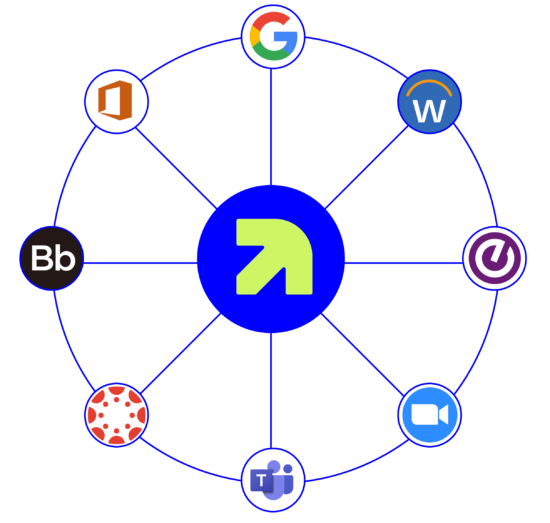
By consolidating these interactions into the Campus Experience Platform (CXP),alerts can be migrated from the cluttered inbox to personalized, actionable tasks. This shift offers staff what they need most: the gift of time. When a student receives a mobile notification stating they have one task remaining to secure their financial aid, and that link leads directly to the solution, engagement converts to completion.
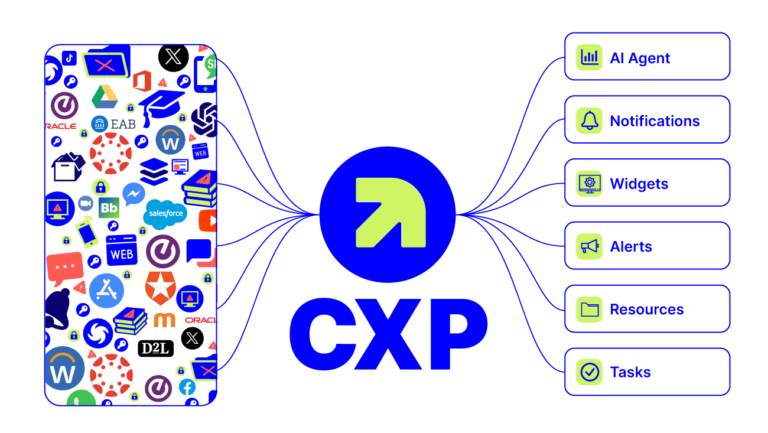
This transformation liberates staff from the grind of digital crisis management. It empowers them to stop acting as navigational guides for lost students and return to high-impact mentorship and student support. However, reclaiming human capacity is only one part of the puzzle. To truly close the experience gap, the digital infrastructure must evolve to meet the needs of a new generation of students—artificial intelligence (AI) natives who view personalized, intelligent support not as a luxury, but as a non-negotiable standard.
Meeting the AI Prerequisite
As consumer-grade AI expectations flood campuses, institutions face an uncomfortable reality: a predictive AI agent cannot navigate fifty disconnected links. For AI to revolutionize campus life, it requires a unified environment. It must "see" the holistic student journey—academic progress, community engagement, and administrative hurdles—to move beyond simple answering and toward actual doing.
As the industry pivots toward agentic AI, the key to success lies in data access. On a campus defined by a fractured landscape of siloed portals, an AI agent remains effectively blind.
To provide a consumer-grade experience, leaders must acknowledge that today's students live as AI natives. These students expect their digital world to behave intuitively. When data stays siloed, and interfaces remain fractured, AI tools function as mere gimmicks—chatbots that answer questions but lack the context to execute tasks. Think of a unified digital experience as the landing strip for agentic AI.
By integrating the digital surface into a data layer today, leaders construct the infrastructure that enables the proactive, task-executing campus to thrive.
Implementing the Shift
Becoming an experience-first institution demands a strategic shift in mindset grounded in the success of pioneering institutions. This journey follows four distinct steps:
1. Eradicate the cognitive tax.
Institutions must map the student journey to expose friction points where administrative hurdles kill momentum. This involves looking beyond the functionality of a tool and understanding the effort required to use it. The Ventura County Community College District (VCCCD) recognized that its legacy systems blocked the path for 30,000 students. VCCCD didn't just need a new portal—it needed a way to remove the barriers facing hybrid and adult learners. By streamlining digital access and removing these hurdles, VCCCD cleared the way for students who demand a frictionless path to persist.
2. Consolidate the front end.
Rather than attempting to fix every legacy backend simultaneously—an expensive and often futile endeavor—savvy institutions integrate their SIS, LMS, and engagement tools into a single, mobile-first interface. This creates a digital "single pane of glass" that hides the complexity of the backend from the user. Seton Hill University bypassed the link farm by unifying its legacy portals into one cohesive experience. This move secured $60,000 in annual savings and reclaimed thousands of staff hours. The IT team stopped fixing portals and started innovating experiences that actually move the needle on student success.
3. Personalize the life cycle.
Leaders should reject the one-size-fits-all approach to digital experiences. A first-year student seeking a roommate has different needs than a third-year one seeking career placement or a graduate wanting to mentor a current student. Using role-based permissions ensures that an applicant finds a sense belonging, while a student embarking on their final year gains career-readiness. Chaffey College proved this by automating orientation and transfer milestones via digital communities. By meeting students on their phones within a curated space, Chaffey College shattered records for orientation completion. More importantly, the institution shifted staff focus from data entry to human connection, ensuring every student feels seen and supported from their first interaction.
4. Build the foundation for agentic AI.
Centralize engagement data to meet the baseline expectations of AI-native students. A unified digital experience does more than provide current support—it creates the necessary environment for future AI agents to find, know, and act on a student's behalf. This foundation identifies a student's struggle before it leads to withdrawal. If activity in a first-year experience hub drops in week three, the system identifies the trend, allowing advisors to intervene instantly. This paves the way for a truly predictive, consumer-grade campus that acts before a student even knows they need help.
Defining the Modern Campus
In 2026, the digital experience no longer functions as an "extra" provided by the IT organization. It serves as the primary lens through which students, staff, and faculty judge institutional relevance. While students choose campuses where they feel they belong, faculty and staff commit to environments that respect their time and empower their expertise.
When colleges and universities force their communities to struggle with antiquated tools, they signal that people's time isn't valuable. Conversely, when they provide a unified, intuitive environment, they signal that they are invested in the success of the communities they serve. Ultimately, every member of the community forges their connection to the institution within the digital spaces it provides.
Innovation doesn't stem from buying the loudest new tool—it flourishes by creating the most unified, human, and frictionless journey possible. Leaders who prioritize a unified digital experience today will do more than solve the retention challenges of the present—they will possess the infrastructure to lead the AI-ready campuses of tomorrow.
Thank You

© 2026 Pathify.