
Higher education institutions should stop asking which artificial intelligence (AI) tool to buy and instead develop an integrated "AI for operations" architecture to execute end‑to‑end institutional processes effectively.
The question many colleges and universities are asking about artificial intelligence (AI) is, "Which tool should we buy?" That is the wrong question.
A new category is arriving in higher education: AI for operations.
Unlike the chatbots, copilots, and analytics tools that dominate today's AI conversation, AI for operations does not help people work faster. It does the work itself. It runs the verification queue. It builds the schedule. It identifies at-risk students and intervenes before they withdraw.
The operational distinction changes everything.
This proactive approach cannot be solved with a purchase order. The real decision is how AI fits into the institutional operational architecture, and many colleges and universities are about to learn that lesson at great expense.
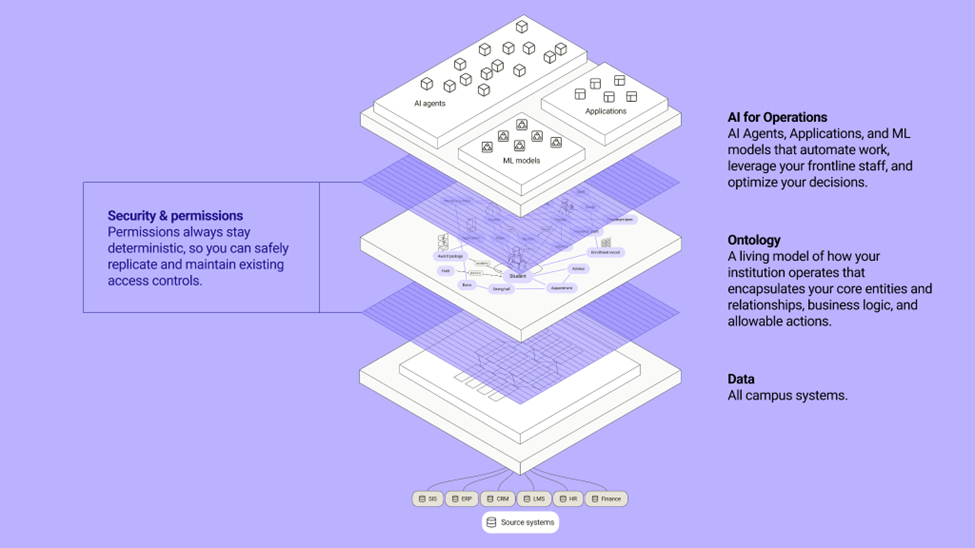
Buying a separate AI capability for each problem feels like progress, but it delivers almost none. No consequential campus process lives in a single silo. Operational AI has four requirements, and all four must hold at once: (1) unified data across disconnected systems, (2) a semantic operational model that captures how the institution runs, (3) multiple instruments built on that shared model, and (4) permissions enforced in the data layer rather than application code.
These constitute a single system, not a menu assembled from four vendors.
If CIOs get it right, the advantages compound. If they get it wrong, they will keep mistaking motion for movement.
The Gap Nobody Admits
When it comes to AI in higher education, two narratives tend to dominate: the breathless one about transformation and all the claims that come with it, and the anxious one about whether any of those claims are real. Both miss what actually changed.
In 2023, researchers introduced three benchmarks—MMMU, GPQA, and SWE-bench—to test the limits of advanced AI; a year later, scores rose by 18.8, 48.9, and 67.3 percentage points on all three, respectively.Footnote1 Adoption followed: 65 percent of organizations now report regularly using generative AI in at least one function, up from roughly a third the year before.Footnote2 The capability and demand are real.
Enterprises are spending enormously, but they don't notice an impact. AI spending across all sectors surged to $13.8 billion in 2024, more than six times that of the prior year, even as roughly four in ten decision-makers questioned whether current solutions fit their needs.Footnote3 Breakthrough capability, record spend, negligible operational change—those are the tells. The money is going to the wrong layer.
The category that matters, AI for operations, has four preconditions, and each maps to a problem colleges and universities already have.
Why Buying Capabilities Fails
A tool bought per problem is smart only inside its own silo: brilliant at the slice it can see, blind to everything it can't. But no process worth automating lives in one silo.
Financial aid verification alone touches the student information system (SIS), the aid system, the document-imaging platform, and the IRS data that FAFSA pulls in. Institutions purchase instruments for each of these touchpoints, but no single system can carry the process end to end. The result is a collection of tools—a chatbot, a predictive model, a workflow platform—but not the ability to complete work.
AI for operations is not a feature to bolt onto that pile. It's a foundation to stand on.
Requirement One: Unify the Siloed Data
An agent can only act on what it can see. When Saint Joseph's University merged with the University of the Sciences, integration teams identified more than ninety overlapping software applications across two campuses.Footnote4
This is an everyday reality of higher education operations.
Today, college and university staff are the integration layer: retyping a number from one tab into another, reconciling a name spelled two ways, chasing a document in a fourth system. That is where cost, cycle time, and error concentrate. Take summer melt: 10 to 20 percent of college-intending students in the United States fail to enroll in the fall.Footnote5 Preventing pre-enrollment attrition requires tracking deposit status, aid completion, orientation, and housing across multiple systems—often with no single owner.
At scale, this is not a workflow problem. It is an operating-layer problem.
Anyone who owns a data warehouse will object and say they've consolidated. That's a fair point, but even when consolidation works, it only puts data in one place. A warehouse lets users look at the institution; it does not enable software to act on it.
Requirement Two: A Semantic Operational Model, Not A Bigger Database
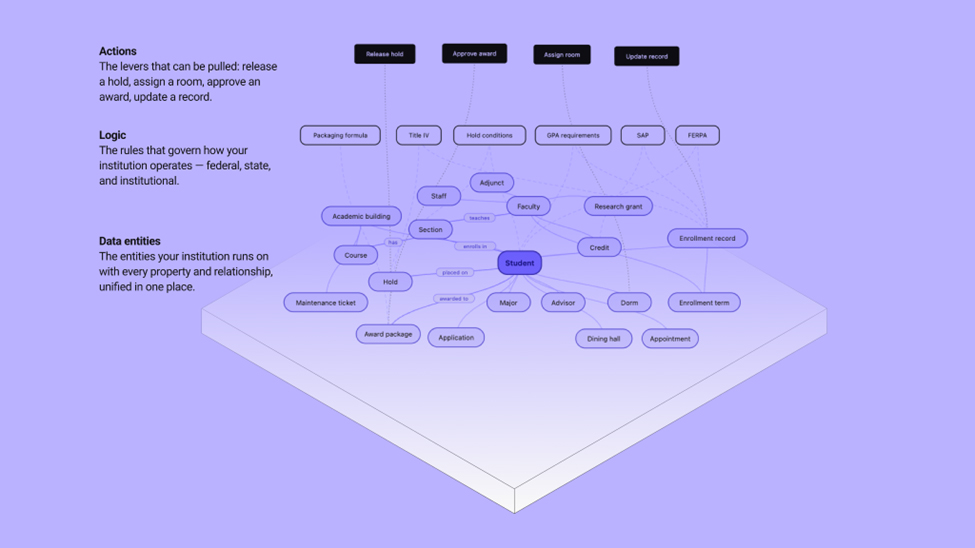
The second requirement is the crux, and the one nearly everyone gets wrong. CIOs do not close the gap between looking and acting by storing more data. To operate, software needs three things that a data store alone cannot provide:
- Entities and relationships: that this student holds this award, governed by this enrollment status, within this degree plan.
- Business logic: the rules that determine what may happen, from Title IV requirements and FERPA constraints to satisfactory academic progress and degree requirements.
- Allowable actions: the things the institution can actually do, such as posting a disbursement, lifting a hold, repackaging an award, or certifying enrollment.
Entities, logic, and actions together form a semantic operational model, which is categorically different from a data lakehouse. A lakehouse stores what happened. An operational model encodes how the institution runs.
An aid agent without Title IV encoded into its model is not slow; it is a compliance liability with a confident tone. A scheduling agent that does not understand prerequisites and faculty load will produce confident nonsense and present it as ready for publication. Action is safe only when the action and the rules governing it live together.
Most of an institution's operational logic is not written down. It lives as tribal knowledge in the heads of the people who run the offices: the director who knows which verification edge cases trigger which actions, the scheduler who knows which faculty member never teaches at 8 a.m., and why. That is a knowledge crisis disguised as a staffing crisis. More than half—56 percent—of financial aid employees say they are at least somewhat likely to leave within a year, according to CUPA-HR.Footnote6 Every departure risks the loss of institutional knowledge. A semantic model institutionalizes that knowledge instead of "renting" it from whoever happens to hold it.
A model worth building adapts to schema change rather than breaking under it, unlike brittle ETL pipelines that fail every time a source system updates.
Requirement Three: Leverage Across Three Instruments on One Shared Model
Different problems need different instruments, and the payoff is that all three stand on the same model. "Deploying AI" is not one thing.
The first thing is the agent that completes the work. Drop the chatbot frame: an operational agent has its own environment. It can place a call, send a text, log in to systems, build a document, and follow a process to its end.
The second thing is the application that structures human judgment—something that can be stood up in a matter of days. Think of it as a decision queue that enables the agent to process routine tasks and surface only items that require human judgement, or as a daily action app that helps front-line staffers determine what items require follow-up today.
The third thing is the model that predicts and prioritizes factors such as persistence risk, yield likelihood, and aid leveraging.
And the payoff compounds. The persistence score that trains tonight's model came from the agent's retention call this afternoon; the dean's dashboard includes the same number. Buy the three separately, and you get none of that.
Requirement Four: Permissions in the Data Layer
The moment software can act across every system on campus, it becomes one of the institution's largest insider-threat surfaces. Security for that cannot live in the application code alone.
Permissions enforced only in software are probabilistic: the model decided not to show the restricted field. For consumer products, that may be acceptable. For FERPA-protected records, federal tax information pulled through the FAFSA, and student health data, it is disqualifying. "The model chose not to reveal it" is not a sufficient answer for an auditor.
The principle is deterministic enforcement at the data layer: unauthorized data is never reachable. Every agent is bound to a specific user and never sees more than the human it serves. Picture one admissions AI agent serving a prospective student, a student worker, and the director of admissions: three views of the data, three sets of allowable actions.
Deterministic enforcement is the unlock. It's exactly where enterprise AI adoption dies in higher education: IT, legal, and compliance will not (and should not) approve agentic access to student records without deterministic guarantees. If permissions are solved here, the category becomes deployable.
Four Requirements, One System
CIOs reading this may be tempted to treat the four requirements as a menu and shop them line by line. They should not.
Without a model to act on it, unified data is inert. The model is dangerous without data-layer permissions to bind it. The applications compound only because they share the data and the model underneath them. Pull any one out, and the rest lose most of their value.
That means a system cannot be assembled from applications from four vendors. It also forces an honest build-versus-buy conversation. Building the foundation is a multiyear, multi-million-dollar platform engineering project far outside the core mission of educating students. Building applications on top of it can happen much faster. CIOs should be clear-eyed about which one they are committing to before signing anything.
Activity Is Not Progress
It would be easier to treat this as a someday problem if the environment were calmer. It is not.
The enrollment cliff is here: U.S. high school graduates peaked at 3.9 million in 2025 and are projected to decline 13 percent through 2041.Footnote7 Labor costs are rising, federal funding is uncertain, and deferred-maintenance bills keep climbing: backlogs have reached $156 per gross square foot, an 8 percent jump in a single year, with sector-wide facilities needs running $750 billion to $950 billion this decade for rated institutions alone.Footnote8
The choice is stark: CIOs can keep buying disconnected tools that create activity, or build the architecture that enables their institutions to see clearly so they can act. The first looks like progress. The second is progress.
The question for CIOs is no longer which AI tool to buy. It is whether they have built the architecture that enables those tools to do real work.
I co-founded CollegeVine because I saw this foundation as the missing layer in higher education AI. I urge any institution to interrogate the architecture beneath any AI pitch rather than the feature list on top of it.
Thank You

Notes
- "MMMU-Benchmark Evaluation Challenge," EvalAI, accessed June 5, 2026; David Rein et al., "GPQA: A Graduate-Level Google-Proof Q&A Benchmark," preprint, arXiv, November 20, 2023; "Frequently Asked Questions," SWE-bench, accessed June 5, 2026; The Editorial Team, "Stanford HIA AI Index Report,"Radical Blog, Radical Ventures, April 28, 2025. Jump back to footnote 1 in the text.
- Alex Singla et al., The State of AI in Early 2024: Gen AI Adoption Spikes and Starts to Generate Value (McKinsey, May 2024).Jump back to footnote 2 in the text.
- Tim Tully, Joff Redfern, and Derek Xiao, 2024: The State of Generative AI in the Enterprise (Menlo Ventures, November 2024). Jump back to footnote 3 in the text.
- "When Universities Consolidate,"Higher Education Executive Intelligence, Substack, March 25, 2026.Jump back to footnote 4 in the text.
- Lindsay Page et al., Helping Students Make It to College: Evidence-Based Design Principles for Reducing Summer Melt (EdResearch for Action, December 2026). Jump back to footnote 5 in the text.
- Melissa Fuesting and Charlotte Etier, The Higher Education Financial Aid Workforce: Pay, Representation, Pay Equity, and Retention (CUPA-HR, May 2024). Jump back to footnote 6 in the text.
- Patrick Lane, Colleen FalkenStern, and Peace Bransberger, Knocking at the College Door: Projections of Higher School Graduates (Western Interstate Commission for Higher Education, December 2024).Jump back to footnote 7 in the text.
- Gordian,"Capital Renewal Backlog Rises 8% in Gordian's 13th Annual State of Facilities in Higher Education Report," news release, April 8, 2026; Ben Unglesbee, "A 'Hidden Liability': Colleges Face Up to $950 in Capital Needs, Moody's Says," Higher Ed Dive, August 27, 2024.Jump back to footnote 8 in the text.
Vinay Bhaskara is Co-Founder at CollegeVine.
© 2026 CollegeVine.