During periods of budget constraints, CIOs can use five actionable strategies to optimize IT costs, drive innovation, and ensure long-term institutional efficiency.
Higher education IT leaders are at a crossroads. Institutions demand robust, innovative IT solutions to enhance student outcomes, improve operational efficiency, and safeguard sensitive data. However, budgets continue to shrink under external pressures. Technology leaders are often expected to achieve ambitious digital transformation goals, even when they lack the resources to do so.
For today's higher education CIOs, the question is less about whether efficiencies can be found and more about how to strategically unlock these savings to ensure that every dollar is put to good use. This assessment requires IT leaders to change their perception of technology. Instead of viewing technology as a business cost, they must regard it as a strategic advantage. This perspective will empower them to help their institutions, large or small, adapt to rapid change and be resilient for years to come.
Emerging Challenges for Higher Education IT Leaders
The economic landscape for higher education has shifted dramatically. A 2025 survey by EDUCAUSE reports that 42 percent of IT leaders anticipate budget decreases in the 2025–2026 academic year. Footnote1 At the same time, student and faculty expectations concerning digital tools have never been higher.
Higher education institutions require CIOs to be familiar with a wide range of technologies and products and to collaborate with business leaders across these institutions. These leaders must oversee security initiatives while helping to drive student engagement and success. Managing these priorities is a balancing act that requires aligning multiple objectives. On top of this, the risks of cybersecurity threats and compliance mandates put enormous pressure on CIOs.
How, then, can institutions balance innovation with fiscal prudence, especially when technology is changing so rapidly?
The answer lies in strategically optimizing costs and deploying actionable measures to minimize the impact of economic pressures while delivering a high-quality student experience. IT leaders must view themselves not just as business leaders but as strategic advisers who must demonstrate how capital upgrades can enhance operational agility and cost efficiency by implementing new technologies.
The five strategies below can help institutions unlock hidden savings and reinvest for the future.
Strategy 1: Reduce Hidden Costs in Cloud Infrastructure
Cloud-based systems have rapidly become the backbone of many higher education institutions. During the cloud revolution, IT departments eagerly embraced cloud migration in hopes of enhancing security, increasing availability, and saving money. However, while scalable, flexible environments come with cost advantages, these benefits are only realized through effective management.
Many institutional leaders believe managing cloud spending is easy. But insufficient oversight or a lack of guidelines for departmental cloud access can lead to inefficiencies and overprovisioning, and strain IT budgets.
To address this challenge, institutions should centralize cloud budgets, consolidate subscriptions, and implement mechanisms, such as chargebacks and budget alignment, at the department level.
Cloud strategies should also look forward, enabling institutions to prepare for AI-driven transformation. Building a common data platform with strong governance is foundational for AI readiness. The first step is to ensure that data from multiple systems is clean and can seamlessly interact or integrate. Institutions should also consider investing in AI-ready devices during refresh cycles to future-proof their infrastructure.
Key Tactics
- Conduct usage audits to eliminate underutilized instances and services.
- Consolidate cloud subscriptions and negotiate enterprise-level agreements.
- Plan two years ahead by investing in AI-compatible hardware during device refreshes.
A trusted integrator of IT solutions and services such as CDW can help colleges and universities align their operations, personnel, and processes with their institutional goals. By working with a trusted partner, institutions can optimize their cloud spending and build economies at scale, which is critical for achieving a seamless experience with the workloads they manage.
Strategy 2: Empower Your Workforce Through Smart Investments
A skilled workforce is essential for maintaining operational efficiency and delivering strategic value. However, institutions often face skill gaps that lead to a reliance on expensive contractors. Institutional leaders should recognize the importance of internal upskilling programs. They need to evaluate team skills realistically and identify processes that could be automated. Then, they can work with their teams to prepare for tasks that generate more business value.
Automation also plays a pivotal role in freeing up IT staff time. For example, self-healing networks and auto-provisioning tools enable teams to focus on innovation rather than maintenance since they can detect and diagnose network failures in real time without the need for human intervention.
Key Tactics
- Identify skill gaps and prioritize certifications for in-demand areas, especially cybersecurity.
- Introduce automation in areas like network operations and user management to free up time so that IT teams can focus on more strategic initiatives.
- Shift IT staff roles toward analysis and strategic activities.
CDW offers cybersecurity training and skill-development programs to help IT teams enhance their technical proficiency in cybersecurity. These programs also provide teams with up-to-date knowledge about networking, cloud computing, and software development.
Additionally, CDW partners with leading software and hardware providers—including AWS, Cisco, Fortinet, Microsoft, and Palo Alto Networks—to deliver training on the latest versions and newest features of the technology tools that many IT teams use today. These offerings help institutions stay competitive and achieve business goals in a rapidly evolving technology environment.
Strategy 3: Focus on Device Life Cycle Management
When it comes to IT hardware, institutions often overpay by adhering to rigid refresh cycles or purchasing unnecessary support renewals; however, refreshing equipment can sometimes be more cost-effective than renewing support contracts.
Institutions should evaluate the value of devices carefully and explore cost-saving strategies, such as third-party maintenance agreements or extended warranties.
Device life cycle management also ties in with in sustainability goals. Through programs such as device-as-a-service (DaaS), institutions can maintain access to the latest technology while repurposing or recycling older equipment. Such approaches reduce costs and align with responsible environmental practices.
CDW's DaaS program helps colleges and universities manage IT assets efficiently, cut electronic waste, boost data security, maximize ROI, and ensure compliance. Here's how:
- Proper asset disposal prevents harmful materials from ending up in landfills, conserving valuable resources.
- DaaS includes proper data destruction, such as secure data wiping, which guarantees that sensitive information is completely erased before devices are disposed of.
- Repurposing retired assets helps colleges and universities recover costs, extend the lives of IT assets, support a circular economy, and create reinvestment funds.
- EPA-approved disposal helps higher education institutions maintain compliance alongside U.S. Department of Defense-compliant erasure services that fully support government standards.
Key Tactics
- Conduct predictive assessments to identify optimal refresh timelines.
- Explore refurbishment opportunities to extend device life.
- Use data analytics to monitor device performance and anticipate failures.
- Negotiate bulk buying agreements with suppliers for quantity discounts.
CDW can assess institutional technology plans and support colleges and universities in building efficiencies that align with their budgets, while also helping them compare the financial impact of traditional maintenance versus new equipment purchases.
Strategy 4: Tackling Telecom Overspend
Telecommunications represents another area where inefficiencies hide in plain sight. Unused phone lines, outdated voicemail systems, and unresolved legacy system costs are common sources of telecom inefficiencies.
Rates change often, so institutions should negotiate regularly with vendors to secure favorable terms. Conducting frequent audits and considering alternatives, such as VoIP or 5G, can keep costs low while improving scalability.
Key Tactics
- Conduct an expert-led telecom audit to identify billing discrepancies.
- Consolidate services under fewer vendors to simplify management.
- Transition to VoIP solutions for affordable, scalable communication.
- Consider vendor consolidation to simplify telecom management.
Strategy 5: Addressing Software Sprawl and Tool Creep to Eliminate Redundancy
Software redundancy remains a challenge as departments continue to add software subscriptions without central oversight. A thorough software audit can help institutions eliminate overlapping subscriptions and reduce expenses. CIOs should evaluate platform strategies versus best-of-breed approaches to achieve operational efficiency and improve user experiences across faculty and student populations.
It's not always about having the best tool. Sometimes, knowing what you have is better than striving for perfection. In other words, using what's already in place may be more practical than purchasing new technologies and managing additional applications.
Tool creep, a related issue, occurs when new tools are continuously added to solve isolated problems without considering overall system integration. This issue leads to operational waste and a disjointed ecosystem. Institutions can combat tool creep by enforcing IT standards and fostering greater communication across departments.
Key Tactics
- Audit all software systems to eliminate underutilized licenses.
- Centralize procurement by leveraging strategic partnerships to achieve cost savings and prevent redundant purchases.
- Align software tools with institutional goals to improve strategic fit.
Consider, for example, the case of California Community Colleges. Facing diverse institutional needs and budget constraints, they turned to CDW to streamline their procurement processes. Footnote2 By leveraging CDW's sourcing solutions, the colleges centralized their procurement processes, which enabled them to negotiate more favorable pricing and standardize the purchase of IT tools and services. This approach not only reduced tool overlap but also helped them achieve significant cost savings while ensuring compatibility and integration across campuses.
4 Pillars of a Strategic Cost Optimization Framework
While each of the strategies outlined above offers impactful savings, long-term success hinges on adopting a strategic, long-term optimization framework. Institutions need a North Star for their spending and initiatives to ensure alignment with their overall goals. Based on CDW's expertise in higher education IT, the following four-pillared approach can guide institutions toward sustainable change.
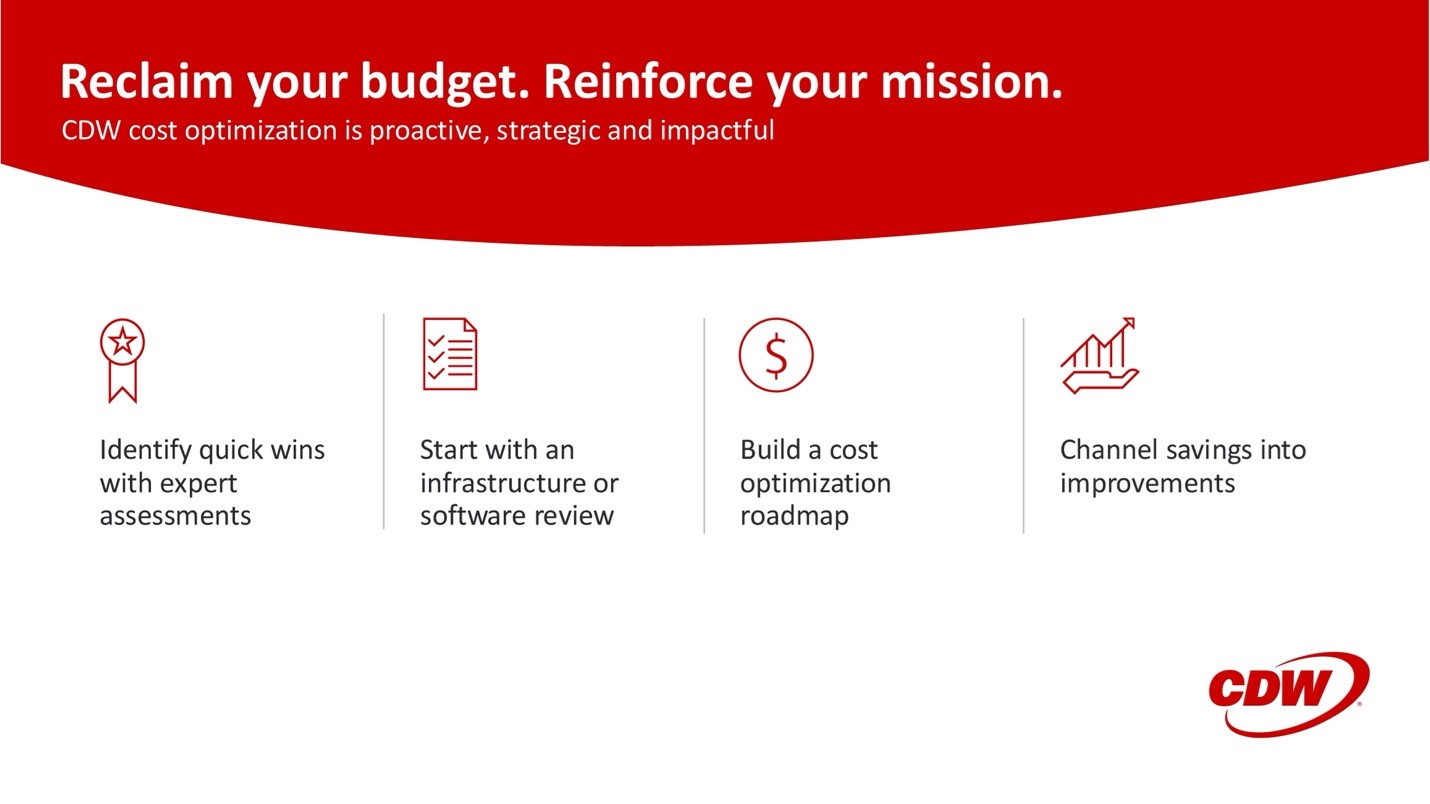
Pillar 1: Identify Quick Wins with Expert Assessments
Professional assessments can uncover blind spots and guide leaders toward immediate opportunities for cost reductions. Bringing in external perspectives fosters creative problem-solving and uncovers overlooked inefficiencies.
Pillar 2: Start with Infrastructure or Software Review
Align your efforts with core operations. For most colleges and universities, this alignment involves conducting a comprehensive audit of server environments, device inventories, and networking capabilities while establishing a baseline understanding of current spending.
Pillar 3: Build a Cost Optimization Roadmap
Cost optimization is not a one-time fix. Create a roadmap that prioritizes bold initiatives based on impact and feasibility, and establish metrics and accountability measures.
Pillar 4: Channel Savings into Strategic Improvements
Don't just pocket the savings from these measures. Reinvest them in high-impact projects like AI readiness, hybrid instructional models, or enhanced student engagement platforms.
Outlook for Higher Education Cost Optimization
Advancements in technology and AI are set to redefine cost optimization in higher education. Leaders need to think in terms of efficiencies—not only for today but for tasks and processes they haven't encountered yet. By combining strategic planning with innovative thinking, institutions can overcome budget constraints while preparing for a future of constant change.
The road to cost optimization is both a challenge and an opportunity. With the right strategies, higher education IT leaders can transform their approach, driving immediate savings and enduring value for their institutions.
Explore your institution's cost-saving potential and build a future-ready IT roadmap today.
 EDUCAUSE Strategic Partners
EDUCAUSE Strategic Partners work closely with EDUCAUSE staff and community members on key areas of higher education and technology to help strengthen collaboration and evolve the higher ed technology market. Learn more about EDUCAUSE Strategic Partners, and how they're partnering with EDUCAUSE to support your evolving technology needs.
Notes
- Mark McCormack, "EDUCAUSE QuickPoll Results: Technology Budgets and Staffing,"EDUCAUSE Review, EDUCAUSE, April 21, 2025.Jump back to footnote 1 in the text.
- Sean Burns, Rupa Saran, and Jen Keiper, "Sourcing Solutions Creatively and Cost Effectively at California Community College,"EDUCAUSE Review, EDUCAUSE, June 23, 2025.Jump back to footnote 2 in the text.
Matt Varin is a Sales Leader at CDW.
© 2025 CDW.