
Thoughtful use of AI prompts can help instructors design learning activities that bring UDL practices into all courses.

Universal design for learning (UDL) is a scientifically valid framework that guides the design of accessible, equitable, and inclusive educational practices.Footnote1 UDL is now written into U.S. education policy, from K–12 (Every Student Succeeds Act, 2015) and higher education (Higher Education Opportunity Act 2008) to educational technology and workforce development.Footnote2 UDL rests on three core principles designed to remove barriers in curriculum design and give all learners flexible ways to access content and demonstrate what they know:
- Multiple means of engagement
- Multiple means of representation
- Multiple means of action and expression
Designing learning activities in accordance with these three principles involves applying four critical steps of UDL, as outlined in Nelson and Basham’s UDL Blueprint:Footnote3
- Establish a clear goal.
- Intentionally plan for learner variability.
- Choose flexible methods and materials.
- Maintain timely progress monitoring.
As classrooms increasingly adopt AI-powered tools, the UDL framework can help ensure that these technologies are integrated in a way that expands, rather than narrows, how students engage with content, express understanding, and stay motivated to learn. Moreover, the UDL framework supports educators’ metacognition in teaching as well as the planning process, empowering them to teach smarter, not harder.
The UDL Prompting Strategies Workflow
Higher education instructional leaders want to design courses and course materials that engage students, help them build persistence, and develop lifelong learning skills. Our recent work identifies six critical skills for instructional leaders in applying UDL practices to support all learners:Footnote4
- Proactively identifying the academic barriers any learner might face.
- Providing participants with a variety of tools and resources to guide learning.
- Creating accessible educational materials.
- Designing and delivering instructional sessions that include a variety of techniques, strategies, methods, and formats.
- Integrating accessible technology tools to support every participant so they can achieve the instructional goals/objectives.
- Designing instruction to support equity across all learners.
To reach those outcomes, effective collaboration with AI in real-world scenarios demands empathy and higher-order thinking skills. That collaboration also demands the nuance of discernment and oversight, as well as the critical evaluation of the prompting process and the quality of the outputs. To create that collaboration, we layered Google’s 2025 prompt‑engineering workflow, which emphasizes objectives and instructional components, onto the UDL Blueprint, creating a process we call the UDL Prompting Strategies Workflow. This workflow is focused on the creation of AI prompts that provide instructional design options that are accessible, equitable, and inclusive and that, when aligned with UDL, help students develop agency, which is the goal of UDL 3.0 guidelines. The workflow covers three steps, which bring together AI’s efficiency and analytical strength with those educational practices (see figure 1).
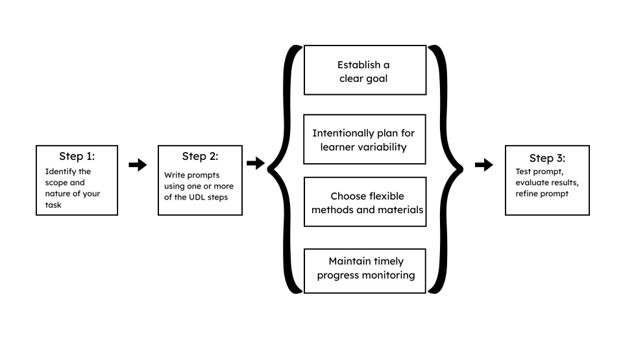
Figure 1. The UDL Prompting Strategies Workflow
Step 1: Define the Task
Before you write an AI prompt, you must understand the scope and the nature of your task (e.g., creation of a new course, revising a course, or improving a program). Clearly defining your task is vital for writing effective prompts.
Step 2: Write Prompts
Write AI prompts to create learning activities that will address the defined task, applying any of the four steps of UDL that haven’t been previously incorporated:
- Establish a clear goal. After you’ve defined your task, establish a clear goal for a lesson or specific component of the course. This helps you determine the challenges and barriers learners might face.
- Intentionally plan for learner variability. A one-size-fits-all approach does not support variability. Learner variability occurs during the interaction between the learner (who the learner is, how the learner feels in response to the learning environment, and the learner’s prior experiences) and the learning environment (the design created by the instructional leader). Although learners’ diverse needs are a part of who they are, when you plan for variability you recognize the impact of the learning environment. For that reason, you create a design that lowers any anticipated barriers.
- Choose flexible methods and materials. Select a variety of resources and tools in line with the goal and in response to learner variability. Ultimately, students will choose from the tools and resources offered based on the instructional goal and how they are experiencing their variability. This helps learners achieve the learning outcome and gain agency.
- Maintain timely progress monitoring. Establish a reliable process for progress monitoring that informs your design. This involves monitoring students’ progress toward the goal through formative assessments, providing timely and actionable feedback, shifting your design or instructional methods to lower identified barriers, and then repeating the process.
Step 3: Test Prompts, Evaluate Results, and Refine Prompts
Following the guidance of Google’s prompt-engineering workflow, after you define a task and write prompts to achieve that task, test your prompt, evaluate the results, and refine the prompts.
An important part of the UDL Prompting Strategies Workflow is to intentionally reflect on the steps and document your UDL-aligned practices development journey.
AI and UDL in a Science Course
Linnea is a chemistry professor at a land-grant university. Many of her 200+ entry-level chemistry students aren’t grasping basic concepts before going into their labs. Worse, many of them are distracted in class, don’t read LMS assignments, and don’t watch the videos she cultivates. She really wants them all to connect with chemistry, not treat it as a “weed out” course. Even though many of her colleagues talk about using AI, Linnea has remained skeptical. In her experience, AI responses are long-winded and unfocused. She also knows her students come from various backgrounds, and the AI responses don’t typically address this level of variability.
Nevertheless, Linnea signs up for an AI workshop focused on a process called the Universal Design for Learning (UDL) Prompting Strategies Workflow. In the workshop, Linnea works with the person sitting next to her to identify academic barriers learners might face. They each choose one of six “super prompts” and enhance it with their course-specific information and one of the four steps of UDL that are explained in the workshop. Linnea chooses the super prompt that focuses on the skill “Design instruction to support equity across all learners” and learns to apply practical and equity-centered ideas. She then pulls together support materials to help learners at different prior knowledge levels and various learning preferences.
UDL Super Prompts
Using the UDL Prompting Strategies Workflow, we created six UDL-aligned “super prompts” that educators can use to identify and address learning barriers early in the course-design process. These prompts support the intentional use of teaching strategies, assessment approaches, and accessible technologies that build inclusive learning environments. The result is a powerful combination that brings together AI’s speed and analytical strength paired with educators’ pedagogical insight and creative decision-making.
Each super prompt empowers the educational leader to accomplish these important steps:
- Integrate the four critical steps of UDL in the prompting process. This helps you maintain alignment with a framework that is designed to promote accessible, equitable, and inclusive designs that lead to greater learner agency.
- Adopt a human-centered design approach to support learner variability and build learner agency. Instructors must proactively respond to students’ diverse needs and experiences while centering human judgment, well-being, and choice, moving away from impersonal, one-size-fits-all learning designs.
- Build AI-powered educational tools and systems. You can create AI-powered educational tools and systems that are intuitive and accessible, that support human interaction and creativity, and that empower learners’ agency in the educational process.
For general usage, the super prompts are available online as templates, allowing you to fill in the relevant details as appropriate for your situation. To get started, choose a prompt based on which of the six UDL skills you want the activity to demonstrate. Apply your own background knowledge, experience, course knowledge, and knowledge about your learners to develop your prompts.
Following are illustrations of how each of the six super prompts can be applied to a specific context—using details that could reflect the development of learning activities—to meet the associated skill objective.
1. Proactively identify the academic barriers any learner might face.
I teach a thermodynamics course for college freshmen. There are 300 diverse learners in my lectures. I know that lectures are challenging because the learners are not interacting with me or with each other. I also know that lectures require learners to use prior knowledge that they might not have. What are other academic barriers learners might face, and what should I consider in the course design? Please provide suggestions that focus on barriers in the course design and delivery.
2. Provide participants with a variety of tools and resources to guide learning.
I teach a capstone course with seniors in journalism. The capstone project is designed to help students demonstrate the full range of skills, knowledge, and competencies that they have developed throughout the program. Please offer a variety of tools and resources to help students complete this project, which will lower barriers my 30 diverse learners experience. Students will choose one of the two project options below and publish the final product on a portfolio site. Please provide suggestions that focus on barriers in the course design and delivery.
- Project option 1 (Storytelling): Students must produce a miniseries of two 800–1,000-word stories. The stories must flow logically from one piece to the next with project examples and should be framed as the skills/knowledge/competencies development in the field of journalism.
- Project option 2 (Multimedia): Students must produce a minimum of 15 minutes of video or audio that should be divided into smaller segments ranging from 2.5 to 8 minutes in length to demonstrate their skills/knowledge/competencies development in this field. Videos should be multi-scene and include short interviews from a minimum of three to four sources, stakeholders, or perspectives, as well as demonstrate proper use of narration or voiceover component.
3. Create accessible educational materials.
I teach a master’s-level course on baptism at a seminary. I have 25 learners, and several have requested academic accommodations linked to learning disabilities and ADHD. I would like suggestions about alternative formats of the content that will be helpful for all students to access and process the information. Please provide a response for each of the following requests:
- What are the recommended strategies to make my course materials accessible to support these students?
- I know that many learners are nervous about holding a baby during baptism. What options can I provide to help them gain confidence?
- How can I get an accessibility report for my course content?
4. Design and deliver instructional sessions that include a variety of techniques, strategies, methods, and formats.
I teach a certified nursing assistant (CNA) course at a technical college. Several of my learners are English-language learners, and some have not scored well on high-stakes assessments. All of my learners are passionate about healthcare. My learners are required to learn our state code, define the qualities of a successful nursing assistant, and describe the roles and responsibilities of a nursing assistant. Please provide suggestions that focus on barriers in the course design and delivery.
- Please provide three accessible activities for each of these requirements.
- Please provide three accessible assessment ideas for each of the requirements.
- Please provide a list of up to ten accessible resources learners could use to meet these requirements.
5. Integrate technology, including accessible technology, to support every participant so the participants can achieve the instructional goal/objective.
I teach an organic chemistry course at a land-grant institution. One student has requested academic accommodations linked to visual impairment. I want my students to participate in a lab where they learn how to extract caffeine from tea. They will need to use organic solvents to isolate the caffeine. I want them to focus on the important laboratory techniques involved in this process and the abstract concepts of chemistry in this everyday product. Please offer five different accessible technology tools so I can support the students’ in-person participation in the lab and achieve the learning outcomes. Please provide suggestions that focus on barriers in the course design and delivery.
6. Design instruction to support equity across all learners.
I teach algebra, an entry-level college course at a land-grant institution. My next unit is on the fundamental theorem of arithmetic. Learners with different prior knowledge levels will have access to the learning management system, which has the course materials, as well as to Khan Academy and other materials that cover the basic math information. I work to design my learning experiences and environments so every learner has the academic and social/emotional access and support that allows them to reach the stated goal, but they do not come to class having used the materials I’ve prepared. Please offer five practical and equity-centered ideas of how to help my learners engage with the support materials I’ve pulled together. Please provide suggestions that focus on barriers in the course design and delivery.
The Importance of UDL in Course Design
Designing accessible and inclusive learning environments using the UDL Prompting Strategies Workflow brings together AI’s efficiency and analytical strength with educators’ pedagogical expertise and creative judgment. The prompting process, the quality of prompt outputs, and the reflection process are all critical when instructors and course developers interact with AI tools in course design and delivery. The six UDL-aligned super prompts offer structured guidance for designing AI-supported learning experiences that are intuitive, flexible, and supportive of learner agency. By clearly specifying the task, context, and desired response format, the workflow produces more relevant outputs while helping educators anticipate learner variability, reduce barriers, and design courses and curricula that support all learners.
We invite you to use the prompt templates to begin applying the UDL Prompting Strategies Workflow. You can intentionally reflect on each step, document the reflection journal as needed, and create a professional learning community to share your results and reflections with others.
Notes
- CAST, The UDL Guidelines, version 3.0, 2024. Jump back to footnote 1 in the text.
- See CAST Timeline of InnovationJump back to footnote 2in the text.
- Loui Lord Nelson and James Basham, A Blueprint for UDL: Considering the Design of Implementation (Lawrence, KS: UDL-IRN, 2014). Jump back to footnote 3 in the text.
- Loui Lord Nelson and Jingrong Xie, “Equipping UDL Trainers for Change: Skills That Support Equitable Practice,” inHandbook of Universal Design for Learning, edited by James D. Basham and K. Alisa Lowery (Northampton, Massachusetts: Edward Elgar Publishing, 2026).Jump back to footnote 4 in the text.
Jingrong Pearl Xie is Director of Universal Design for Learning and Accessibility Services at Virginia Tech.
Loui Lord Nelson is President and Lead Creator at The UDL Approach.
© 2026 Jingrong Pearl Xie and Loui Lord Nelson. The content of this work is licensed under a Creative Commons BY-NC-ND 4.0 International License